NASA Sets News Conference on Astrobiology Discovery

Is this the press conference of movies and science fiction novels everywhere?

WASHINGTON — NASA will hold a news conference at 2 p.m. EST on Thursday, Dec. 2, to discuss an astrobiology finding that will impact the search for evidence of extraterrestrial life. Astrobiology is the study of the origin, evolution, distribution and future of life in the universe.

The news conference will be held at the NASA Headquarters auditorium at 300 E St. SW, in Washington. It will be broadcast live on NASA Television and streamed on the agency’s website at http://www.nasa.gov.

Participants are:
- Mary Voytek, director, Astrobiology Program, NASA Headquarters, Washington
- Felisa Wolfe-Simon, NASA astrobiology research fellow, U.S. Geological Survey, Menlo Park, Calif.
- Pamela Conrad, astrobiologist, NASA’s Goddard Space Flight Center, Greenbelt, Md.
- Steven Benner, distinguished fellow, Foundation for Applied Molecular Evolution, Gainesville, Fla.
- James Elser, professor, Arizona State University, Tempe

Media representatives may attend the conference or ask questions by phone or from participating NASA locations. To obtain dial-in information, journalists must send their name, affiliation and telephone number to Steve Cole at [email protected] or call 202-358-0918 by noon Dec. 2.

For NASA TV streaming video and downlink information, visit:

http://www.nasa.gov/ntv

For more information about NASA astrobiology activities, visit:

http://astrobiology.nasa.gov

- end -

I want to know NOW!

(press release from NASA)

Low-budget sci-fi turns into a character piece

I’m looking forward to the November premiere of Monsters, a sci-fi film that looks like it will be about the characters more than it is about the special effects.

That’s the way the director talks about it, though, in this piece from Wired:

“We couldn’t make the big-budget kind of film Hollywood can, so I figured, ‘Let’s make the kind that Hollywood can’t because they haven’t got the balls to do it,’” he says. “They wouldn’t have the balls to invest this much CGI into something and make it a character piece, whereas if you’ve got loads of things exploding and big fight scenes and monsters everywhere, you’ve got a guaranteed return. We felt kind of obliged to do something different.”

With a five-guys-in-a-van ethos, the picked up weird and unusual shots where they could, flipping through the script to see what scene might fit in with the backdrop they had found.

Makes me want to make a movie! But I guess I will have settle for watching this one.

Oh, another plus — it’s R-rated. Hooray for a movie that doesn’t feel like it has to whitewash things.

Three cheers for the comeback of the alien invasion movie

Worried about aliens crossing the border from Mexico into the U.S.? You should be! Check out a trailer for Monsters, a low-budget British movie that posits a quarantine zone in Central America after a space probe crash-lands, and weird lifeforms begin to take over:

I really love that the sci-fi alien invasion flick is staging a comeback. There’s also Battle: Los Angeles and Skyline that look amazing (though similar).

There’s a bit of a synopsis at io9, where I saw the trailer.

Prepare for an alien invasion

It was only a couple of weeks ago that Stephen Hawking was warning us to be careful about looking for alien life. He feels that finding alien life is a dangerous proposition.

“If aliens visit us, the outcome would be much as when Columbus landed in America, which didn’t turn out well for the Native Americans,” he said. “We only have to look at ourselves to see how intelligent life might develop into something we wouldn’t want to meet.”

A valid point, perhaps, but a theoretical discussion at best. Since they left the planet after helping build the pyramids (sarcasm, please note), mankind has been watching the skies for visitors through increasingly powerful means of technology. To date, nothing can be confirmed. Thus, Hawking’s warning is largely a point philosophical debate.

Or is it?

Voyager 2, one of the furthest man-made objects from Earth (the other being Voyager 1), has suddenly, after 33 years and travelling over 8 billion miles into space, started sending back messages in a new format scientists cannot decipher.

According to the Associated Press, Voyager 2 sends back two streams of information — scientific data and engineering data. The engineering data, consisting primarily of the status of the space probe, continues to broadcast regularly. The scientific data has mysteriously changed into an unknown format.

Obviously, it is the work of aliens. Because, you know, a computer should be able to run continuously for three decades with out a malfunction.

Ask German academic Hartwig Hausdorf (yes, a real name; yes, a bit of a fringe author and UFO believer). He claims the strange messages from Voyager 2 are due to the fact it has been taken over by extraterrestrials.

He told the German newspaper Bild: “It seems almost as if someone has reprogrammed or hijacked the probe – thus perhaps we do not yet know the whole truth.”

If that is the case and our German crackpot is correct, Hawking was right. Aliens are not very nice: our first conversation with them, and it’s a crank phone call.

Life on the moon. Well, not our moon.

europarise

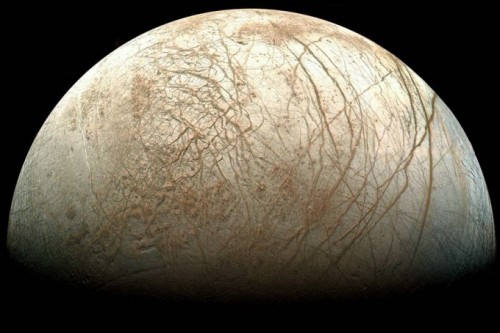
Ever since reading the novel “2010“, I’ve been somewhat fascinated with Europa, a moon of Jupiter. As (correctly) depicted in the book, it’s a moon that is probably covered with an ocean of water, underneath a thick crust of ice.

Scientists think that the gravity of Jupiter might keep Europa geologically active, which means heat, which means that in the liquid water down deep, there might have formed life.

Now, there’s even more hints.

A recent theory (reported here in Wired) is that cosmic rays striking the ice may have libertaed free oxygen particles. As the ice sinks down and melts (new ice forming on top) this free oxygen can be released into the water. Therefore, even without photosynthesis, by some calculations, there might be enough oxygen to support millions of fish … or, um, fish-like aquatic lifeforms.

I’m not alone when I say that Europa is the most-likely place in our solar system for us to find complex life (uh, outside of Earth, obviously). But it still excites me to say it.

And, with luck, we’ll discover such life in my lifetime.

E.T. phone again

Wouldn’t it be really cool to actually make contact with an alien race? They don’t even have to land in the U.S. Midwest in their brushed chrome spacecruiser outfitted with the lastest in blinking light technology. They could just call. You know, we here on Earth could be like interstellar Facebook friends — exchanging information, telling each other about our various misadventures, chit-chatting about interests…

It would be the greatest discovery in the history of mankind (beer excepted). The media would go crazy with it. People of all races, religions and other various socio-economic demographics would be united in their awe that we are not alone in the universe…

Or would it happen like that at all? Would the first call we get from an alien race be a forgetten footnote in astronomical texts, something to be puzzled over by hobbyists and debated in a tired, disinterested manner by scientists?

Ever hear of the Wow! signal?

The Big Ear radio observatory in Ohio has spent some time listening to deep space as part of the SETI program (Search for Extra-Terrestrial Intelligence). On August 15th, 1977, a signal from within the constellation of Sagittarius was received. This signal was strong enough to push the monitoring equipment at Big Ear beyond its capabilities. The volunteer looking at the printouts of the signal wrote “Wow!” in the margin, hence the name of the signal.

The signal lasted 72 seconds at 1420.456 MHz before it faded away. It has never been repeated. Or, at any rate, it has never been found again despite repeated attempts.

Why the one-time signal? If other intelligent beings are out there looking for us, just as we are looking for them, shouldn’t they be continually broadcasting? Were we just a wrong number?

Here’s something to think about: we’re just listening. Mostly.

Ever seen the James Bond movie GoldenEye? (Hang on, I’m going somewhere with this…) It’s the one with the huge satellite dish hidden under a manmade lake. That huge structure is called the Arecibo Observatory and has an amazing story unto itself. Nonetheless, in 1974 the instrument was used to beam an encoded message towards a cluster of stars about 21,000 light years away.

It has never been repeated.

Perhaps great minds think alike?

Wikipedia’s entry on the Wow! signal has technical info and some more links if you are so inclined. The Arecibo message entry is also incredibly fascinating.

Creepy creatures

Hat-tip to BoingBoing, but the vid originally comes from the website Forgetomori, which explores and debunks weird and interesting occurrences like the one in this video:

This reminds me of the movie Signs, and the video from the children’s party where the alien walks through. Brrr, it gives me the chills.

There’s a longer, also creepy video here, where not one, but two of these weird, bipedal creatures walk through someones lawn, and the subsequent explanation for what they probably are.

Aliens in our midst

The alien autopsy was too obviously faked, but are we that far away from finding extra terrestrials? I bet within my lifetime.

The alien autopsy was too obviously faked, but are we that far away from finding extra terrestrials? I bet within my lifetime.

Hooray!

Earth-like planets with life-sustaining conditions are spinning around stars in our galactic neighborhood, US astrophysicists say. They just haven’t been found yet.

In a talk given by astrophysicist Alan Boss at the annual meeting of the American Association for the Advancement of Science, he told his fellow scientists that two new satellites (Kepler and Corot) would have a great chance of finding these new Earths and analysing their atmospheres:

The images from those new planets, he added, should identify “light from their atmosphere and tell us if they have perhaps methane and oxygen. That will be pretty strong proof they are not only habitable but actually are inhabited.”

“I am not talking about a planet with intelligence on it. I simply say if you have a habitable world … sitting there, with the right temperature with water for a billion years, something is going to come out of it.

“At least we will have microbes,” said Boss.

Not good enough for you? Other scientists think that the aliens are already here — among us, hidden from view beneath our very noses:

No, not like that! Aliens could be living among us as a “shadow ecosystem,” based not on carbon and DNA, but using arsenic, say:

If we do discover exotic life unrelated to ours, it might not have developed here, Davies said. Instead, it might have originated elsewhere, then hitchhiked to Earth by piggybacking on a meteorite.

But it doesn’t matter where it originated, Davies argued, because it’s still an indication that life has cropped up from scratch in more than one place.

“If it’s happened more than once in the Solar System, then the Universe will be teeming with life,” said Davies.

Science fiction, every now and then, likes to experiment with silicon-based life. Silicon, if you remember your periodic table, is right below carbon, which means that you could have very similar structures to the carbon-based ones that we’re used to, only with slightly weaker atomic bonds. Similarly, sulfur would replace oxygen (there’s a mildly length Wikipedia article on the subject, if you’re interested).

I don’t need Little Green Men coming down in flying saucers, I’d just love to find some kind of life on other planets.

Bad news: It wasn’t aliens

There was something spooky about this:

I posted about it before, and I noted how weird it was, not only that the wind turbine spontaneously flew apart — but that one of the blades had vanished!

Deep down, I knew it would be something prosaic, but I was kind of in love with people suggesting that it was aliens. As if ET is as dumb as those birds who get all disoriented by windmills. What, never heard of radar, Mr. Intergalactic Traveller? Electromagnetic waves in the visual spectrum too confusing?

Or, perhaps they were just disgruntled alien teens, cruising around with their rag-top UFOs, playing a game of mailbox baseball writ large. Yeah, extraterrestrial vandals, that’s the ticket!

But no. It was metal fatigue.

(sad face)

Hmm, still no explanation for the glowing orbs spotted in the sky that night, though!

Turbine trouble!

Was this wind turbine in England hit by a chunk of ice? Fireworks from an 80-year-old’s birthday party? — or a UFO? Will your answer change when I reveal that one of the three turbine blades is missing and cannot be found?

(Tip of the ol’ hat to the New York Times, which provides me with endless reading material every day.)