

Welcome 2010! Fond farewell, 2009.
Here’s a cute video of spider monkeys being given a special treat — Jell-o with blueberries inside it. Yes, apparently everyone’s grandmother now cooks for the spider monkeys at the Bronx Zoo.
According to the YouTube video description, the hidden blueberries help to stimulate the monkeys’ foraging instinct, which is kind of cool.
I wonder if that’s why my mom never put coins inside my birthday cakes when I asked. All that mumbo-jumbo about metal leaching out, I could have used a “but this will develop my foraging instinct” rejoinder.
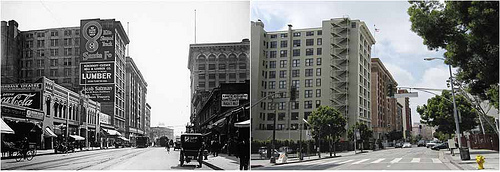
Above is a shot of Sixth and Main, in Los Angeles, looking south, as it appeared in 1918, and again almost 90 years later, as it appeared in 2007.
It’s from a fabulous Flikr pool of old/new juxtapositions just like this. I’m a sucker for this kind of stuff, and it’s kind of in the vein of the younger pictures blog I posted about earlier.
Although it’s been stripped out of the main gallery for being slightly offtopic, a subset of these juxtapositions includes people who are holding the old photo up to replace part of the new scenery — with an exact match making it look like a window through time has opened up in the middle of the shot. It’s a cool effect, like the woman on a bench, below. You can find more of those types here.
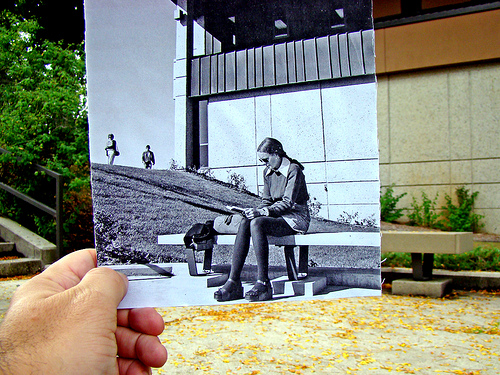
(props to vokoban and uwgbadmissions for the pics)
If you’re so lazy/unmotivated that you can’t even be bothered to conceive of a single way in which you could self-improve over the next 365 days, then I’m not convinced of your follow-through potential, but let me stop judging you and send you the link to a New Year’s Resolution Generator. Some of them are quite specific, others are more open to interpretation. Good luck!
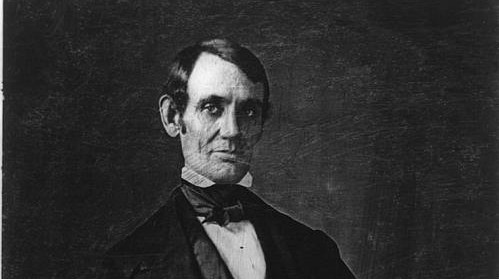
That’s Abraham Lincoln up there — without his trademark beard or top hat (but with the stern-faced look that all people had for the camera back then). It’s part of a cool little blog that Amy left up for me, which showcases then-and-now photos of people.
As the Mitch Hedberg bit they use in their “About” page puts it:
One time, this guy handed me a picture of him, he said, “Here’s a picture of me when I was younger.”
Every picture is of you when you were younger.
“Here’s a picture of me when I’m older.”
You son-of-a-bitch! How’d you pull that off? Lemme see that camera… what’s it look like?
Although they have some famous people, like Lincoln, as well as Einstein and Bill Gates, most of the site so far is just average, ordinary, everyday people (unless they are famous but I don’t recognize them — the site is first-name-only, most of the time).
It’s worth looking at just to see how people change, but also stay the same, but I also loved checking out the old colours, old fashions and old photographic compositions that people have uploaded.
Looks like the blog is just getting started. I wish them well!
I Used To Be Younger
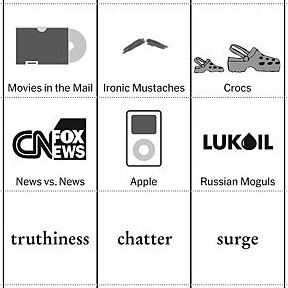
Amy found me a great “op-chart” at the New York Times. It’s essentially a giant grid — on one axis is every year from the last decade, but on the other, it’s a series of things that may have defined a year: what was “newish” that year, for example, or who the “maverick” or the “champion” of the year was. And it’s all handled graphically.
So you can follow the grid down, for example, to see a full year in icons. Or you can follow the grid across, to see each year in sequence, but under the same subject heading.
I’ve put a slice of the chart above. See if you can figure out the years and the subject matters before you click here to see the whole thing.
In a special New Year’s Eve post, Amy films while I use a heavy kitchen knife on a $9 bottle of “sparkling wine.”
It’s open!
Now, I have posted about this before. So has Keith. And Wired has a “how-to” wiki that explores the difference between sabring a real French champagne, and an American one.
I have a sneaking suspicion that I’ll be posting about it again, too.
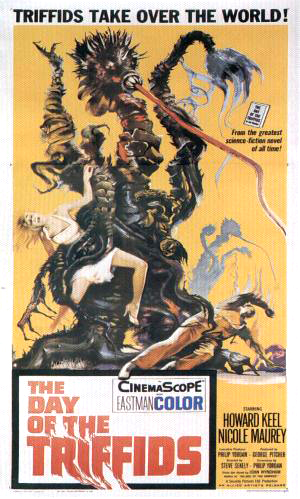
Plants are alive — and they want to stay that way — so it may not be any more ethical to eat them than it is to eat meat. At least, that’s what I’ve argued before.
But maybe my argument didn’t convince you. Maybe you thought to yourself, “Heck, plants are alive, sure, but they don’t really feel. They don’t really think. They aren’t conscious or anything!”
Well, you’re right — so far as I know, nothing like a triffid exists on Earth (and if it did, you’d be morally obligated to kill it and eat it, murdering plant that it is).
But an intriguing survey of the available science by Olivia Judson suggests that plants do have a potent form of memory:
Previously attacked plants respond to new leaf damage more quickly. And plants that have been attacked twice are faster to respond than plants that have only been damaged once. Somehow, they remember.
The physical basis of plant memory is still being figured out. (Needless to say, it isn’t conscious memory: the trees outside your window aren’t standing there reminiscing to themselves about the great caterpillar plague of 2009.) But by now it’s clear that wild tobacco is not the only plant with the capacity for memory, nor is caterpillar attack the only stress that produces such an effect. Drought, cold and altered salt levels in the soil all do so; likewise, exposure to hostile fungi or bacteria.
If plants remember — can they also forget?
As Judson points out, helping a plant “forget” a recent drought, or priming it to be prepared for an insect pest, could have huge implications in agriculture. She also implies a comparison to the “memory” that your immune system has for infections it has already fought off.
But the lessons here are clear. If you’re a vegetarian — and I support your choice, though I don’t choose it for myself — you should make sure that you finish your plate of vegetables. No one cuts a steak off a cow, then leaves it to heal before cutting off the next steak, so why should it be any different with a plant?
After all, plants remember. And if they remember, then the next time you go looking for your rutabaga or your celery — well, maybe it’ll be waiting for you …. ready for you … lurking in your garden ….
Two great op-eds on the Christmas Day crotch-bomber, the latest in a slew of inane, fruitless attempts to create mild havoc that are foiled by absolutely none of the massive security apparatus that we’ve ereected to make ourselves feel safer.
For your consideration:
In my boyhood, there were signs on English buses that declared, in bold letters, “No Spitting.” At a tender age, I was able to work out that most people don’t need to be told this, while those who do feel a desire to expectorate on public transport will require more discouragement than a mere sign. But I’d be wasting my time pointing this out to our majestic and sleepless protectors, who now boldly propose to prevent airline passengers from getting out of their seats for the last hour of any flight. Abdulmutallab made his bid in the last hour of his flight, after all. Yes, that ought to do it. It’s also incredibly, nay, almost diabolically clever of our guardians to let it be known what the precise time limit will be. Oh, and by the way, any passenger courageous or resourceful enough to stand up and fight back will also have broken the brave new law.
and Bruce Schneier:
Despite fearful rhetoric to the contrary, terrorism is not a transcendent threat. A terrorist attack cannot possibly destroy a country’s way of life; it’s only our reaction to that attack that can do that kind of damage. The more we undermine our own laws, the more we convert our buildings into fortresses, the more we reduce the freedoms and liberties at the foundation of our societies, the more we’re doing the terrorists’ job for them.
So, who do you think makes better points? (Please, read both op-eds. They’re worth it.)

So, how many cups of coffee do you drink in a day? I tend to drink upwards of three or four regular-sized coffee mugs full of black (no cream or sugar or girlaccinos), but I’m never sure how many “cups” that is. When I make coffee, for example, I make either eight or 12 “cups” — according to the carafe. But I sure don’t get that number of mugs out of it.
I suppose some simple experimentation would answer my question. But I drink coffee when I am tired and unmotivated — hardly the best time for a science project.
For more on the health benefits (alleged) or concerns (even more alleged) that come from coffee consumption, you should check out the extensive Wall Street Journal article I pinched the chart above from.
Professional golfer Padraig Harrington tests out the Happy Gilmore hockey-style swing when teeing off. The results are surprising.
(From Atomic Robot, via @mike_thomas.)
by Amy Breen
I had no idea what was going on in this little video. I thought he was practicing before he asked for real. The big reveal at the end brought a lump to my throat.
I think it’s a brilliant little ad for a huge issue that is taking place all over the world, in this case Ireland, and the creators of the ad approach it with such beautiful simplicity.
So many people look at gay marriage as a religious issue, or that it is tradition to call marriage a union between a man and a woman only, so why change it.
Well, not too long ago in our history, inter-racial marriage wasn’t allowed. It was illegal, in fact. And many people probably looked at a black and white coupling as not quite real. This is how people are looking at gay marriage now, pushing terms like “civil union.” It’s not quite real, so give it another wording.
Of course, in Canada, it is considered and called marriage. It was met with much criticism and controversy, and even Stephen Harper had tried, after being elected, to re-open the debate by changing the definition of marriage to the “traditional” definition. He was thankfully shut down, and now, hopefully, has more important things to worry about.
Ultimately, gay marriage is a civil rights issue. Not a religious issue. Not an issue of tradition. And just like it seems ridiculous to us now to have denied inter-racial couples the right to marry, soon I hope it will seem ridiculous that those in power were denying gay and lesbian couples the right to marry.

Scanned pages of the Weekly World News are being hosted by Google Books. It’s the best Christmas present I could have asked for. When I was in junior high and high school, we used to buy copies of the Weekly World News all the time. It was like a MAD Magazine that pretended to be real.
I can’t deny that I’ve always had a hankering to work there. I guess The Onion is the closest thing now, but they don’t have the same panache as the WWN did.
Although they have a regularly updated website, the WWN is no longer printed as a stand-alone publication. That makes me sad. They were almost a living fossil — a link back to when tabloids were lurid and gruesome and downright weird, not just celebrity gossip all the time.
And they weren’t always made-up. I know they “enhanced” the truth to the point of breaking, but several of their stories were always based on strange-but-true happenings. And even their wild, outlandish predictions sometimes had a grain of truth to them. Consider this front-page headline: “Next Great Depression to Strike 6/6/06“. Not so far off, were they? Especially when the story cites a housing market collapse, stock market meltdown and bank failure as the causes.
Frankly, I miss ‘em. Amy bought be a book of the “best of” the WWN news which I like leafing through — but it’s even better to have full issues online. Enjoy!
Try this one on for size: Walmart puts surveillance cameras in washrooms. (And they weren’t the only ones.)
privacy ≠ wrong
Search engine giant Google loves net neutrality. If you don’t know, that’s the concept that when you sign up for internet service, you’ll get access to any website or web service you want, equally. This is like the telephone — if you call, it rings.
Some companies don’t like net neutrality. If you sign up for their internet service, they want to be able to deliver their own streaming video faster than their competitors — or, give you faster video service, while slowing down your email, say.
People fear, though, that it could lead to a situation where AbsurdIntellectual.com (say) could pay to have its website delivered extra fast — at the expense of competitor IntellectuallyAbsurd.com, whose poor users would be left watching the “loading” bar.
Google, as a company that benefits from people being able to access it from anywhere, at any time, with reasonably quick speed, obviously would like net neutrality to be enforced. And, the FCC is looking at the concept.
But is Google really in favour of a full and neutral internet? It’s a search engine, right? So it ranks and lists websites in a specific, ordered fashion, right? It’s that obviously a business model that’s specifically tied to promoting some websites at the expense of others?
That’s the argument persuasively made in this opinion column:
With the introduction in 2007 of what it calls “universal search,” Google began promoting its own services at or near the top of its search results, bypassing the algorithms it uses to rank the services of others. Google now favors its own price-comparison results for product queries, its own map results for geographic queries, its own news results for topical queries, and its own YouTube results for video queries. And Google’s stated plans for universal search make it clear that this is only the beginning.
The author, who claims to have suffered at the hands 0f unpreferential treatment by Google, suggests that net neutrality be expanded to include “search neutrality.”
I’m sympathetic, but his argument lacks a compelling definition of such neutrality. Like it or not, when I’m searching for something specific, that’s what I want. Google’s whole raison-d’etre is to provide me with the one thing that I want at that time.
And I worry that an ever-reaching desire for fairness in everything will require things like “news neutrality.” And who’ll enforce that?