A diamond (advertising campaign) is forever

DIAMOND

Wow — never have I felt such loathing and grudging respect for an advertising company as I do after reading this feature in The Atlantic: “Have You Ever Tried To Sell A Diamond?”

The article is from 1982, so it’s dated — there have been plenty of goings-on in the diamond world in the past 25 years, including growing awareness of “blood diamonds” and the opening up of Canadian mines — but since most of the writing is about the history and development of the concept of the diamond, it’s still relevant.

Basically, there is no particular reason that diamonds are “forever” — the tradition of them representing love, or engagement, or marriage, or anything at all is a recent invention, devised to protect the interests of mine-owners who found themselves in the late 19th century with such a surplus of gems that they feared a market crash.

The solution was a decades-long advertising strategy, genius in how it was devised to create demand among women and girls — starting with them young, so that they would naturally want a diamond as they grew to marriageable age. Once North America was conquered, the tradition was internationalized.

And, of course, since these are precious stones that symbolize an individual love, you don’t pass them on to your daughter — she has to buy a new one.

Controlled by a wildly successful cartel, DeBeers, the diamond industry was extremely successful — until the Soviets discovered huge diamond mines of their own. So DeBeers just made them part of the cartel, too. The problem was that Soviet diamonds were much smaller than DeBeers was used to marketing. No problem, just create a demand:

DeBeers devised the “eternity ring,” made up of as many as twenty-five tiny Soviet diamonds, which could be sold to an entirely new market of older married women. The advertising campaign was based on the theme of recaptured love. Again, sentiments were born out of necessity: older American women received a ring of miniature diamonds because of the needs of a South African corporation to accommodate the Soviet Union.

The new campaign met with considerable success. The average size of diamonds sold fell from one carat in 1939 to .28 of a carat in 1976, which coincided almost exactly with the average size of the Siberian diamonds De Beers was distributing.

I don’t know enough of the recent history of the diamond business to judge the accuracy of The Atlantic’s predictions, later in the article, but I do know that diamonds are still expensive, they are still a required purchase for people looking to demonstrate love, and they are still difficult for individuals to sell — so I’m guessing the DeBeers people are still on top of their game.

Fascinating, yet frustrating, reading.

Get into the movie business — for $50, you can be a producer

Brian Carroll is making a movie. Okay, he’s also a comic artist and he’s been making movies for 10 years, but now he wants to make a real feature film — with a budget of a quarter-million dollars.

That sounds like nothing for a movie, but it’s still a substantial amount of money. So, to fundraise, he’s selling shares in the movie — 5,000 at $50 apiece. Somehow, he guarantees that you’ll make your money back even if he doesn’t finish the movie, and even if it doesn’t sell, he’s pledging to pay you back within three years.

Frankly, that part sounds fishy — or over-optimistic.

I tried to check out some of his “investor graphs” and other documents, but in between me opening his website in a new tab (a couple of days ago) and blogging about it (today), the site’s gone haywire. According to what’s up there now, he raised over $18,000 in 24 hours — far above what he was prepared for. So, the site’s down for a bit, until he gets everything sorted out. He also mentions something about running stuff past a lawyer, which somehow both worries and alarms me.

I have high hopes for these sorts of microfinanced projects — I think there was an amateur Star Trek production done along these lines? — and I hope this works out. I’d check back in a couple of days to read what he has to say.

In the meantime, think about it. Fifty bucks is what you might drop on a night out where you have a couple too many drinks. It’s not an obscene amount of money. It’s not an unreasonable amount to spend. So if it’s burning a hole in your pocket, it might be okay to finance a film with it.

(Other microfinance projects tend to be third-world and “green” development projects, which is cool, too, but I like the idea of financing someone’s movie or music or TV dream — creating something that’s between Big Hollywood and Amateur YouTube.)

Another thing you could consider is buying into this film as a gift for someone.

Here’s a clip of a movie he made before, so you know what he’s capable of:

Cheese of the Week: Swiss Knight process gruyere

IMAGE_128

It’s the game of world domination — Risk. And it’s a classic amongst my friends and I. So when it came time to do Cheese of the Week, and it was also our not-as-regular-as-it-used-to-be Risk Night, I decided to combine the two. But, hmmm, I thought, what cheese would go best with a game of military might, strategic ebb and flow, and intricate negotiation.

That’s right, the neutral Swiss!

But the store I was at had only large bricks of expensive, imported Swiss cheese, and I don’t really like my Risk friends that much. So “Swiss Knight” brand cheese was my, um, white knight to the rescue.

This is actually a gruyere cheese, which is a semi-favourite of mine. It melts really nicely, so it’s a good cheese to have in fondues or on sandwiches, if you liked melted cheese on your sandwiches (I do!). But it’s not gruyere the way I normally do it. Nope, it’s individually wrapped in foil! Take a look:

IMAGE_130

As you can see, the red armies (that’s me) are not doing too well — we’ve got our backs up against the wall in South Africa and Madagascar. Luckily, we still have armies in the southern part of North America. (That won’t last long.)

Now, about the cheese: In each wheel, there are two layers, with six foil-wrapped wedges in each layer. This makes it perfect for hands-on events like a games night, since you don’t have to bother with cutting the cheese, and you don’t get greasy cheese-leavings all over your hand as you also try to pick up cards, roll the dice, and move your men.

It’s also kind of fun to play with.

IMAGE_136

It’s an invincible border between the Middle East and the Ukraine!

“Alright, men — we’re going to have to eat our way through!”

IMAGE_135

Despite the neat-looking bite marks on this unwrapped wedge, the foil is insanely difficult to peel off. If you have fillings, you might end up not enjoying this cheese at all, since there is a high probability of foil pieces remaining stuck to your cheese.

There is a red plastic ribbon to help you peel it off, but it doesn’t work very well. There’s always lots of cheese still stuck to the foil, and you always feel that you’re wasting cheese. But unless you want to scrape it off with your teeth you’re best off just crumpling it up and throwing it away.

That’s another thing — this is an astonishingly wasteful cheese. It’s very much overpackaged.

And how does it taste? Well, okay, I guess. It’s nothing special. As a processed cheese, it’s got an extremely soft texture, and it has almost no resistance to your teeth. Hmmm, scroll back up, and you’ll see on the package that it’s made by Gerber, which explains much. You could gum this cheese as a toddler.

The taste itself is best described as reminiscent of gruyere, but it’s not really a good gruyere by itself. It’s almost got the distinctive gruyere taste, but it tastes sort of washed out, like a shadow of the earthy, complex flavour it should have.

If it wasn’t for the agility you require to unwrap this cheese, it would be well-suited for kids, but you couldn’t trust them to get all the foil off, and I’m not sure that foil is nutritious.

Despite all my complaints, though, I actually liked this cheese. The foil makes it a bit of a challenge, and gives you something to do besides just mindlessly slicing and eating the cheese. It’s got an unprepossessing flavour that goes well with low-brow beers and Coke-based drinks (like a rye-and or a rum-and). Frankly, this is a cheese for late evenings and unpretentious friends.

It won’t win you any gourmet points, but with a healthy dose of unirony, you can actually dig in and enjoy this cheese.

Who’s up for a party?

At six seconds after 4:05 am on July 8, the date and time will be:

04:05:06:07:08:09

If that’s not an excuse to have a party, I don’t know what is…

Crowdsourcing the news: Help a reporter out

Now this is an intriguing idea for a web-service: Help a Reporter Out. From the site’s description:

Each day, you’ll receive up to three emails, each with anywhere from 15-30 queries per email. They’ll all be labeled with [shankman.com] in the subject line, for easy filtering. If you see a query you can answer, go for it! HelpAReporter.com really is that simple.

I built this list because a lot of my friends are reporters, and they call me all the time for sources. Rather than go through my contact lists each time, I figured I could push the requests out to people who actually have something to say.

This is really the only thing I ask: By joining this list, just promise me and yourself that you’ll ask yourself before you send a response: Is this response really on target? Is this response really going to help the journalist, or is this just a BS way for me to get my client in front of the reporter? If you have to think for more than three seconds, chances are, you shouldn’t send the response.

In the end, we could probably all stand to do this a bit more, huh?

I sent it out to some of my journalist co-workers, because I think it could be a useful service. Of course, I’d be skeptical of any individual source, but somewhat like Wikipedia, I’ll bet if you were looking for a consensus on something, this could be a fast way to poll a few dozen people who consider themselves experts in the area.

What’s the copyright on a blog post?

Something that I didn’t think would be a brain-teaser: is a blog post copyrighted? Well, I would argue that it is. Would it be okay to excerpt part of someone else’s blog post? I should hope so, since I do it all the time.

But I doubt it would be okay to republish wholesale the full text of someone else’s work, even with attribution. It would at the very least make me uneasy. Maybe if there was extensive commentary and no way to clip just a portion of the work involved?

Now, here’s what happened in California: A girl graduates high school and goes away to college. Upon her return on holiday, she writes a MySpace blog post that describes how much she dislikes her family’s hometown. Her former high school principal discovers the posting, and hands a copy of it to the local paper’s editor, who runs it as a letter to the editor, attributing the girl, without her knowledge.

The fallout: the girl’s family has their house shot at, their business ruined, and they are forced out of town.

She sues the principal and the paper for copyright infringement.

What do you think the outcome should be?

There’s an extensive analysis and ensuing discussion over at Slashdot, plus on this blog, plus some news stories here and here.

Here’s the fallout so far: the girl’s copyright lawsuit has been thrown out, but it remains before the court whether the principal acted with malicious intent. The newspaper itself is protected underthe First Amendment, but the editor was fired, presumably for the serious breach of ethics involved.

Where would you draw the line?

Big Brother is watching

big brother Everything I’ve ever read about the NSA (National Security Agency) has felt like the creation of an author of thriller novels — a large, faceless government agency brimming with unimaginable technology and power. Because of the unbelievable projects that are purportedly undertaken by this agency, I’ve always felt that what is reported about the NSA is more rumor than fact.

This article from Nova is no exception. The undertakings it claims the NSA are involved in range well into what should be the realm of science fiction:

With the entire Internet and thousands of databases for a brain, the device will be able to respond almost instantaneously to complex questions posed by intelligence analysts. As more and more data is collected—through phone calls, credit card receipts, social networks like Facebook and MySpace, GPS tracks, cell phone geolocation, Internet searches, Amazon book purchases, even E-Z Pass toll records—it may one day be possible to know not just where people are and what they are doing, but what and how they think.

Seriously? With enough information about my online activities, purchase history and physical movements, it is possible to know what and how I think? From a theoretical point of view, I can see how that idea could be debated, but from a realistic point of view, I rarely know what I’m thinking myself. I refuse to believe that a computer will be able to predict what I will be thinking based on my past. Humans are simply not consistently rational.

As this project expands, they plan on including newpaper information, historical data and other inputs that will allow this computer to have predictive capabilities:

Unregulated, they could ask it to determine which Americans might likely pose a security risk—or have sympathies toward a particular cause, such as the antiwar movement, as was done during the 1960s and 1970s. The Aquaint robospy might then base its decision on the type of books a person purchased online, or chat room talk, or websites visited—or a similar combination of data.

The implications such a machine would have on personal privacy are immense. And completely terrifying.

Teenager gives up his iPod for a vintage Walkman

walkmanipod

13-year-old Scott Campbell had never seen a Walkman before. At least, not one like this. With up to 90 minutes of hissing music, it was the killer accessory of the 1980s. But Scott wasn’t born until the late ’90s, and he’s grown up with digital music his whole life. Still, for a week, he swapped out his latest-and-greatest, going retro.

Best line in the whole piece? “It took me three days to realize that there was another side to the tape.” I also liked how he thought that the “metal” switch was for metal music.

But the whole article is funny and also illuminating. It’s nice to take a bit of time to really realize how things have changed.

From the BBC: “Giving up my iPod for a Walkman

(via BoingBoing)

Despite it all, Michael Jackson will be missed

At first I didn’t think I was going to say anything about the sudden death of Michael Jackson. Everything that could be said has been said, and I don’t count myself as a huge fan.

But then I thought how could I not say something? I knew and loved many of his singles, and his influence in terms of music, style, dance, and the medium of videos will be felt for generations.

Having been born in 1986, I wasn’t around for much of Jackson’s career (or at least wasn’t very cognizant of it), but he was the kind of superstar whose hits were still (and are) being played, and I soon knew all about his start in the Jackson 5 and his subsequent solo career.

(Side bar fact about me: I loved Billie Jean, and danced to it at an impromptu sock hop dance competition in about grade seven, earning a solid second).

His life for the past 15 years or so had been mired with controversy, from the child molestation allegations, to the bizarre facial reconstruction. But through it all, Michael Jackson remained a phenomenal song-and-dance man who inspired so many to step up to the mic, or get on the dancefloor. He will be missed, but not soon forgotten.

These are my two favourite Michael Jackson songs, which never fail to get me moving.

Don’t Stop Til You Get Enough

Great idea: Pizza delivery via pink balloon

pinkpizza

While reading a great travel piece in the New York Times about enjoying Paris on a frugal budget, I happened across this paragraph:

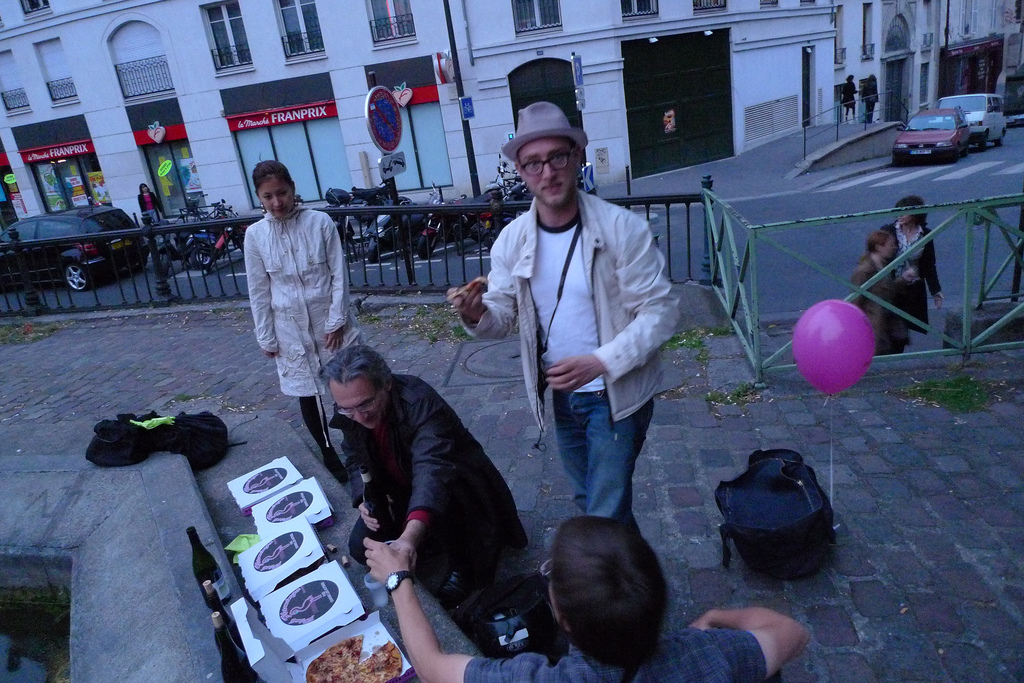
By the water, there is a small pink dot of a helium balloon, bobbing in the intermittent breeze. The balloon is key. It was given to you by Pink Flamingo, a pizza parlor down the nearby Rue Bichat, whose bicycle deliveryman will use it as a beacon to locate you and present the five pies you’ve ordered (10.50 to 16 euros each). They’re not all for you, of course — you’ve got friends to help eat the pizza and drink the four bottles of red wine (40 euros) you picked up from Le Verre Volé, a wine bar across the canal.

Wait a minute — a pink balloon as a delivery marker? Genius! I checked the pizza restaurant’s website (French) for more details but it was a little sketchy. Still, under the “Pink-nik” section, they describe a delivery service that’s simple, practical and charming. I’ve (liberally) translated:

Relax! Let us deliver. Would you like to enjoy a delicious pizza picnic along the banks of Canal St-Martin? Order from Pink Flamingo! You’ll depart with a pink helium balloon, which will allow our deliveryperson to find you later. It’s our “pink-nik” service — like no other.

Seems like a fantastic idea for any restaurant that might be located adjacent to a park, or other gathering place. A helium balloon may not be the most environmentally-friendly item, mind you, but it’s probably better than driving a car.

(Photo from Meg Zimbeck’s photostream on Flickr. She also blogged about the Pink Flamingo here.)

How offensive is swearing — and why?

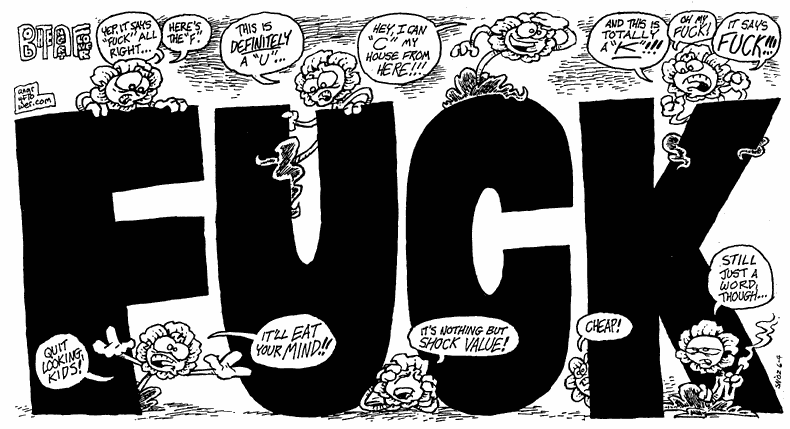
fuck

A great column in the Guardian asks why it is that people are so offended by a simple word, like “Fuck”:

“If you overuse them, they’ll lose their effect.” Well, so what, if you hate them so much? Or is the prospect of a rude word losing its offensive power too unsettling for the offendees, as it would reveal that it was only ever a word and the power was an illusion of their own making? It would emasculate their attempts to censor with their censure.

They needn’t worry. People will always find new words to offend with or be offended by - it’s a limitless resource, so why don’t we enjoy it? Let’s say “fuck” as often and conversationally as we can and we’ll be on to “cunt” before you know it. Bookmakers could take bets on what the word after that will be. As surely as we move on from MySpace to Facebook to Twitter, so shall we pass seamlessly from the f-word to the c-word to, let’s say, the d-word. “Drung” - meaning a combination of Jesus’s snot and a paedophile’s desire. Obviously its sense would soon be lost, but it would be a satisfying thing to yell if you’d just hit your thumb with a hammer.

I wonder if our language would be richer or poorer if we didn’t have so-called “forbidden” words.

(Image from Bob the Angry Flower)

Kevin Smith protests his own movie

An oldie but a goodie. Glad I happened across it:

Has the “Lost Ark” been hidden in Ethiopia? Will it be revealed? This week?

According to a dubious news source, World Net Daily, an Ethiopian church has been hiding the Ark of the Covenant for millennia, but they are just about ready to unveil it to the world. It was supposed to be revealed on Friday.

Now, they report, no one knows when it will be shown to the public. But they go whole-hog to report that it’s really there:

Next week, Cornuke will travel to Ethiopia for the 13th time since he began his search for the Ark. He told WND he believes it is possible Ethiopia could have the real artifact.

“They either have the Ark of the Covenant or they have a replica that they have believed to be the Ark of the Covenant for 2,000 years,” he said.

Cornuke said, if it is genuine, there’s a plausible explanation of how the Ark may have come to the Church of Our Lady Mary of Zion in Ethiopia.

“The Ark could have been taken out of the temple during the time of the atrocities of Manasseh,” he said. “We have kind of a bread crumb trail that appears to go to Egypt, and it stayed on an island there for a couple hundred years called Elephantine Island. The Ark then was transferred over to Lake Tana in Ethiopia where it stayed on Tana Qirqos Island for 800 years. Then it was taken to Axum, where it is enshrined in a temple today where they don’t let anybody see it.”

Personally, I would be enthralled to see such an old and venerated object — even if it is a replica.

But, if it turns out to be real … we all know how well that worked out last time:

Who creates the creators?

Provocative piece in the New Yorker: Should creative writing be taught?

Creative-writing programs are designed on the theory that students who have never published a poem can teach other students who have never published a poem how to write a publishable poem. The fruit of the theory is the writing workshop, a combination of ritual scarring and twelve-on-one group therapy where aspiring writers offer their views of the efforts of other aspiring writers …. There is one person in the room, the instructor, who has (usually) published a poem. But workshop protocol requires the instructor to shepherd the discussion, not to lead it, and in any case the instructor is either a product of the same process—a person with an academic degree in creative writing—or a successful writer who has had no training as a teacher of anything, and who is probably grimly or jovially skeptical of the premise on which the whole enterprise is based: that creative writing is something that can be taught.

What is usually said is that you can’t teach inspiration, but you can teach craft. What counted as craft for James, though, was very different from what counted as craft for Hemingway. What counts as craft for Ann Beattie (who teaches at the University of Virginia) must be different from what counts as craft for Jonathan Safran Foer (who teaches at N.Y.U.). There is no “craft of fiction” as such.

I’ve snipped just two bits from the lengthy article, which I found interesting, but also lacking. It spends almost no time dealing with the number-one benefit that a creative writing class offers to the aspiring writer: it gets you writing. Once you’ve paid to enter the program, writing becomes homework — it becomes something you must do, something that can no longer be put off, something more than a hobby. A lot of people, I imagine, find that it takes a pleasurable pursuit and turns it tedious. In creative writing classes I’ve taken, I’ve really enjoyed the fact that writing becomes necessary — something I can tell other people that I have to go do. And I’ve benefited from an explosion of creativity when I’m forced to sit down and write and write and write.

Postulated: 10+1 rules for time travel

There’s an interesting post on a blog at Discover Magazine about time travel, a subject which I find endlessly fascinating. I love it because it’s a “top-ten” list that starts at zero, so it’s actually 11 items long. I also like it because it doesn’t shy away from a little bit of science in laying out how time travel is possible, but difficult. A sample:

7. There is no meta-time.

The least realistic time-travel movie of all time might be Back to the Future. When Marty McFly changes the past (violating Rule 6), the future “instantaneously” changes. What the hell is that supposed to mean? Time measures the temporal interval between different events in spacetime, and can be quantified by clocks. There is no set of clocks outside the universe, with respect to which you can go muck around in the past and have effects propagate into the future “at the same time.” Likewise, your brain is not going to change to remember things differently, nor will any other record-keeping device such as diaries or photographs or embarrassing sex tapes. Sorry about that.

There’s some interesting assertions in the list about what you can or can’t do, as a theoretical time traveller, and then he throws it all out the window by saying, “well, if you went to the past in an alternate universe, then maybe!”

Related: Instructions to make yourself awesome if you do happen to go back in time.

Older posts «