Bush daughter gets a job. Why is that so bad? Here’s why:

The big political gossip news of the day, of course, is that Jenna Bush Hager, Dubya’s daughter, is taking a job as a Today correspondent. Why are people wailing and gnashing their teeth? The New York Times’ “Opinionator” offers a well-crafted roundup, running down the opinion of others in a way that puts it all into context.

Because it’s not just “Oh, shrug, another born-with-a-golden-horseshoe kid gets a cushy job.” Opinionator points out that Jenna’s already had opportunity after opportunity: including penning two bestselling books and working for UNICEF.

But the real scary stuff comes at the end, with a link to Andrew Sullivan’s commentary. “Nepotism, he writes, is a symptom of a greater national disease.”:

Late empires are known for several things: a self-obsessed, self-serving governing class, small over-reaching wars that bankrupt the Treasury, debt that balloons until retreat from global power becomes not a choice but a necessity, and a polity unable to address reasonably any of these questions - or how the increasing corruption of the media enables them all.

That’s “late empire” as in, before the fall. See also: Rome, Russia, Ottoman. Is British the best-case scenario?

BREAKING NEWS: Disney buying Marvel

spidermanI fail to see how this is a good thing: the Walt Disney Company is buying Marvel Entertainment. The price? Four billion dollars.

Full story here.

I will be posting more on this topic, once I’ve had a chance to think it through. You see, Marvel’s greatest strength in recent years has been it’s ability to translate various properties into cinematic success (Spider-Man, Iron Man, The Hulk, etc), while DC has had immense difficulties. The primary reason for DC’s problems has been the interference run by higher levels of corporate structure, as DC is owned by Time Warner.

Will Marvel begin to suffer the same fate? I hope not, especially since the announcement of the Avengers Initiative.

Video for Friendly Fires song Skeleton Boy

Who remembers The Wedge? You know, the only hour on MuchMusic that wasn’t dominated by the latest pop sensation or crappy alt-rock man-child? The Wedge played the most interesting videos from some of the most obscure bands (or at least those under-the-radar bands) and it was often where I was able to hear music I wouldn’t otherwise hear (pre-Internet, you know).

I haven’t watched The Wedge in years, but the occasion came the other night where I was at home, late at night, watching t.v and the only other thing on was the Red Shoe Diaries (hellooo young David Duchovny).

The Wedge it was.

And I’m glad for it, because this very entertaining video started, and I was instantly hooked by the dancing and the insanely catchy chorus.

Check out more Friendly Fires here.

Finding out what makes cancer tick

645px-Dog_tick_5148

Let’s file this under the “extraordinary claims require extraordinary proof” category, shall we?

It may be one of nature’s repulsive little blood-sucking parasites, but the humble tick could yield a future cure for cancers of the skin, liver and pancreas, Brazilian researchers have discovered.

They have identified a protein in the saliva of a common South American tick, Amblyomma cajennense, that apparently reduces and can even eradicate cancerous cells while leaving healthy cells alone.

“This is a radical innovation,” said Ana Marisa Chudzinski-Tavassi, the molecular biologist at the Instituto Butantan in Sao Paulo who is leading the research.

“The component of the saliva of this tick… could be the cure for cancer,” she told AFP.

Tick saliva could hold cancer cure: Brazilian scientists

But here’s my prediction: Quack medical “tick cures” will be filling your inbox as spam within weeks. And all of them will point back to this research as proof that their special “t1ck extract balm” will cure you of all ailments.

(Icky dog tick photo by Gary Alpert)

More on barefoot running

From kind of a fringe thing that I’ve been following for only a few weeks, and only aware of for a few months, I’m starting to see the concept of barefoot running in more and more places.

I wrote about Vibram Five Fingers earlier this month, but now I see that the New York Times has joined the chorus:

Proponents of this approach contend that naked feet are perfectly capable of running long distances, and that encasing them in the fortress of modern footwear weakens foot muscles and ligaments and blocks vital sensory input about terrain.

“The shoe arguably got in the way of evolution,” said Galahad Clark, a seventh-generation shoemaker and chief executive of the shoemaker Terra Plana, based in London. “They’re like little foot coffins that stopped the foot from working the way it’s supposed to work.”

I am seriously thinking about picking up a pair of Vibrams — I just wish that I could try on a pair before I order online — and I’ve been trying to do more walking around barefoot. But for now, I’m hesitant. Maybe that’s because winter’s coming.

In the meantime, for crying out loud, watch this video that I posted earlier. It’s freaking hilarious.

Camera filter turns bokeh into pretty shapes

Bokeh is the Japanese word for blur which has been adopted into a photographic term for the out-of-focus area in a picture, often referring more specifically to blurred lights in the background of a photograph.

bokeh

Like this photo I took last year in my backyard. The rounded, blurry lights are bokeh. The better the lens, the better the bokeh.

So I was intrigued when I came across a website selling bokeh filters, which can turn the blurry rounded lights into different shapes.

The website has a low-quality “act now!” informercial vibe, which causes me to be a little distrusting. If it’s legitimate, though, you can really add an interesting element to your photos.

bokehex

Like the photo above, taken from the bokeh filter website. They also have a video that shows off the filter in action.

They say it works best with cameras with large apertures, of course, because the largest apertures give the best bokeh. They’re currently only making it for lenses of 52mm, though, so I’m out of luck with my 50mm f/1.4 lens.

(Link via Geekologie)

The future of the suburb was built a century ago in vintage medieval style

foresthills

In this photo, from Joe Shlabotnik’s photostream on Flickr, you can see the types of townhouses they have in the suburb of Forest Hills Garden, in Queens, New York. Based on the style, you’d never guess that it was part of a planned community, built using pre-fab concrete decades before anyone else thought to, right?

There’s a fascintating slideshow on Slate about Forest Hills Garden and how it came to be. It was ahead of its time — we’re just now starting to come back to its mixed-use, transit-oriented, walkable community plan. Says Slate:

Forest Hills has a variety of single-family houses: attached, semidetached, and freestanding. The aim of having many housing types was partly to give more choices to buyers and partly to create the kind of visual variety found in old towns. This is very different from the sort of homogeneity that characterizes most modern suburbs.

Homogeneity and, I would argue, soullessness.

Guinness to celebrate its quarter-millennium

GaeilgeGuinness

Some people are fanatical; me, I could take it or leave it. But you have to respect a beer that’s been around for 250 years. Heck, that’s nearly twice as old as my country.

This Sept. 24, Guinness will celebrate its semiquincentennial — or is that its bicenquinquagenary?

Apparently, the time to hoist a pint of the black stuff is just one minute to six o’clock — or, 17:59, which is the year that Arthur Guinness leased his brewery in Dublin. From an article in the Toronto Star:

In the lobby of the Guinness Storehouse, a glass panel set into the floor. Below the glass is an old document, dated Dec. 31, 1759. This piece of paper records, perhaps, the greatest real estate bargain since Dutch explorer Peter Minuit bought Manhattan for $24 worth of beads.

Arthur Guinness, owner of a small brewery near Dublin, had come to the capital with expansion on his mind. He spotted a run-down brewery, but didn’t have the cash to buy it outright, so he leased it.

“A very profitable move,” the guide says. “He got the lease for £45 a year – for 9,000 years.”

No, it’s not my favourite beer, but you gotta respect that foresight.

(PS. The poster is from Wikipeida, where they translate it as “Guinness is Good for You”)

‘Best of Wikipedia’ is a time-suck

I love Wikipedia. It’s often my first stop when I’m looking for information — and if Google is my first stop, then it generally leads me to Wikipedia right away.

If I’m bored online, I know that there’s always a featured Wikipedia article that will entertain me for a few minutes. And sometimes I play a game with myself where I try to get to a specific Wikipedia page from whatever other Wikipedia page I’m on. (Let’s say I’m reading about World War 2, and I suddenly want to read about, say, the latest Hollywood blockbuster. You’d have to get there just following the links in the page — no searches).

Now, though, I’ve been introduced to a sped-up, even more addicting version of that featured article. Daniel Finkelstein of the Times Online tells me this:

I’ve just stumbled across a brilliant blog, but first, a warning:

If you’re busy at work, busy as in ‘can’t afford to be completely and inexplicably sucked up and then spat out again a good 30 minutes later’, then it’s probably best you read no further.

Best of Wikipedia cuts through the zillions of Wikipedia entries and delivers a twice daily pick of the most curious.

As a form of encyclopedic-russian-roulette it can’t be beat. But another warning: it makes no claim that the material conforms to anything more than Wikipedia’s usual standards of truthfulness…

He re-links to “Best of Wikipedia” things like:

  • Mary Toft [née Denyer] (c. 1701–1763), also called Mary Tofts, was an English woman from Godalming, Surrey, who in 1726 became the subject of considerable controversy when she hoaxed doctors into believing that she had given birth to rabbits.
  • The Cure for Insomnia is officially the world’s longest movie, running 5220 minutes (87 hours) in length. The movie has no plot.
  • Nix v Hedden was a case in which the United States Supreme Court addressed whether a tomato was classified as a fruit or a vegetable under the Tariff Act of March 3, 1883, which required a tax to be paid on imported vegetables, but not fruit.

…and I guess now I’m done work for the day.

Flu season approaches…everyone panic!

We live in alarmist times. The slightest hint that anything MIGHT go wrong sends the media (apologies to Grant and Matt who are sure to comment), the government and the public into hysterics.

With flu season approaching, it seems the entire world is collapsing in fear that the swine flu - or H1N1, if you prefer — will sweep the globe killing us all. Think I’m overstating the case? Here’s a sample of some headlines and stories:

According to the World Health Organization (WHO), the total number of deaths worldwide attributed to H1N1 was 1,799 as of August 21. Since these numbers were collected from this particular strain of flu’s emergence in April, we can currently calculate the number of deaths caused by H1N1 on an annual basis to be somewhere in the area of 4,500. Let’s be generous and say 5,000 deaths/year (at current count) are caused by H1N1.

Again, according to the WHO, the annual numbers of deaths due to influenza is between 250,000 and 500,000. Why the focus on H1N1, when there are other strains that are apparently far more deadly?

In 2004, a study of deaths worldwide found (not a complete list):

  • Coronary health disease - 7.2 million deaths worldwide
  • Stroke and other cerebrovascular diseases - 5.71 million deaths
  • Diarrhoeal diseases - 2.16 million deaths
  • HIV/AIDS - 2.04 million deaths
  • Road traffic accidents - 1.27 million deaths

Comparitively, 5,000 deaths seems low. Where’s the worldwide mobilization regarding HIV? Road safety? Improving physical fitness levels?

Vaccination programs, in and of themselves, are not what I am opposed to. However, using untested (or undertested) vaccines is a bit scary: In 1976, a strain of the H1N1 virus appeared, eventually hospitalizing 13 and killing 1 individual. The vaccine introduced to fight it had side effects that killed 25. The side effects were given a name — Guillain-Barré syndrome (GBS).

Already a GBS montoring system is being put into place and the vaccination program has barely begun.

This flu season, make your own decision regarding vaccinations. However, make sure it is an informed decision.

I will not be getting the flu shot.

In image of a single molecule, you can see the atomic bonds

dn17699-1_300

According to New Scientist, a team of researchers with IBM has managed to capture a photograph of a full molecule for the first time. Pentacene, which is “a polycyclic aromatic hydrocarbon consisting of 5 linearly-fused benzene rings,” (Wikipedia) normally looks like a pile of purple or green, powdery crystals, but up this microscopically close you can actually see the structure of the rings.

Says New Scientist:

The molecule is very fragile, but the researchers were able to capture the details of the hexagonal carbon rings and deduce the positions of the surrounding hydrogen atoms.

One key breakthrough was finding a way to stop the microscope’s tip from sticking to the fragile pentacene molecule because of attraction due to electrostatic and van der Waals forces – van der Waals is a weak force that operates only at an intermolecular level.

The team achieved this by fixing a single carbon monoxide molecule to the end of the probe so that only one atom of relatively inactive oxygen came into contact with the pentacene.

I find is amazing that this picture looks pretty precisely like the drawings in a chemistry textbook — you can see those types of drawingsin the Wikipedia article. Way to go, science!

Fill ‘er up — with watermelons

Watermelons

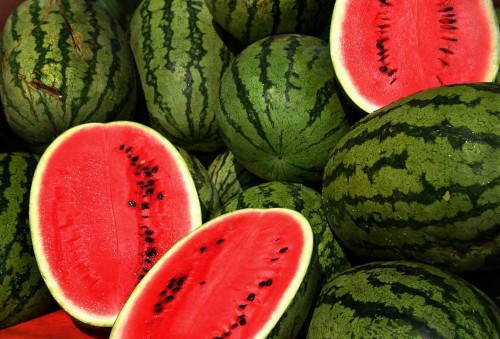
Like watermelons? Me too! Especially when you upend a bottle of vodka into them and make a tasty adult picnic snack.

So while it doesn’t surprise me that watermelons and alcohol go together, I was pleased to learn that watermelons may be the next go-to crop for making ethanol. I learned from Slashdot that the USDA is looking at watermelons for ethanol production, citing their high levels of fermentable sugars.

Why is this better than corn, which is how most of our ethanol currently ges produced? Well, waste corn can be processed into lots of different things — from corn syrup to animal feed — and ethanol is just one use for it.

But, apparently upwards of 20% of watermelon production is just left on the fields, because it’s not pretty enough to humans to buy it in the store. That waste product can be fermented into ethanol.

Eventually, of course, the holy grail is to take completely unusable woody plant stalks, which we mostly just plough under right now, and turn that into ethanol, but we haven’t figured out how to break it down yet. In the meantime, anything that gets us off of corn-based ethanol (or, worse, sugar-cane-based) is good in my books.

(Watermelon pic from Flickr user babasteve)

How best to share my vintage magazines?

scifi1

Remember a few weeks ago? When I said that I was thinking about buying, on eBay, the two magazines above, because they happened to have been published during my birth month and year?

Well, I bought ‘em. And they arrived, and I have had a great time going through them and reading the stories and just looking at the vintage design and illustrations.

So I did a few more eBay searches, and I’m currently awaiting delivery of several more magazines from October, 1976. I’m going to be the proud owner of a vintage Rolling Stone (actually, I’ve already received that one — and it’s awesome), plus an old Popular Science, a Mad magazine, a High Times — even a Playboy.*

I recommend it, if you’re into vintage stuff at all.

However, I’d like to share my vintage magazines with the world, and I’m wondering if anyone has a good idea how to go about it.

I considered scanning each and every page of each and every magazine. I don’t mind the time that this will take — I’m looking at this as a long-term project — but I really am wary of creasing the spines of some of these magazines. They are in fantastic shape, and I don’t want to wreck them; some of the pages are a bit on the brittle side.

I also know that scanning pages sometimes gives you weird moire patterns, and sometimes the other side of the paper bleeds through. As well, the Rolling Stone, at least, is far too big to scan.

So I thought about taking pictures of each page, but I know that then the pages won’t lay flat.

Any insight on the best way to digitize these old magazines? I really don’t want to take out the staples or something like that.

(*update: the PopSci, Mad and Playboy — explicitly NOT just for the articles — arrived in today’s mail)

Rare, gigantic, endangered fish looking for a new home

090826-sturgeon

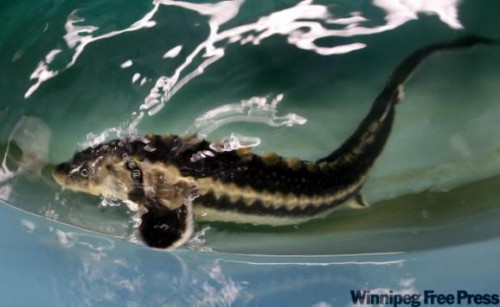
Three Black Russian sturgeon that are currently swimming at the University of Manitoba have grown too big for their tanks and need a new home, according to a story in the Winnipeg Free Press:

Black Russian sturgeons can grow to about four metres in length and weigh nearly 50 kilograms. In the wild, they live between 30 and 50 years but in captivity they could live to be nearly a century old, provided they’re kept in a sufficiently large tank.

Terry Dick, a professor in biological sciences at the U of M, said fish this size obviously can’t be kept in the same bowl as your goldfish.

“They would have to go to a public aquarium,” he said, noting the three fish are now each a metre in length, after having arrived at one-tenth that size.

Although the Freep says that there are three fish, the original press release at the University of Manitoba refers to “Igor and his three friends”:

The sturgeons, Acipenser gueldenstaedtii, are renowned for producing great caviar. They are also docile – open the tank lid and they come to the surface for petting – and they are big: they currently stretch about a meter in length but will grow to four meters.

Technically the Canadian Wildlife Services own the fish so all owners need to be approved by them, but staff members in the department of biological sciences are propositioning aquariums and research study groups.

“We love taking care of them but we can’t do it for much longer because they’re getting too big for us,” a spokesperson said. “It will be sad to see them go but as long as they go to a good home we’ll be happy.”

The fish were seized from smugglers about two years ago and would be worth big bucks on the black market for their caviar.

I haven’t been to the Assiniboine Zoo in ages — do they have any kind of aquariam/tank facility? Seems a shame to ship these fish off somewhere else when they could be an asset in Manitoba.

And come on — maybe it would take some money to construct and run such a facility, but a “Black Russian” fundraiser? It writes itself!

(Picture by Joe Bryska, Winnipeg Free Press. I am *assuming* that by watermarking their image, the Free Press is tacitly allowing people to copy and use it. I have linked the picture back to the original article. However, as always, if you have copyright concerns, contact me and I’m happy to work something out.)

Canburger: fast food, meet shelf life

canburger

I didn’t think they could come up with a burger that would actually produce more physical waste than the old foam McDonald’s containers, but my good friend Noto reminds me that modern ingenuity always outdoes itself.

Yes, it’s a cheeseburger, in a can. Gizmodo refers to it as either “the greatest achievement of mankind thus far,” or ” an abomination of foodstuffs that deserves to be hucked back into the gaping maw of whatever food processing plant it was spewed from.”

I think I’ll refer to it as the post-apocalyptic fast-food meal of my nightmares.

Oh, and if you think this is weird, this should just whet your appetite for a mega-post that Keith and I have coming ….

Older posts «