I love piano, hate commercials

So what happens when a lousy car commercial uses a famous piano composition?

It drives me crazy, that’s what.

There’s a new Lexus commercial that I see almost every ad break while watching an hour-long show. I don’t really watch too much T.V anymore, but this commercial is always on.

It’s a typical car commercial these days: slow motion action shots of the interior and exterior, in the big city, comforting dad looking through the rear view mirror at young daughter, shots intended to show how well the car maneuvers while still being a comfortable hunk of metal, shots intended to show how much better a car it is than the one you’re driving.

I dislike all commercials, but ones involving cars are especially egregious. But this commercial, well, it always catches my attention. Instead of changing the channel, I wait and listen because I’m drawn in to the beautiful piano.

Now I’m sure you’re dying to know what it is. Wait no longer! Here!

The actual commercial doesn’t have the handy song information like in this video, so while I kept saying to Grant every time it came on, “I know this song!” it took him 45 minutes to find out it was Clair de Lune by Debussy (Of COURSE I thought). Because Lexus is notorious for using classic songs. Or something.

Anyway, it reminded me how much I now love Erik Satie, and of my perennial favourite, Moonlight Sonata.

Damn you, Lexus. Damn our love/hate relationship.

And now … the world’s first juggling robot

The Unabomber was right?

unabomber-fbiA post over at The Technium begins with the eye-cocking premise that the Unabomber had a few things right:

As best I understand, the Unabomber’s argument goes like this:

  • Personal freedoms are constrained by society, as they must be.
  • The stronger that technology makes society, the less freedoms.
  • Technology destroys nature, which strengthens technology further.
  • This ratchet of technological self-amplification is stronger than politics.
  • Any attempt to use technology or politics to tame the system only strengthens it.
  • Therefore technological civilization must be destroyed, rather than reformed.
  • Since it cannot be destroyed by tech or politics, humans must push industrial society towards its inevitable end of self-collapse.
  • Then pounce on it when it is down and kill it before it rises again.

In short, Kaczynski claims that civilization is the disease and not the cure. He wasn’t the first to make this claim.

In a lengthy and fairly-well-thought-out post, though, the author goes on to deconstruct that claim, and the claim of other, similar “anti-civilzation collapsatarians.”

The problem is that Kaczynski’s most basic premise, the first axiom in his argument, is not true. The Unabomber claims that technology robs people of freedom. But most people of the world find the opposite …. In his Montana hermitage he was free to move about as much as the snow and weather permitted him. He could freely choose among a limited set of choices of what to do in the evenings. He may have personally been content with his limited world, but overall his choices were very constrained, although he had unshackled freedom within those limited choices. Sort of like, “you are free to hoe the potatoes any hour of the day you want.” Kaczynski confused great latitude within limited choices as superior over modest latitude in an expanding number of choices.

It’s a good read!

Oh, and speaking of the Unabomber — he totally spawned a “look” didn’t he? He wanted to spawn a movement, but I’ll bet he didn’t want it to be a fashion movement. This always makes me think “Unabomber”:

Ever wonder who invented tighty-whities?

The history of the Jockey short:

Although the briefs had been put on show in the window at the Marshall Field & Co department store, its management thought it ludicrous to try and sell such skimpy items on a cold day that cried out for long johns - then the dominant form of men’s underwear - and ordered the display to be removed. They were so wrong. Before their orders could be carried out, 600 packages of Jockey shorts were sold. And 30,000 pairs were sold in the next three months alone.

The article goes on to describe the strugge between boxers and briefs, plus the emergence of hybrids like boxer-briefs and shorter trunks. Strangely, nowhere does it mention going “commando.”

PS. Before the comments section starts a’flyin’ I don’t normally just go searching for web pages about men’s underwear. But a recent comic over on dinger.ca made a pun about “tie fighters” (guys who were battling each other with neckties) and I thought I could make a related Star Wars joke about Y-wing fighters and Y-front briefs. It didn’t work out. Also, no picture on purpose. Google Images is not your friend in this instance.

UPDATE: Holy crap. More here than you could even want to know. Thanks to Wikipedia for the link.

To the glue factory!

Although this picture looks like a still from the movie "Black Beauty" it's actually a re-creation of a common horse nightmare. Running, endlessly running, along a beach, hoof-deep in an advancing tide of glue ...

Although this picture looks like a still from the movie "Black Beauty" it's actually a re-creation of a common horse nightmare. Running, endlessly running, along a beach, hoof-deep in an advancing tide of glue ...

Amy and I had a discussion the other day (I spoke, she tolerantly listened) which eventually led to my post on whether or not you had to wash an organic apple. One of the questions that came up concerned the little stickers that grocery stores put on produce. When you have to pick a sticker off the skin of an apple, what kind of adhesive is left behind? And, if it’s organic produce, is the glue used in the sticker organic, too?

Because I haven’t yet worked up my nerve to call 1-800-SAFEWAY (that’s 1-877 in the US) to find out about what I’ve started to mentally call “The Organic Glue Dilemma,” I came up instead with various possible scenarios:

1. It could be regular old glue. Just like if you buy organic produce, you don’t have to put it in an organic bag (although, really, you could/should).

2. It could be some kind of natural glue, which could also be organic.

Normal glue is based on yucky things like polyvinyl acetate. No thanks. But didn’t they once ship horses off to the proverbial “glue factory.” Don’t they, you know, make glue there? And, supposing you had an organically-fed horse, which you turned into glue, wouldn’t that make it organic glue?

And, to be honest, shouldn’t a glue made from animal products be edible? I’ll even include bone and hoof here, because if you can nibble at your fingernails, you should be able to eat a hoof. See also: gelatin.

Then I did some research. I found out some interesting things, like that organic apples aren’t waxed post-harvest, but that apples produce some natual wax of their own. Also, that the glue used in stickers is a food-grade glue, so the government thinks it’s okay for you to consume it.

I also found out an awful damn lot about horse glue. Turns out that horses (and other livestock animals) are regularly slaughtered and rendered in Canada — many horses are shipped up here from the States, which only recently legalized horse slaughtering again. Horsemeat is shipped overseas to countries that have a taste for it. It’s also used in zoos, to feed carnivores like lions and tigers (and bears? oh my!). Some of it probably goes into pet food. And yes, some of the connective tissues are rendered into what’s called “hide glue.”

Hide glue has important properties that make it different from regular glue. Says Wikipedia:

Hide glue creates a somewhat brittle joint, so a strong shock will often cause a very clean break along the joint. In contrast, a joint glued with PVA will usually break the surrounding material, creating an irregular, difficult to repair break. This brittleness is taken advantage of by instrument makers. For example, instruments in the violin family require periodic disassembly for repairs and maintenance. The top of a violin is easily removed by prying a palette knife between the top and ribs, and running it all around the joint. The brittleness allows the top to be removed, often without significant damage to the wood. Regluing the top only requires applying new hot hide glue to the joint. If the violin top was glued on with PVA glue, removing the top would require heat and steam to disassemble the joint (causing damage to the varnish), then wood would have to be removed from the joint to ensure no cured PVA glue was remaining before regluing the top.

Hide glue also functions as its own clamp. Once the glue begins to gel, it pulls the joint together. Violin makers may glue the center seams of top and back plates together using a rubbed joint rather than using clamps. This technique involves coating half of the joint with hot hide glue, and then rubbing the other half against the joint until the hide glue starts to gel, at which point the glue becomes tacky. At this point the plate is set aside without clamps, and the hide glue pulls the joint together as it hardens.

And now you know!

A message to be thankful, for a change

Shamelessly pinched from my friend Ben, whose daily cartoon I direct you to.

Now, the comedian on Conan’s show, a gent by the name of Louis CK, does seem to have a point: despite the economic downturn, we really are surrounded by a pretty amazing life. We live in a pretty good time. And even if you lose your job, and house, and things look dire, it’s not like medieval Europe, when your life as a serf meant unending toil until the Black Death took ya.

So, are we all just spoiled brats? Or what?

Bubble, bubble, toilet trouble

It ain’t exactly Shakespeare, but there sure has been a lot of ink spilled in Manitoba about toilets recently. The provincial government offered a $50 rebate to new toilet buyers, but the cash came with a catch: you had to buy a dual-flush toilet, and you had to buy it on a specific day.

The one-day stipulation was a genius marketing move (it followed a marketing nightmare: originally, the toilets had to be bought from only certain big-box retailers, shutting out every small hardware store in the province, to a cacophony of howls).

Now, with thousands of shiny new porcelain water-saving thrones underneath ‘Toban tushies, there’s still more ink being spilled about where the old ones are going. Answer: recycled! Every story written has had the same self-congratulatory sheen: “Boy, we Manitobans are going to be doing a great thing for the environment, and even though we live in a water-rich province, we’re conservationists to the core!”

But wait: we could do more.

I read with interest about the concept of a NoMix toilet. NoMix, technically, is a brand from Sweden, but the concept is similar across brands: instead of a dual-flush system, it’s a dual collection system.

That is, there’s a place to pee and a place for No. 2. Separate collection points in the bowl make it look like a slightly smaller toilet bowl coupled with a tiny backwards-facing urinal shoehorned into the front.

They say that it means men have to pee sitting down, which is kind of a non-starter for me (and for others — from the New York Times article: “Professor Jenssen was flummoxed by one participant at a training workshop in Cuba who said firmly, ‘If a man sits, he is homosexual.’”).

Judging by the pictures I’ve seen, though, and by my own (perhaps inflated) sense of aiming ability, I don’t think it’s necessarily necessary for boys to sit. Take a look:
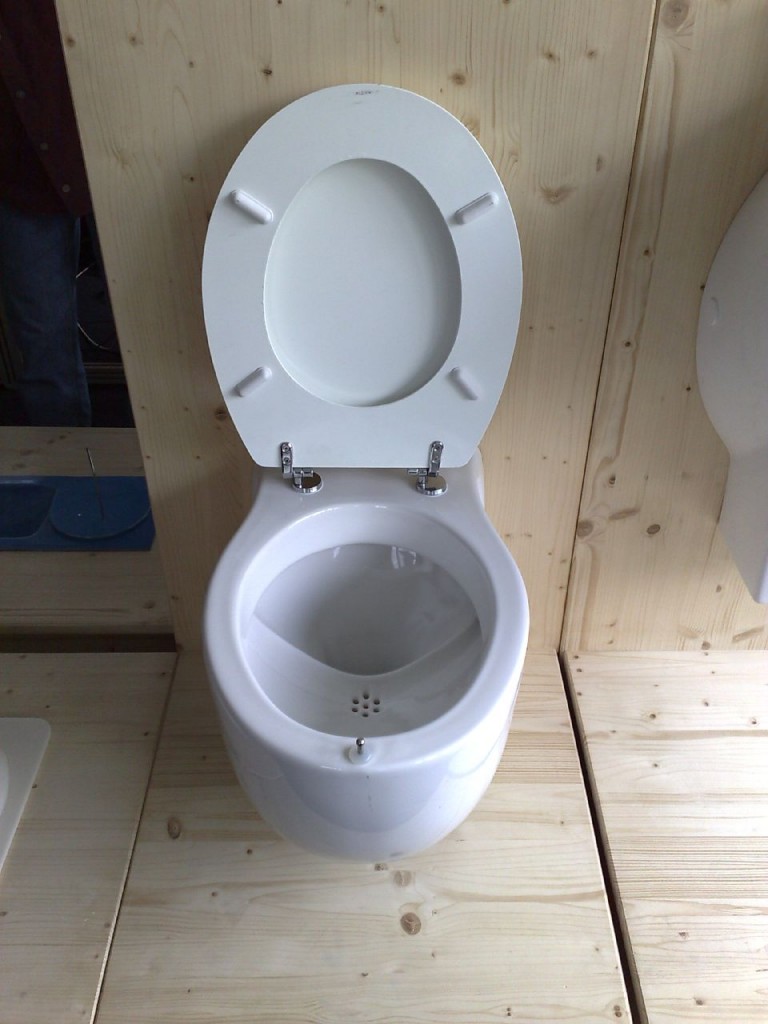
This NoMix toilet looks like a man could aim right into the urinal portion without too much trouble. Unfortunately, this particular model has a weight-activated valve, so you still have to sit. A problem that doesn't have to be a problem, methinks. Photo by Flickr user kikuyumoja.

This NoMix toilet looks like a man could aim right into the urinal portion without too much trouble. Unfortunately, this particular model has a weight-activated valve, so you still have to sit. A problem that doesn't have to be a problem, methinks. Photo by Flickr user kikuyumoja.

On the other hand, I’ve long dreamed about having a bathroom with a real urinal in it, and I know there are others like me out there. In fact, I’d suspect there is a market for a toilet that is also half-urinal, if that’s how it was marketed — not as “the sit-down toilet for guys.” (Or this, ha ha)

Outdoor porta-potties often have side-mounted urinals that feed down into the tank alongside the sit-down seat, and if they can fit into those tiny spaces, I’m sure engineers could design a toilet/urinal that would fit into current home bathrooms. Perhaps a urinal that is mounted along the side of the tank?

Why is this important? Because it’s not just conserving water that is environmentally friendly — sewage is a major problem, too. Wastewater treatment is a gigantic energy hog, and dumping it into lakes, rivers and oceans leads to

Human waste was, for thousands of years, an important fertilizer, and even after sewage treatment, it remains potent enough to upset the natural balance of water we dump it into. That causes things like algae blooms and ocean “dead zones.”

Separating solid waste from liquid waste makes it easier to treat — and possibly to collect and use as fertilizer again.

Of course, in cities with existing sewer systems, building a brand-new dual collection network seems cost-prohibitive. That’s why the “urine diversion” toilet is being adopted more in places that the Times calls “fast-industrializing countries like China and India, which have money to invest in alternatives but few sewers.”

What’s interesting to me, though, is that this kind of toilet could be fairly easily incorporated in houses that use a septic tank, which are fairly common in rural areas. Hey, rural areas — isnt’t that where they use a lot of fertilizer, too? And haven’t fertilizer prices skyrocketed lately?

Seems to me like there’s an innovative answer being flushed right down the toilet.

Missed it by that much

Yesterday, while I was walking back into work, I saw an ambulance come screaming towards me, from a few blocks away. As it headed towards the red light at the intersection nearest to me, they sounded that “blaaat” horn, as well as the siren, to make sure that everyone got out of the way and let them through.

Well, the driver of the Greyhound bus that was turning right onto that street must not have been paying attention. As the bus swung wide across the path of the ambulance, I thought I was about to see a crack-up of massive proportions.

I happened to be carrying a camera, and I was prepared to do my reporter duty, but the bus driver braked at the last second, and the ambulance was able to swerve over into basically the parking lane and get by.

A juvenile part of me, deep inside, was disappointed. Thanks, YouTube, for cheering me up!

(PS. According to the Internet, everyone involved in this accident ended up okay.)

UPDATE: Even better!!!!!

Question: Do you have to wash an organic apple?

I was eating an organic Granny Smith the other day, and as I ran it under the tap, I wondered if I really had to.

My mom raised me to wash my fruits and veggies — excepting things like bananas, of course — but my dad was always of the opinion that an apple just needed to be “shined up” or polished, preferably on one’s jeans.

Seeing as how an organic apple wasn’t grown with any pesticides or other chemicals, it wouldn’t be necessary to wash them off. Normally, apples are among the worst offenders, too! But an “organic” designation should solve that issue.

On the other hand, though, you’re not just washing off chemicals; you can also wash off plain old dirt, or dust and other grime. Plus, who knows how many people before you have handled that particular apple, in its journey from the field — and how many of them had coughs or colds.

But on the other hand again, you’re probably handling more bacteria on the shopping cart handle than on the apple when you buy it. Many apples come inside plastic bags, too. And even the ones that are sold loose tend to look clean — grocery stores don’t generally let their merchandise get dusty.

And frankly, a little dirt won’t kill you. Neither will a bit of bacteria. In fact, I’d argue that hypercleanliness is worse for you than letting your body deal with bacteria and viruses the way it’s evolved to. Let your immune system out to play! By the way, your body did not evolve to deal with Javex, Lysol or Purel all over every surface.

So, a few days ago, I ate an organic Granny Smith, and I washed it off out of habit. But last night, I took an organic Granny Smith out of the same bag and ate it straight, no washing. I just shined it up some on my jeans.

I just had one thought, as I picked the “certified organic” sticker off the apple: “What’s in this sticker’s glue? Is it organic?”

Ancient archaeological discovery — in a guy’s backyard

Photo by Glenn Asakawa, University of Colorado

Photo by Glenn Asakawa, University of Colorado

Here’s a cool story: Guy digging around in his backyard makes a random discovery that could turn out to be substantially important:

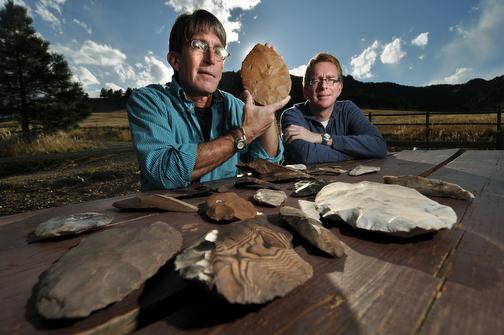
Patrick Mahaffy was just getting a little routine landscaping done outside his Boulder home — the work crew was shaping a small drainage ditch — when a shovel hit stone.

The “chink” of the impact sounded odd, so the crew poked around, and just 18 inches beneath the soil surface they made an extraordinary find: 83 stone tools left in a cache 13,000 years ago by people who used the sharpened rocks to butcher ice-age camels and horses.

It sure made University of Colorado anthropology professor Douglas Bamforth pretty excited: “This is the only time in my career that this is ever going to happen to me,” he said. “To have something like this appear — to have it be what it turns out to be — it’s quite spectacular.”

There’s more info in this story:

The artifacts were buried in a coarse, sandy sediment overlain by dark, clay-like soil and appear to have been cached on the edge of an ancient stream.

“It looks like someone gathered together some of their most spectacular tools and other ordinary scraps of potentially useful material and stuck them all into a small hole in the ground, fully expecting to come back at a later date and retrieve them,” Bamforth said.

One of the tools, a stunning, oval-shaped bifacial knife that had been sharpened all the way around, is almost exactly the same shape, size and width of an obsidian knife found in a Clovis cache known as the Fenn Cache from south of Yellowstone National Park, said Bamforth. “Except for the raw material, they are almost identical,” he said. “I wouldn’t stake my reputation on it, but I could almost imagine the same person making both tools.”

“There is a magic to these artifacts,” said Mahaffy, the landowner. “One of the things you don’t get from just looking at them is how incredible they feel in your hand -they are almost ergonomically perfect and you can feel how they were used. It is a wonderful connection to the people who shared this same land a long, long time ago.”

The Clovis-era people, to put the age of this in perspective, would have hunted things like mammoths, as well as camels — when camels lived in North America. For the Manitobans in the mix: the Clovis era ended when Lake Agassiz broke through its shoreline and suddenly drained a bunch of freshwater into the Atlantic, cooling the climate dramatically (like 15 degrees C average).

Amazing to think that evidence of this was just buried in a guy’s back yard. I’m going digging this spring!

Newspaper death watch: Rocky road edition

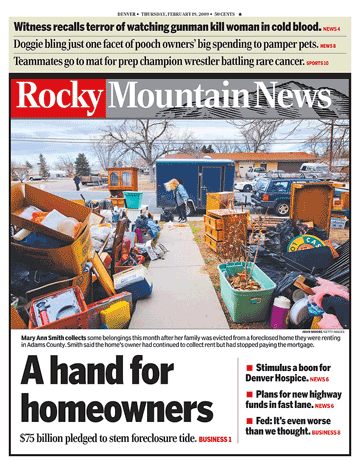
Closed. The Rocky Mountain News finds itself in the same position as the homeowners it recently reported on.

Closed. The Rocky Mountain News finds itself in the same position as the homeowners it recently reported on.

It was a long and winding road for Colorado’s oldest newspaper, the 150-years-young Rocky Mountain News. But in the end, they just couldn’t go on any longer.

The paper’s owner, Scripps, has announced that, unable to find a buyer, the doors on the Rocky will be closed for good Friday.

It’s tough times for the industry, sure, but I had kind of high hopes for the Rocky. According to their own story on the closure:

In the past decade, the Rocky has won four Pulitzer Prizes, more than all but a handful of American papers. Its sports section was named one of the 10 best in the nation this week. Its business section was cited by the Society of American Business Editors and Writers as one of the best in the country last year. And its photo staff is regularly listed among the best in the nation when the top 10 photo newspapers are judged.

The paper was one of the first to shrink to a tabloid size, in 1942, and it slimmed down dramatically in 2007, as well, moving to an almost magazine-like size, with lots of bold colour and photography.

The content was strong, and the presentation was impeccable. Just leaf through some of their front pages here.

Unfortunately, Denver’s a two-newspaper town, and that town just ain’t big enough for the both of them anymore. Don’t think that the Denver Post is going to be happy to see them go, though: in a bid to save money, the two newspapers have been sharing business services — from advertising to a printing press — for eight years.

The Post, by the way, recently wrangled wage and benefit concessions of nearly 12% from its unions, to try and save that business.

I remain confident that, when the dust settles, there will still be professional journalism, but we’re really witnessing a shakeup in the industry, and a lot of babies are being thrown out with the bathwater.

Sad news: Philip José Farmer dead at 91

pjf9

Philip José Farmer

Saw this today, but I guess it happened yesterday: Prolific science fiction author Philip José Farmer died Wednesday at 91. I’ll be honest, I didn’t even really know he was still alive.

dayworld1I remember picking up one of his books from the library when I was in junior high and it blew my mind. It was “Dayworld” and it was the first in a long series (he was famous for his ongoing series). It told the story of a world beset by overpopulation, where the government had “solved” the problem by putting everyone into suspended animation and leting them out only one day a week. If Tuesday was your day, for example, you spent Wednesday through Monday hibernating while six other families used your house, car, job, etc. The novel followed a “daybreaker” who didn’t hibernate (I think he was trying to bring down the government) and who had to keep track of seven different lives — families, friends, careers.

I didn’t quite get how he didn’t age seven times as fast as everyone else, but Farmer tended to skip over things to get on with the storytelling, which was riveting (at least for a junior high student).

I’d like to revist some of his stuff in his honour, now that he’s dead. I think I might start with the Riverworld series. According to Farmer’s obituary:

In his Riverworld series Mr. Farmer imagined a river millions of miles long on a distant planet where virtually everyone who has died on Earth is physically reborn and given a second chance to make something of life. … one of the resurrected is a resentful Jesus, angry that he had been deceived about the nature of the afterlife.

I don’t know where people really go when they die, but that’s a more imaginative ending that I could have come up with.

A different kind of “Octopussy”

It was one of the best Bond film titles ever, causing umpteen adolescent jokes as I was growing up: Octopussy.

It would have been the only possible porn name for Nadya Suleman, who gained infamy when she popped out eight (more) kids in January.

Unfortunately, she has declined the million-dollar offer to appear in pornographic films:

“Who wants to see me naked? Maybe in a year when the baby fat goes away.” she jokes. “Of course, if I have more kids I may have to ask for two million dollars.”

For the record, I’d still be more interested in that kind of octo-porn than this kind.

Street art on crosswalks

Following Amy’s post about the Abbey Road crosswalk, I did some Googling to see if I could find the source of something I remember reading a while back. I read that you should stand on the edge of the crosswalk nearest the oncoming traffic, to provide yourself with the highest visibility. Now I can’t find where I read that.

But I did find some awesome crosswalk-based street art!

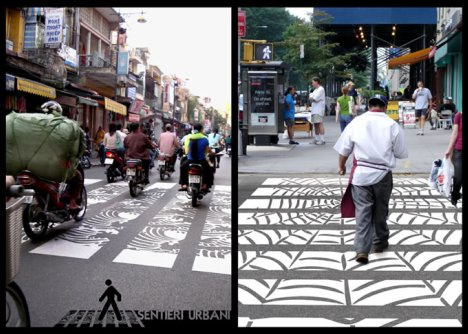
peter-gibson-2

The one above is by a Montrealer, Peter Gibson — you can find a lot more of his work here.

The one below I found on Web Urbanist, and they’ve got loads of other links and other information for you.

sentieri-3

If you think using pedestrian crosswalk to make a statement is a good idea, try out the video below, also from Web Urbanist.

I’m a huge fan of these small-scale make-people-think initiatives. More! More!

All about the Octomom backlash

I saw on the Globe and Mail site a great story about the backlash facing Nadya Suleman, who gained quick fame by carrying octuplets to term, then infamy, when it was revealed she was a single mom with (now) 14 kids, and no job.

What backlash?

Consider this rap rhyme quoted in the story: “pops ‘em out like a toaster/needs a pacifier holster” for an example. Consider also the plight of Suleman’s one-time publicist, who quit after receiving death threats:

“Not in my experience have I ever seen anything like it. And I would add that I was involved in public relations for Three Mile Island.”

But although the G&M story allegedly tries to examine the origins of said backlash, it ultimately feels like a pretty shallow hack at it. Still, they’ve done a great job in summing up the sheer negativity that people have about her, even if they haven’t plumbed the depths of why those feelings exist.

Older posts «