Posts tagged: science

Our incredible sun

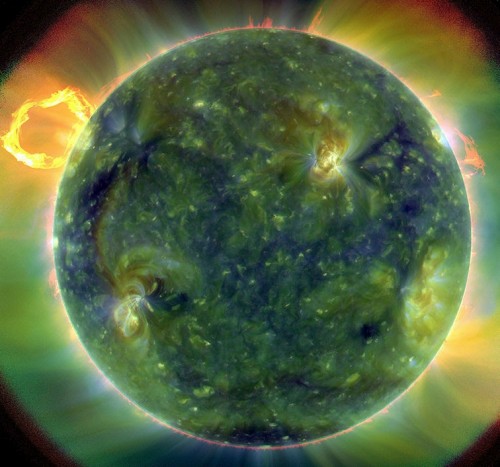
Launched in February, NASA’s Solar Dynamics Observatory — the “Hubble for the sun” — has started to send back some amazing footage.

Take this image for example, which is a full-disk multi-wavelength extreme ultraviolet image of the sun:

The red spots are relatively cool, while the green and blue spots are much, much hotter.

One of the amazing things about SDO is that it is able to study the sun in its entirety, rather than small patches like previous observatories.

An objectives of SDO is to learn more about the sun’s relationship to Earth. From NASA:

Launched on Feb. 11, 2010, SDO is the most advanced spacecraft ever designed to study the sun. During its five-year mission, it will examine the sun’s magnetic field and also provide a better understanding of the role the sun plays in Earth’s atmospheric chemistry and climate.

SDO will determine how the sun’s magnetic field is generated, structured and converted into violent solar events such as turbulent solar wind, solar flares and coronal mass ejections. These immense clouds of material, when directed toward Earth, can cause large magnetic storms in our planet’s magnetosphere and upper atmosphere.

Another objective is to use SDO to predict when solar events are going to happen, probably in the hopes of avoiding the massive electronic damage a storm can cause here on Earth.

And for something related, but also completely different (which I saw on my friend Adam’s facebook) is a video called Black Rain created using raw images from the solar mission STEREO.

Kind of creepy, non?

Social, economic, cultural…and now erotic

Capital. We’ve all got it to some degree in all its forms.

Our economic capital is, briefly, the money, property and human resources (or our ability to work) we have available to us in order to accumulate and produce more wealth. There are complex mathematical instruments to do this, but my personal economic capital is so low such an exercise would only bum me out.

Cultural capital is the non-financial assets we possess - our education or intellect, for example - that provide us with the opportunity to advance socially. Basically, it is what we have to make us look good when we’re broke.

Finally, social capital is a fuzzy concept that basically boils down to our social contacts. Who do you know? That’s an asset.

Those are the big three capitals. It’s what you’ve got to work with and make your life into something — use your money, your education and your networks and you can become a success. Sure we have them in differing amounts, but don’t think that a whole whack of money can’t overcome an educational deficiency.

That was the common belief. Recently, however, there has been talk about a fourth capital — your erotic capital.

Recently, Catherine Hakim, a sociologist at the London School of Economics, has caused a controversy with her claims that one’s erotic capital might be more important to one’s career than something so minor as say, an education.

According to Hakim:

All in all, good-looking people can earn 10-15 per cent more than the average-looking, who in turn can earn 10-15 per cent more than the plain.

At first blush, it seems to make sense. Those that seems to rake in the millions tend to be good looking, right? But not always. There are some people that just aren’t that attractive. At least, not physically.

According to Wikipedia, which has been updated with Hakim’s research, erotic capital is derived from six (or seven) elements:

1) beauty; 2) sexual attractiveness; 3) social attractiveness; 4) vivaciousness; 5) presentation; 6) sexuality; 7) fertility

Unfortunately, the Wikipedia entry doesn’t define each of these elements. (Not that I need “fertility” explained to me, but I would like to know the difference between say “beauty” and “presentation” or “sexuality” and “sexual attractiveness”.)

Hakim’s research was presented in an issue of European Sociological Review — not the kind of magazine you’re likely to find in your dentist’s office or on the rack at the drug store. Luckily for you, I am associated with an educational institution that allows me access to such light reading material (I found it wedged between “European Social Policy” and “European Spine Journal”).

Like most, if not all, scientific journal articles, “Erotic Capital” takes what could be a titillating subject and makes it…well, boring. So instead of summarizing a dry academic paper, I instead offer a more readable article by Prospect magazine.

In short, I ask: what’s your erotic capital stock?

Iceland, home of the environment-saving volcano

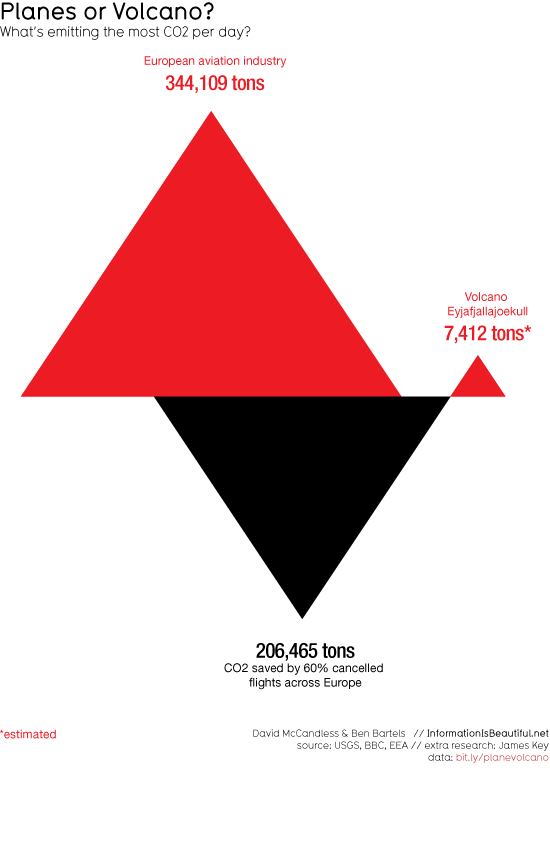
Think all that ash being spewed across Europe is bad for the environment?

Well, it is — kind of. But it just might be better than all the airline flights that would otherwise be spewing their exhaust through the atmosphere.

InformationIsBeautiful does it up in graphic style for you.

So maybe the Bible did have it right

Let’s gather up a bunch of (seemingly) random scientific discoveries to see what we can make of them:

  1. Paleoclimatologists have discovered physical evidence of a shift in climate in Egypt that took place during the reign of Pharoh Ramses II.
  2. One of the biggest volcanic eruptions in human history took place around 3,500 years ago when Thera on Santorini exploded.
  3. The city of Pi-Rameses, which was the capital of Egypt during the reign of Pharaoh Rameses II, seems to have been abandoned around 3,000 years ago.

Three bits of information for which there is valid, verifiable, physical evidence. Compare these against the story of the Biblical plagues of Egypt.

According to Exodus, there were plagues of blood, frogs, lice, flies, livestock death, boils, hail, locusts, darkness and the death of the firstborn. In that order. All in all, it doesn’t sound like much of a good time.

When the climate changed all those millenia ago, there would have been consequences for the Nile:

The rising temperatures could have caused the river Nile to dry up, turning the fast flowing river that was Egypt’s lifeline into a slow moving and muddy watercourse.

Slow-moving, warm water is the ideal environment for Oscillatoria rubescens, also known as Burgundy Blood algae. When this algae dies, it stains the water red and could have easily given rise to the story of the first plague wherein the waters of the Nile turned to blood.

The scientists also claim the arrival of this algae set in motion the events that led to the second, third and forth plagues – frogs, lice and flies.

Frogs development from tadpoles into fully formed adults is governed by hormones that can speed up their development in times of stress.

The arrival of the toxic algae would have triggered such a transformation and forced the frogs to leave the water where they lived.

But as the frogs died, it would have meant that mosquitoes, flies and other insects would have flourished without the predators to keep their numbers under control.

Right, so that accounts for plagues two through four. With a rising insect population and unhealthy water, is it any mystery about dying livestock and boils? Insects are well-known carriers of all manners of disease and a polluted water source would have only compounded the problem. That solves plagues five and six.

So far, all the plagues have been a logical, biological, progressive cahin of events springing from a documented climate change. What about the rest of them? That’s where the volcanic eruption of Thera comes in.

One of the biggest volcanic eruptions in human history occurred when Thera, a volcano that was part of the Mediterranean islands of Santorini, just north of Crete, exploded around 3,500 year ago, spewing billions of tons of volcanic ash into the atmosphere.

Nadine von Blohm, from the Institute for Atmospheric Physics in Germany, has been conducting experiments on how hailstorms form and believes that the volcanic ash could have clashed with thunderstorms above Egypt to produce dramatic hail storms.

The documented eruption of a volcano thus accounts for the plague of hail. Now we might seem to be stymied. The next plague — that of locusts — surely can’t be tied to a volcano. Or can it?

Apparently, it can. The ash in the atmosphere would have contributed to more climatic changes, exactly the sort that create the conditions needed for locusts. Additionally, the ash clouds could have contributed to the plague of darkness.

All that’s left is the plague of the death of the first borns. Which, to me, doesn’t sound like a plague. If it is, it’s a heck of a specific one. Nonetheless, if we assume this “plague” also occured, we can hypothesize that what with the bad water and crazy weather, a blight or fungus or something could have affected the crops.

Culturally speaking, it would have been the male first born that would have first shot at the produce and, thus, been the first to fall afoul of the nasty whatever it was.

If, as some scholars believe, the plagues we centered around Pi-Rameses, we can certainly understand why the city was abandoned. It wasn’t like the place was a barrel of laughs 3,000 years ago.

(All quotes and most details from this article in the Telegraph)
Your puny steel is no match for the power of the Sun

When I was in junior high, a solar oven, made of a small parabolic mirror, was a popular science fair project, and it was also much ballyhooed as a solution for the developing world or for science-y camping. Nowadays, I’ll bet it’s touted as a carbon-free environmental solution.

I even saw a speculative pseudo-science piece on A&E once that said such mirrors could have been the fabled Greek Fire. (Unlikely.)

But I never thought of supersizing it! Imagine the gold medals I would have won if I had had a solar oven that could melt steel.

Power a house with a bottle of water?

There’s plenty of possible energy in water: hydrogen and oxygen are famously combustible, the only problem being that, in water, they’re already combined.

Splitting them unfortunately requires the same amount of energy combustion would later release — minus inefficiencies.

But a new chemical process could help low-power solar panels achieve the same effect with “artificial photosynthesis.”

Here’s a video that goes through some of it:

There’s a bit more at Scientific American and Popular Science.

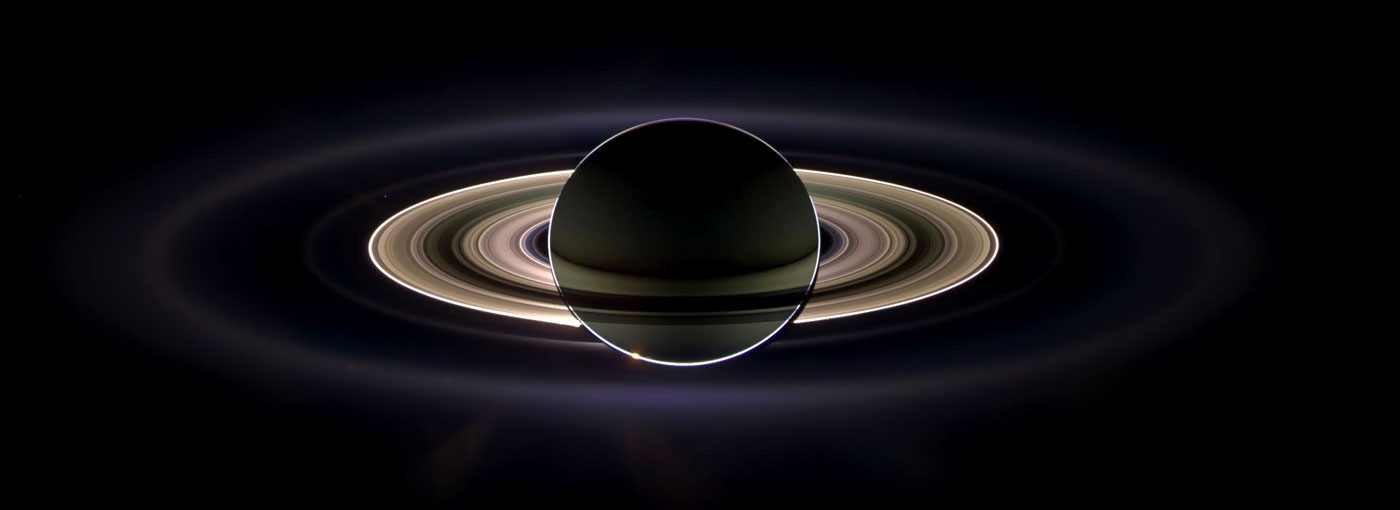
Hooray for Cassini

I remember in 1997 when the Cassini probe to Saturn lifted off. As the first (in a while) nuclear-powered spacecraft, there were all kinds of protests. After the launch, though, you didn’t hear much about Cassini-Huygens, because it kind of takes a long while to get to Saturn.

Then in 2004, images and data from the probe starting coming back. Wikipedia, of course, has a detailed page with many links, that will tell you all you need to know.

But if you really want to fall in love with Cassini, head over to the Boing Boing feature page. In honour of NASA deciding to extend the probe’s lifespan until 2017, they’ve put up a special feature, breaking down the science and what it means — while also managing to display some jaw-dropping images.

It’s the kind of feature that would do any mainstream magazine proud — and I’m happy to see it on a blog. Good work by all involved.

Angry science prof is angry

(via engadget)

So this is what a sonic boom looks like

I’ve seen this on a couple of sites over the past day or so, but I finally got around to watching it — and it’s pretty cool. Sure, just watching a needle-thin rocket (an Atlas V) ascend to space on a jet of flame looks identical to the pulp sci-fi fantasies of my youth.

But when the rocket goes supersonic — and happens to be in the midst of a layer of ice crystals — my jaw dropped. Because of the ice crystals, you can actually see the shock wave of the sonic boom rippling out. It looks like a pebble tossed into a lake, except that this lake is thousands of feet up, in clear air.

And here’s another video of the same event, from a NASA camera:

10 things you didn’t know about orgasm

In this video, taken at a TED talk, author Mary Roach discusses ten things you may not know about the orgasm.

The video is pretty long, running at almost 17 minutes, but it was entertaining, interesting, and often hilarious. I suggest at least sticking around until the 12 minute mark, where Roach talks about how an orgasm in a female pig increases fertility. I promise, hilarity ensues.

One more scientific study in favour of barefoot running

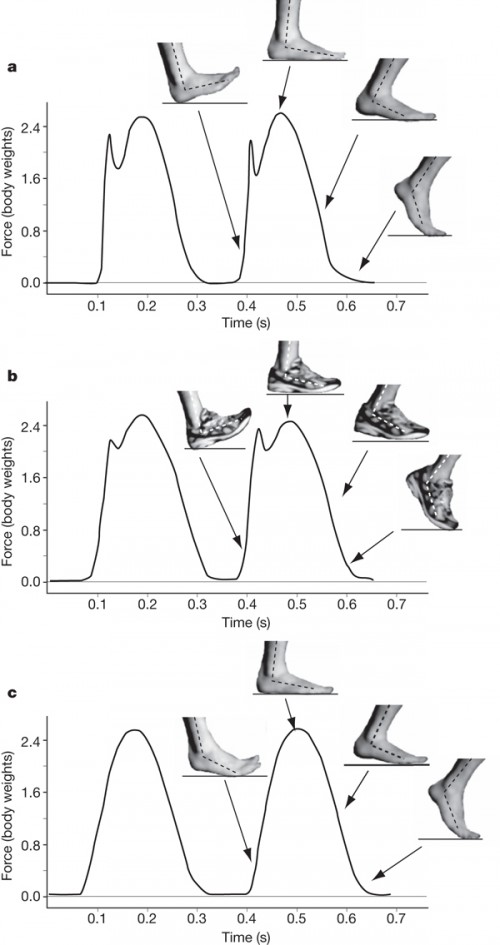
Unless you have a subscription to Nature, you can’t read the article that this picture accompanies, but it’s striking (pun!) nonetheless. A bit of explanation:

If you normally run with shoes, especially ones with big, padded heels (read: most shoes) then you’ll run with what’s called a “rear-foot strike” or a “heel strike” or a “heel-toe strike.” That is, you’ll land on your heel, roll through the mid-foot and push off with your toes.

This probably even feels natural. I know it does to me — when I wear shoes, at least.

The middle graph of impact forces shows how steep and irregular is the pressure of your body weight coming down on your feet when you’re wearing shoes and running like this.

The top graph shows the exact same thing, except the pressures are even steeper and more jagged. Or, in science-speak: “Both RFS gaits generate an impact transient, but shoes slow the transient’s rate of loading and lower its magnitude.” That’s what happens when you run barefoot and use the same technique as when you run with shoes.

But now take a look at the bottom graph. That shows a type of running called a “fore-foot strike” and it’s the type of running gait that most barefoot runners will accustom to naturally (pun!) and it’s the type of running that you’ll see if you go to a primary school playground, and watch kids who haven’t yet overcompensated for their shoes.

That graph shows a smooth, natural weight transfer. I think that’s because instead of landing hard on a bony heel, you’re letting your ankle absorb some of the weight by flexing and then pushing off.

I’ve said this before, but I’m pretty sure now that I’m buying a pair of Vibram Fivefingers.

Original Nature article here, if you happen to have a subscription. The abstracts says:

Kinematic and kinetic analyses show that even on hard surfaces, barefoot runners who fore-foot strike generate smaller collision forces than shod rear-foot strikers. This difference results primarily from a more plantarflexed foot at landing and more ankle compliance during impact, decreasing the effective mass of the body that collides with the ground. Fore-foot- and mid-foot-strike gaits were probably more common when humans ran barefoot or in minimal shoes, and may protect the feet and lower limbs from some of the impact-related injuries now experienced by a high percentage of runners.

(via @nxthompson)

Maybe Greedo did shoot first, after all

When Han Solo was facing off with Greedo in Mos Eisley, negotiation failed, and blasters were fired. Originally, Han Solo just out-and-out shot Greedo, but in the Star Wars re-releases, Greedo shoots first, and misses, before Han Solo shoots. It’s a bone of contention among Star Wars fans that I won’t get into here.

But science now has an opinion on this science fiction. And, if you think about high-noon showdowns in Hollywood westerns for decades, the dilemma’s an old one. From Sciencemag:

Have you ever noticed that the first cowboy to draw his gun in a Hollywood Western is invariably the one to get shot? Nobel prize–winning physicist Niels Bohr did, once arranging mock duels to test the validity of this cinematic curiosity. …. Bohr was seemingly unhappy with the Tinseltown explanation that the good guy, who never shoots first, always wins. Legend has it that he procured two toy pistols and enlisted the aid of fellow physicist George Gamow. In a series of duels, Bohr never drew first but won every time. The physicist suggested that the brain responded to danger faster than it carried out a deliberate intention.

Well, scientists have now confirmed Bohr’s intuition — in computer simulations done at the University of Bristol, the person who is forced to react actually acts 9% faster than the person making the first move.

That’s a significant speed advantage. Unfortunately, it’s partly negated by the fact that reactors were more likely to make an error.

[Experimental psychologist Andrew] Welchman speculates that this rapid, if somewhat inaccurate, response system may have evolved to help humans deal with danger, when immediate reaction is essential and the risk of an error worth taking.

2029 - the year we stop aging

It’s like something out of a science fiction novel (Robert J. Sawyer’s Rollback, for example). A team of researchers is working on a human longevity project with the goal of being able to reverse aging in humans by the year 2029.

If this is true — and I have no reason to believe that it is not — and these scientists succeed, the implications are mind-blowing.

First, the project:

After nine years of research and collaboration, a group of entrepreneurs and scientists [...] are disclosing their plan “to start saving up to 100,000 lives lost to aging every day, by 2029.” A Longevity Summit in November 2009 [...] brought together a number of researchers on human aging and longevity for a discussion on the state-of-the-art research, the implications of their discoveries, and round table, cross-disciplinary discussions that may lead to new and accelerated results.

It seems straightforward. Stop and reverse aging in humans. As sci-fi as it seems, it would be easy to pooh-pooh the idea and chalk it up to wishful thinking. But it seems that some are taking the potential seriously.

It’s serious enough that members of the Obama Administration consider it to be one of the major global destabilizing forces of the next 25 years.

I guess so! What about food shortages? Over-population? Disease? Without meaning to sound callous, people aren’t dying fast enough to keep the planet healthy as it is. When we stop an additional 100,000 people from dying every day, we’re talking about some explosive population growth.

On the other hand, I’d like to think that maybe two good things could come out of an extended human life:

1. If we knew we’d be around to see the outcomes of our actions, perhaps we’d take better care of our planet. Maybe we’d recycle more, be more conservative in our water use, take more care with the kinds of products we use — that sort of thing.

2. Space exploration! Now we that have people that can live a long time, maybe we can start shipping them out into the farthest reaches of space and get a real start on colonizing space.

If the potential for radically extending the human life exists, there needs to be some serious discussion from the earliest days of what to do with all the extra people…

Interactive LED wall

This interactive LED display can be found at La Vitrine (The Window), a arts and culture venue in Montreal. Developed by Moment Factory, and created by Photonic Dreams, the wall was created for a special event, but is now being kept as a permanent display, and will be lit from 7-11 every night.

The most interesting part, for me, was how the wall reacted when you went to the door.

While watching this video, I was immediately reminded of the scene in Minority Report where with a scan of his eyes, Tom Cruise’s character had commercials calling his name. And then when he gets his new eyes, it amusingly calls out an Asian name.

Personalized commercials and an interactive LED wall are obviously not quite the same in terms of execution, but they are similar in the sense that they both aim to have technology interact with us.

(via)

The perils of technology — a cell phone that runs on Coke

Some mashups are great — David Bowie vs. MGMT, for example — and others are not. Now that technology has enabled mashups to move beyond the realm of music and into the wider world, we’re seeing all kinds of weird things. I don’t mind a book table made of books, say.

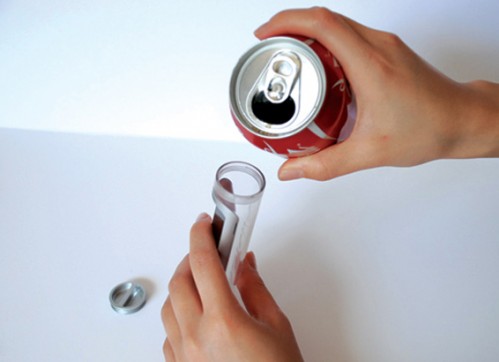
But a cell phone that runs on Coke?

And yet, such a Frankenstein exists, at least conceptually, thanks to the efforts of designer Daizi Zheng, on behalf of Nokia.

From the project’s website:

A bio-battery is an ecologically friendly, energy supply system which uses enzymes as a catalyst to generate electricity from carbohydrates (currently sugar). In order to use the bio-battery as a power source for the phone all that is required is a small supply of a sugary drink. Once the battery dies only oxygen and water remains. Bio-batteries are fully biodegradable and have, on a single charge, a potential life-span three to four times longer than conventional lithium batteries.

Now, a phone that runs on Coca-Cola is hardly ecologically friendly. But a sugar-powered fuel cell that lasts three times as long as a lithium battery does sound like it has potential.

(via Brand X)

Dansette