A blog that makes me realize I’m not so strange

A blogger named Amy (how fitting!) living in Vancouver has started a new project: scanning the pages of her diary from the 5th grade, unedited, for everyone to see.

How embarrassing! Reading my diary entries from when I was 11 are almost painful. Was I really that boy crazy, I wonder? There must have been something wrong with me, I often think.

Except, maybe there wasn’t anything wrong with me. Amy’s diary entries sound just like my own from that age: she talks about boys, talks about her day, complains about any annoyances in her life, and generally treats her diary like it was an actual person, that she would need to explain why she hadn’t written recently.

It’s kind of eerie, actually.

I wonder how many women are out there thinking they were weirdos just like I did, and are coming to the realization that at 11, we were all kind of the same.

Here’s a sample page (click for bigger size):
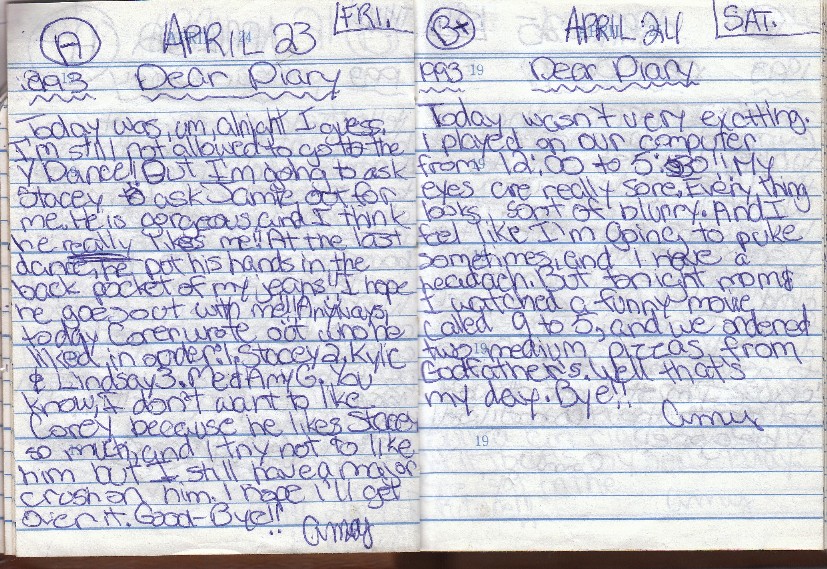
amydiary

(h/t to Jezebel who is urging readers to send in scans of their old diaries)

Time takes hipsters far too seriously

A hipster in his natural habitat. From Look at this Fucking Hipster

A hipster in his natural habitat. From Look at this Fucking Hipster (latfh.com)

There’s a little piece on the Time magazine website offering a brief history of Hipsters. Seriously.

Hipsters are the friends who sneer when you cop to liking Coldplay. They’re the people who wear T-shirts silk-screened with quotes from movies you’ve never heard of and the only ones in America who still think Pabst Blue Ribbon is a good beer. They sport cowboy hats and berets and think Kanye West stole their sunglasses. Everything about them is exactingly constructed to give off the vibe that they just don’t care.

But they do care, they just want you to think they are too cool to care. And the obsession with irony? Like, “I grew this beard ironically” really makes me want to get punchy.

Crazy free-climber pushed the limits, and paid for it

Over on Boing Boing Gadgets, where they were having a “climbing” theme day, I just learned about climber Dan Osman. That’s him, in the video above, basically running up a cliff. Intense.

But, speed-climbing didn’t always provide the rush that Osman was looking for. Instead, he started jumping from the top, using a self-designed system of ropes and pulleys to keep him free-falling right to nearly the very bottom. Intense.

So intense, that it killed him.

There’s a bit of a eulogy as a story in Outside magazine, which I found mesmerizing:

“I had a bad feeling about it,” says Daisher. “He was jumping from a different angle than we usually did, which meant he had to jump over the retrieval line, which he wasn’t even going to be able to see, as dark as it was by then. And he’d added 75 feet to the rope, which was about three times more than he usually added from one jump to the next. So he was jumping on a thousand feet of line, which meant he was going to be only about 150 feet off the ground when he stopped. I was really skeptical. I kept saying, ‘I don’t think so, Dano, I don’t like this.’”

I know it’s dangerous, and I know it’s risky, and I don’t know if I could find the courage to do it, but there’s something I find really attractive about the concept of hurtling yourself into the void.

Use a shredder? Now those documents can be put back together

SHREDDER_CUTTING_HEAD

Using an ordinary office-grade scanner and some simple character recognition, at least one company promises to recreate shredded documents. That’s just one of the things I learned in this Slate article about “unshredding”:

Before advances in scanning and computer technology, documents had to be reconstructed by hand. Assuming all the pieces are in one place, reassembling a shredded document is a bit like solving a jigsaw puzzle; the reconstructionist must painstakingly sift through the shreds, looking for matches. During the 1979 Iranian Revolution, students and militants who took over the U.S. Embassy in Tehran turned to local carpet weavers to reassemble classified CIA documents they found that had been shredded. These pages were later published in a set of about 60 volumes called Documents From the U.S. Espionage Den. And in 2002, former FBI agent William Daly took about an hour to reassemble a shredded page from the dictionary on Good Morning America.

Other takeaways? Some “shredders” go way further than that — they pulverize the paper into dust, says Slate. I should tell my sister. She’s been a ferocious user of paper shredders since she was about a pre-teen. Anything — even junk mail — that has her name or address on it goes into the shredder. Once, we got her a crosscut shredder for Christmas, which cuts the paper into small squares, rather than long strips and is much harder to reassemble. She was delighted.

Newspaper life watch — afternoon edition

A new commuter paper in Toronto looks to stand out from the crowd by focusing on the afternoon commute, not the morning one. It’s a blast from the past for a newspaper. Years ago, many cities had both a morning paper and an afternoon one — eventually, most PM editions folded, leaving the early-morning thump of a newspaper on a porch the only one.

But why? In a lot of ways, an afternoon newspaper makes sense: you can get at least some of that days’ news in; you can print it during the day rather than paying pressmen an overnight rate; and there’s a little bit more flexibility with delivery — get it to the house after people leave for work, and it sits there for eight hours, yellowing in the sun. Get it there half an hour after they get home, and they can still pick it out of the mailbox after supper.

There’s also the competitiveness aspect of it. We live in a world where news is almost instantaneous on the Internet. When people read their news online, and then go home and read yesterday’s news in the paper, the paper looks even more stodgy than before. And when the paper does scoop something, it’s pretty easy for the morning news radio and TV shows to read it out on the air — hours before anyone else sees it in the paper. An afternoon paper would make that a lot tougher.

So why might it not work? One of the people heading up a morning commuter paper, Metro, says that the company has considered it, but it doesn’t work in practice:

the global daily giant has examined the possibility of an afternoon edition but has dismissed it due to several roadblocks, including how to transport the newspapers through heavy traffic. Metro has launched afternoon editions in Stockholm and Copenhagen, only to see them fold.

“It lasted just for a few months because we simply were unable to get advertisers to move to an afternoon format,” Mr. McDonald said. “That was an absolute killer.”

Advertisers and heavy traffic, eh? Seems manageable.

Celebrity culture taken to another, creepier level

Hey celeb-stalkers! Are you desperate to have a baby that looks like your favourite celebrity, but don’t want to go to jail trying to get their sperm?

Then California Cryobank has the solution for you!

Researched and selected from the limitless expanses of the internet, CCB Donor Look-a-Likes can be actors, athletes, musicians, or anyone else famous enough to be found on the web. Worried you don’t know enough pop-culture or watch enough TV to recognize the names? Not to worry… CCB Donor Look-a-Likes link directly to photos of the 2-3 celebrities our staff has deemed each donor most closely resembles.

You don’t have to worry about your favourite celebrity issuing a pesky restraining order, or their annoying wives and girlfriends getting in the way, with California Cryobank’s Donor Look-a-Likes!

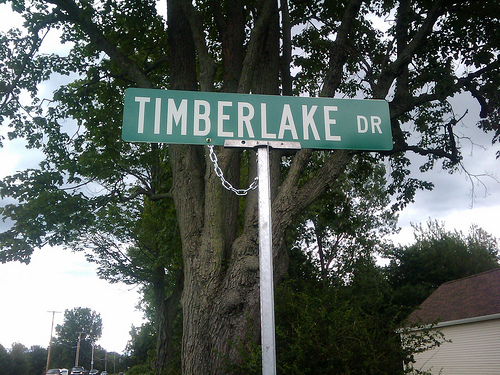
City in Vermont has to lock down its ‘Timberlake Dr’ sign

timberlake

I found this picture in the Flikr photostream of Raines, who says:

What happens when an innocuously-named-for-local-natural-features street in a college town area happens to match the name of a teenage heartthrob superstar musician? Clearly, it gets stolen a lot for adorning bedrooms/dorm rooms. The solution? Advanced protection.

Now, “advanced protection” or not, it can’t seriously be too much harder to unscrew the bolt holding the chain that it would be to unscrew the bolts holding the sign on — but I have to admit, the chain on the sign makes it look more secured. Kind of bad-ass, really.

I’ve often wanted a street sign with my name on it — “Grant Avenue” or “Grant Street” is a pretty common one, too — I’ve just never gone and done it. In his garden, my dad has a street sign, with the original pole, from the intersection where he grew up. I think he took it when the city was replacing old-style signs with newer ones. I’m not convinced that he actually asked, but he seems sure that they were just going to junk it.

I wonder if there’s a place you could buy them, and get them to say whatever you want on them? The ones my dad has feature embossed letters that are stamped out of the metal, but most newer ones just seem to have reflective white stickers on the reflective green surface. (Answer: yup!)

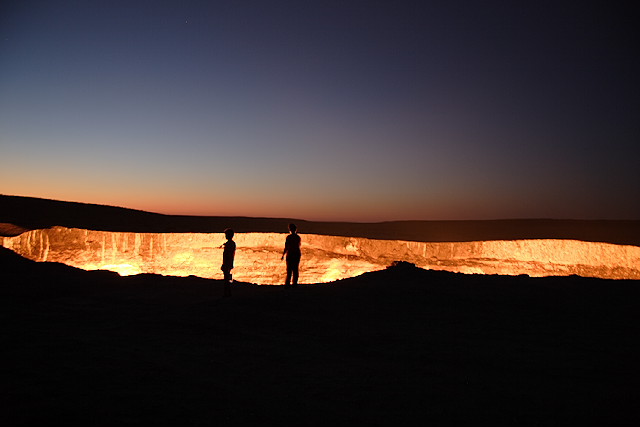
‘Door to Hell’ is a massive pit of flame in Turkmenistan

3

According to Wikipedia, in 1971, geologists drilling in Turkmenistan came across a massive cavern that was filled with natural gas. For whatever reason, perhaps to flame off hydrogen sulfide, or perhaps accidentally, the gas was set on fire.

It’s still burning today. The locals call it the “Door to Hell.”

Check out this video from a nearby hilltop:

He’s also got a close-up video. At the very start, you can see a tiny human figure on the left-hand side. That will give you an idea of the scale of this enormous pit. It’s between 50 and 100 metres wide:

Amazingly, you can see it on the satellite imagery from Google Maps, even though their resolution in that area of Turkmenistan is awful.

If, instead, you believe that Hell is cold and not hot, try this alternative “Door to Hell”.

(via English Russia)

Vintage Carl Sagan teaches science

I started watching this Carl Sagan video when it was featured on Boing Boing, and before I knew it, I had watched about half a dozen more.

I’ve always been fascinated by multiple dimensions, above, and also by religion, UFOs, and the Rosetta stone. There are many more.

Warning: these are immense time-sucks. Also, I think I want to get a turtleneck and a blazer now.

Could you work for Fox News?

Fox News seems to be in need of a fact checker. I want to know if this is simply a failing of the individual in charge of these sorts of things, or if the education system in the good ol’ US is in worse shape than I thought…

Can you spot the error?

Can you spot the error?

The most extreme flexibility I have ever seen

I am not a flexible person. Actually, I can feel the stretch when I bend over to touch my knees. I think that when God was handing out flexibility, this girl went around and got mine as well as hers.

This is unbelievable — some parts of it look almost insectoid, she’s so inhumanly twisty.

Also, is that Santa Claus judging her? At the very end?

This year, I want to see at least two movies with “9″ in the title

District 9 looks way awesome, except I made the mistake of Googling to find out more and I learned some spoilers. Don’t! Don’t do that! Go into it blind. It is an obvious allegory for apartheid, but that doesn’t change how great it is. Also — wicked sci-fi special effects.

Also, a movie called simply “9″ — a post-apocalyptic movie that is semi-indescribable. Just check out the trailer:

Food dye may help heal spinal cord injuries

ratafter_553255

According to a report in Wired magazine, new research (that was a happy accident has) shown that a common blue food dye, when injected into rats that have suffered spinal cord injuries, can dramatically help the injured nerves heal.

The only downside is that the rats turn blue, Wired says. In humans, that might actually be kind of cool.

However — and this is a stupid side-effect of our market-based capitalist society — the researchers don’t know when they’ll be able to move on to the next stage of clinical trials:

Unfortunately, because blue food dye is so cheap, they’re not likely to find a drug company to sponsor the trials. “There’s no commercial interest because you can buy it by the pound,” Nedergaard said.

(Image from Takahiro Takano, University of Rochester Medical Center, via Wired)

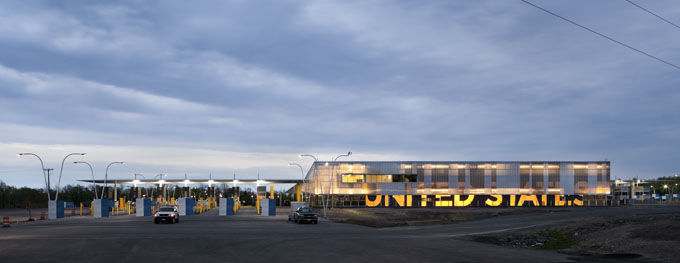
Excellence in government architechture torn down by government less than a month after it opens

bordercrossing

This is depressing. Border crossings these days are already stressful enough, so I was really jazzed when I read about the one at the Canada/U.S. crossing between Cornwall, Ont. and Massena, N.Y. It’s named the Three Nations Crossing in honour of the Mohawks who also live there. You may have heard about their recent occupation of the Canadian side of the crossing, closing it temporarily.

Anyway, the new American port of entry was heralded as a new era in government design — functional but also architecturally worthwhile. One of the key design elements was the giant yellow sign, half-hidden, that spells out United States.

Now, less than a month after completion, the sign is being dismantled. Apparently, the government now feels that the big yellow sign is perhaps too bright, and could make border officers a target. This according to a story in the New York Times that’s worth reading just for this line:

The move is a depressing, if not wholly unpredictable, example of how the lingering trauma of 9/11 can make it difficult for government bureaucracies to make rational decisions.

Hear hear. Remember right after 9/11, when you were told “if you don’t do this or that, then the terrorists have won”? This is exactly the type of stuff that hands a victory to the forces of terror (overwrought intensity intentional).

I know that hardened borders and security paranoia have happened in the past, and I’m confident that in the future, openness and a welcoming attitude will return to the world. But I worry that it will be a generational thing.

Things that will make kids think you’re old

A few days ago, I mused about creating a post listing things that I would never have to teach my kids. I don’t have kids, of course, but someday I probably will. And I’ll teach them life lessons. But I doubt that they’ll ever have to learn to drive standard, say. So they’ll never learn to pop the clutch. That’s already a skill that’s fading away, honestly.

But think about things that are just about on the cusp of changing. I suspect that, unless we visit grandma and grandpa’s house, and an old light bulb burns out, I will never have to teach my kids that light bulbs are hot. I will bet that light bulbs will be exclusively compact fluorescent or LED-based by the time I’m teaching kids how to change them.

So I was thinking about some other things that I might not have to ever teach my (future, hypothetical) kids.

But then I saw that a blog on Wired has already done it. Geek Dad’s list (of 100! I never could have come up with that many!) is heavy on the tech and computer side of things, but it also has a few poignant, nostalgic items.

Rotary dial televisions with no remote control. You know, the ones where the kids were the remote control.

Blowing the dust out of a NES cartridge in the hopes that it’ll load this time.

Finding books in a card catalog at the library.

Remembering someone’s phone number.

Yeah — things are changing! I wonder what things I’ll never know that, to my dad or granfather, say, would have just been taken for granted. I know, for example, that when my dad was a teen, he worked as a pin-setter in a bowling alley, before they invented a machine to set them back up automatically. But there’s probably dozens of similar things like that.

Anyone got any examples?

Older posts «