
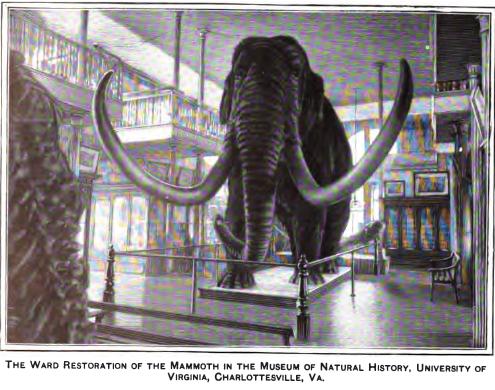
I’ve always loved “Land That Time Forgot” or “Lost World” style fantasies, in which the (often Victorian) protagonists are stranded in an inaccessible place, surrounded by dinosaurs and other prehistoric beasties who have somehow survived to the present-day.
So I was intrigued to read about an 1899 magazine article, published in McClure’s Magazine, in which the author purported to have, during a trip to Alaska, stalked, trapped and killed a living woolly mammoth.
There’s a lengthy post going through the plot of the article at ScienceBlogs.com:
The trip was arduous but Paul and Tukeman soon found signs they were on the right track. They found a cave “paved” with the numerous remains of mammoths. Surely there would living ones nearby, and the bones provided Tukeman the chance to test the strength of the firearms he had brought for the hunt. His bullets punched right through vertebrae and skull bones: bringing down the mammoth might be easier than he thought.
Unfortunately, the article turned out to be fiction — and was marked as such, though it didn’t prevent many people from believing that it was true.
Which raises the question, just when did the last mammoth die?
It turns out that’s a difficult question to answer. The most-recent mammoth fossils we know of are dated to about 10-13,000 years ago (except for some dwarf mammoths who survived in isolated island populations — Lost World-style — until about 1700 BC). Fossils, however, aren’t very accurate in this way, because very few dead specimens ever become fossils, and who knows how many we find or don’t find — or even exist to find. For all we know, the last 1,000 years of mammoth life didn’t even produce a single fossil, let alone any that we’ve found.
But an international team of scientists — including Canadian scientists working out of the University of Alberta — have a better idea. From a related post on Science Blogs:
Mammoths were not just shuffling collections of teeth and bones. They were living creatures that bled, defecated, urinated, shed hair, and eventually decomposed, spreading their genetic material all over the land they occupied. This means that there is a second sort of record for the mammoths that, under the right conditions, might be able to provide us with a better idea of where they lived and when they disappeared, and an attempt to mine this rich source of fossil data has just been published in the journal PNAS.
In short, they were looking up north, in the permafrost, for actual preserved mammoth DNA.
And they found some (not surprising, considering that every now and then, actual frozen mammoths turn up to be defrosted).
According to DNA traces in ancient layers of permafrost, mammoths were stomping about Alaska as recently as 7,000 years ago. Which, by the way, would be almost a death blow to the theory that a comet did them all in 13,000 years ago.
It’s super-awesome that people are looking for mammoth traces as cellular evidence in ice that’s tens of thousands of years old. And it’s a reminder that, just like rain forest destruction could eliminate countless species that we’ll never know about (with all the potential medical and other applications), climate warming and the melting of the permafrost could destroy scientific evidence of stuff we don’t even know we need to know.
 Bookmark on Delicious
- Digg this post
- Recommend on Facebook
- Share on Posterous
- share via Reddit
- Share with Stumblers
- Tweet about it