The ingenuity of drunks knows no bounds
What happens if you ban alcohol on the beach?
Why, enterprising youth will buy floating toys and just drink their booze in six inches of water — technically “off shore.”
They call it “Floatopia.”
What happens if you ban alcohol on the beach?
Why, enterprising youth will buy floating toys and just drink their booze in six inches of water — technically “off shore.”
They call it “Floatopia.”
I remember when Brandon, where I live, experimented with a program called “White Bikes.” The idea — ambitious, and (for Brandon) jaw-droppingly progressive — was that reclaimed bikes would be tuned up by volunteers, painted white, and left around the city at designated stations.
If you needed a bike, you could just hop on, ride away, and return it later, when you were done.
Tragically, the optimists who came up with the system were no match for the citizens of Brandon who tended to:
a) shun the bikes as for poor people only
b) take them and never return them
c) take them for joy-riding, which inevitably destroyed them.
The program didn’t last long.
I’ve read of other systems, in other cities, that have suffered similar fates, and they’ve come up with a few solutions — mostly, make people pay.
And, it seems to work in Dublin. From globalPost:
A free bicycle scheme in this rainy metropolis of narrow roads, potholes and, it has to be said, bicycle thieves, has been a spectacular triumph. Indeed Dublin City Council boasts that the program is “the most successful in the world by any measure.”
Despite predictions that the 450 specially-made bikes, available from 40 stations around the city, would quickly be stolen or tossed in the River Liffey by vandals, only two have been pilfered in the first six months of operation. These were quickly recovered, and none have been vandalized, according to council spokesman Paul Finan.
It helps that the bicycle is ugly and that one needs a credit card to use it. The machine is free for the first half an hour, but costs half a euro ($0.67) for the first full hour, and 6.50 euros for four hours. This ensures that riders don’t leave them lying around, otherwise the final charge on their credit card would be substantial.
I don’t consider that ideal — a substantial portion of the population doesn’t have a credit card, and I kind of hate the fact that we’re rapidly requiring one for everyday life.
But I can’t argue with the fact that it’s working. Good for Dublin.
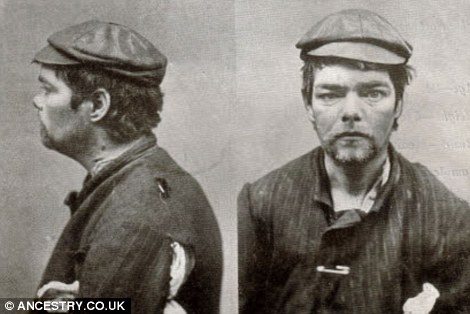
The Daily Mail has a rogues gallery from 1902 up — they are mug shots and descriptions of “habitual drunks” who were photographed by the police and then placed on a special “Black List” which was distributed to local pubs and taverns in Birmingham, England.
Luckily, some of those pubs were owned by Holt Brewery, which kept a copy of the list, including all the photographs. Ancestry.co.uk has scanned them.
The guy above, says the Daily Mail is “Richard ‘Dirty Dick’ Flemming (left) – also listed with the alias ‘Dick the Devil’. He was sentenced on February 20, 1903 for being drunk and disorderly, receiving 21 days of hard labour. He is described as 5ft 2in with a slim build and pug nose.”
There’s a ton of interesting characters there, and if you’re interested, there are similar galleries of Welsh criminals as well as Australian ones.
(via BB)
Perhaps because I am too young and too North American, I had never seen this 1937 photo before.
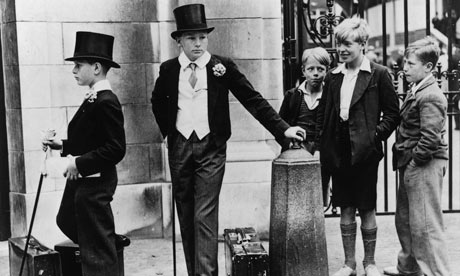
It’s famed, however, as “Toffs and Toughs” and it came to epitomize the class divide in England. The two very-well-dressed boys are in formalwear, attending a cricket match that was a social outing from their school. The three others were hanging around, hoping to make a shilling or two from unloading rich peoples’ cars.
I learned all this — and more — from reading a very interesting feature in Intelligent Life magazine. The writer tracks down (as much as he is able) the five boys, and teases out hints of what their class divide might have meant for them.
Almost more interesting, though, is how the photograph itself has come to define them, more so even than the class divide it was supposed to represent:
All three men had reached old age and a plateau of contentment. But Catlin hadn’t maintained contact with Salmon and Young. His wife said that when a newspaper (perhaps the Daily Mail) had asked the three men to get together to reconstruct the picture at Lord’s, or at least their part in it, Jack had refused. I could see why. To be stereotyped as a poor London boy – a tough even – may have irritated a man who had made good and probably felt no nostalgia for the pre-war streets of his childhood.
It’s a good read, and the author makes an interesting point near the end about how, if the picture were recreated today, both the “rich” and the “poor” would probably be wearing similar name-brand jeans. But they’d still have wildly differing access to education, to society, and to opportunities.
Plus ca change…
There’s plenty of possible energy in water: hydrogen and oxygen are famously combustible, the only problem being that, in water, they’re already combined.
Splitting them unfortunately requires the same amount of energy combustion would later release — minus inefficiencies.
But a new chemical process could help low-power solar panels achieve the same effect with “artificial photosynthesis.”
Here’s a video that goes through some of it:
There’s a bit more at Scientific American and Popular Science.
It sounds like something straight out of a Hitchhiker’s Guide — looking at a full list of Heinz’ legendary 57 flavours, it turns out that ketchup is number 42.
A vintage ad posted by Lileks reveals the full list:
I wonder how many of those are still available?
I think you could make a persuasive argument that it was DJs and the invention of the “scratching” technique that really kept vinyl records from disappearing. Even today, you can buy high quality turntables that are designed for spinning, mixing and scratching.
But it’s hard to find a good cassette deck.
Maybe the invention of a “cassette scratching” technique will revive the magnetic tape? Check it:
(via Coudal)
Reporter Charles McGrath, writing in the New York Times, and looking at the Canadian program to “Own The Podium” at Vancouver 2010 (which he calls somewhat unCanadian in its naked ambition for success) makes an interesting observation about the Canuck reputation for niceness and its contrast with the sport of hockey (the Times insists, in charmingly American fashion, on calling it “ice hockey”):
Ice hockey … has always been the great exception to the national culture of modesty, civility and pacifism. The game, especially the way the Canadians play it, is rugged and antagonistic, and may be the escape valve that makes Canadian niceness possible.
Now, I’m not sure I agree. Frankly, I like to think of myself (don’t we all) as typically nice and easy-going. Perhaps that’s more because I’m a Libra than a Canadian? But I just couldn’t care less about hockey — and partly, that’s because I find the violent culture that surrounds it takes away from the game.
But it’s an intriguing thought: hockey as the great national escape valve.
What do you think?
If you go more than 10 minutes in any direction from my house, you’ll be surrounded by endless fields of grain. It’s not as all-wheat as it once was, not by a longshot, but you could still say that I live in the “breadbasket of the Empire” — so long as by “bread” you mean “canola oil.”
I never really connected the legendary Canadian thirst for beer with my grain surroundings until I saw this map, over at StrangeMaps.
In red is the areas of Europe that are traditional wine drinkers. In brown, the traditional beer drinkers. And in blue are the vodka countries. Of course, there is much individual variation, but you can note that it by and large matches up with both the places were grapes grow and the spread of the Roman Empire.
As Strange Maps notes:
Either through effects of climate change or renewed viticultural enthusiasm, grapes and wine-making have in recent years been introduced in areas to the north of the traditional Wine Belt, in southern Britain and the Low Countries, creating an overlap between Wine and Beer Belts. That overlap is often ancient rather than recent; the introduction not rarely is a reintroduction. And indeed, southwestern Germany, for example, has an ancient and unbroken tradition of wine-making.
Mmm, now I’m thirsty.
I’ve always been a little bit curious of those CDs that offer “relaxing” noises like waves crashing or a crackling fire to lull people to sleep. Do those really work for people? I’ve never had trouble sleeping because it was too quiet, myself.
Anyway, if you’re the type who finds that useful, you might like the website SoundSleeping.com, where you can pick and choose from a dozen or so sound effects, add a drum or a flute beat, and mix and match your very own relaxing harmonies.
Remember to play with the volume levels.
Amy got me a great book for Christmas — The Math Book (she was inspired by the BoingBoing gushing, here). It goes through the history of math and spends a page on each of 250 different concepts. I’ve been reintroduced to prime numbers and early numerical paradoxes, but I’ve also learned a whole heck of a lot.
Some of it is beyond me, frankly, but author Clifford Pickover does a fantastic job of making each concept accessible to anyone who’s willing to think a little bit. Or, just to dream and let their imagination run a little wild.
There’s been tons already that I think I’d like to blog about, but the one that I read last night and sticks in my head is about turning a sphere inside-out.
Sure, you could poke a hole in a tennis ball, say, and then pull the inside part out through the hole, but that’s against the rules. Mathematically, for a sphere to turn inside out, there can’t be any holes and there can’t be any creases or pinching. Luckily, a sphere can pass through itself. (I tried visualizing a soap bubble, if two bubble films could come together and then come apart on the other side, like water waves, say.
So, can you inside-out a sphere? Turns out you can — but it’s not easy. If you’ve got a few minutes, these videos show you how its done and take you through it.
According to a recent article in Discover magazine, scientists have located ancient skulls that appear human, but not. Like Neanderthals or Homo Erectus, these skulls appear to belong to a branch of the human family — except they are too big, and have child-like faces. The stunning conclusion? These ancient “Boskops” may have been up to 50% smarter than you and me today:
We have seen reports of Boskop brain size ranging from 1,650 to 1,900 cc. Let’s assume that an average Boskop brain was around 1,750 cc. What does this mean in terms of function? How would a person with such a brain differ from us? Our brains are roughly 25 percent larger than those of the late Homo erectus. We might say that the functional difference between us and them is about the same as between ourselves and Boskops.
The authors speculate that Boskops may have had better, more vibrant memories, the ability to “multi-task” inside their own heads, and a rich ability to plan out actions and consequences.
They also speculate that, in 10,000 B.C., such immense brain power just wasn’t all that useful in terms of everyday survival. Plus, huge heads and big brains come with big costs — childbirth is much more difficult, plus you need more food and energy to support the brain.
It’s wonderful to think about — humbling, even, since we modern humans think we’re the ne plus ultra of evolution. But not everyone agrees. Paleoanthropologist John Hawks says that the big skulls are actually within the realm of the possible, even for modern humans, and people just picked out the biggest ones, then called them a separate race:
If you do a simple Google Scholar search for “Boskop”, you will discover that this has not been a going topic in human evolution for nearly fifty years. Most intellectual effort on the topic of “Boskopoids” happened between 1915 and 1930. I want to emphasize how easy it is to discover these things by a simple Google search. This is obscure knowledge, but for a good reason — it’s obsolete and has been for fifty years!
Sadly, Hawks does a pretty convincing job of debunking the big-brained prehuman theory. But I’m not enough of an anthropologist to judge for sure.
Search engine giant Google loves net neutrality. If you don’t know, that’s the concept that when you sign up for internet service, you’ll get access to any website or web service you want, equally. This is like the telephone — if you call, it rings.
Some companies don’t like net neutrality. If you sign up for their internet service, they want to be able to deliver their own streaming video faster than their competitors — or, give you faster video service, while slowing down your email, say.
People fear, though, that it could lead to a situation where AbsurdIntellectual.com (say) could pay to have its website delivered extra fast — at the expense of competitor IntellectuallyAbsurd.com, whose poor users would be left watching the “loading” bar.
Google, as a company that benefits from people being able to access it from anywhere, at any time, with reasonably quick speed, obviously would like net neutrality to be enforced. And, the FCC is looking at the concept.
But is Google really in favour of a full and neutral internet? It’s a search engine, right? So it ranks and lists websites in a specific, ordered fashion, right? It’s that obviously a business model that’s specifically tied to promoting some websites at the expense of others?
That’s the argument persuasively made in this opinion column:
With the introduction in 2007 of what it calls “universal search,” Google began promoting its own services at or near the top of its search results, bypassing the algorithms it uses to rank the services of others. Google now favors its own price-comparison results for product queries, its own map results for geographic queries, its own news results for topical queries, and its own YouTube results for video queries. And Google’s stated plans for universal search make it clear that this is only the beginning.
The author, who claims to have suffered at the hands 0f unpreferential treatment by Google, suggests that net neutrality be expanded to include “search neutrality.”
I’m sympathetic, but his argument lacks a compelling definition of such neutrality. Like it or not, when I’m searching for something specific, that’s what I want. Google’s whole raison-d’etre is to provide me with the one thing that I want at that time.
And I worry that an ever-reaching desire for fairness in everything will require things like “news neutrality.” And who’ll enforce that?
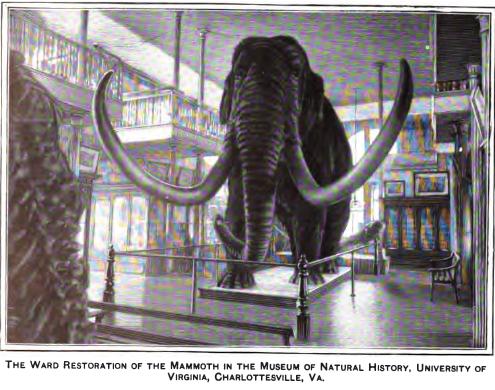
I’ve always loved “Land That Time Forgot” or “Lost World” style fantasies, in which the (often Victorian) protagonists are stranded in an inaccessible place, surrounded by dinosaurs and other prehistoric beasties who have somehow survived to the present-day.
So I was intrigued to read about an 1899 magazine article, published in McClure’s Magazine, in which the author purported to have, during a trip to Alaska, stalked, trapped and killed a living woolly mammoth.
There’s a lengthy post going through the plot of the article at ScienceBlogs.com:
The trip was arduous but Paul and Tukeman soon found signs they were on the right track. They found a cave “paved” with the numerous remains of mammoths. Surely there would living ones nearby, and the bones provided Tukeman the chance to test the strength of the firearms he had brought for the hunt. His bullets punched right through vertebrae and skull bones: bringing down the mammoth might be easier than he thought.
Unfortunately, the article turned out to be fiction — and was marked as such, though it didn’t prevent many people from believing that it was true.
Which raises the question, just when did the last mammoth die?
It turns out that’s a difficult question to answer. The most-recent mammoth fossils we know of are dated to about 10-13,000 years ago (except for some dwarf mammoths who survived in isolated island populations — Lost World-style — until about 1700 BC). Fossils, however, aren’t very accurate in this way, because very few dead specimens ever become fossils, and who knows how many we find or don’t find — or even exist to find. For all we know, the last 1,000 years of mammoth life didn’t even produce a single fossil, let alone any that we’ve found.
But an international team of scientists — including Canadian scientists working out of the University of Alberta — have a better idea. From a related post on Science Blogs:
Mammoths were not just shuffling collections of teeth and bones. They were living creatures that bled, defecated, urinated, shed hair, and eventually decomposed, spreading their genetic material all over the land they occupied. This means that there is a second sort of record for the mammoths that, under the right conditions, might be able to provide us with a better idea of where they lived and when they disappeared, and an attempt to mine this rich source of fossil data has just been published in the journal PNAS.
In short, they were looking up north, in the permafrost, for actual preserved mammoth DNA.
And they found some (not surprising, considering that every now and then, actual frozen mammoths turn up to be defrosted).
According to DNA traces in ancient layers of permafrost, mammoths were stomping about Alaska as recently as 7,000 years ago. Which, by the way, would be almost a death blow to the theory that a comet did them all in 13,000 years ago.
It’s super-awesome that people are looking for mammoth traces as cellular evidence in ice that’s tens of thousands of years old. And it’s a reminder that, just like rain forest destruction could eliminate countless species that we’ll never know about (with all the potential medical and other applications), climate warming and the melting of the permafrost could destroy scientific evidence of stuff we don’t even know we need to know.

Remember that old saw about people being vegetarians not because they love animals — but because they hate vegetables?
Well, now that could actually be true.
I just read a really interesting article about plants, which goes into incredible detail about how they struggle for life just as vigorously as animals do, and how it might not be any more ethical to eat plants than it is to eat meat:
Plants no more aspire to being stir-fried in a wok than a hog aspires to being peppercorn-studded in my Christmas clay pot. This is not meant as a trite argument or a chuckled aside. Plants are lively and seek to keep it that way. The more that scientists learn about the complexity of plants — their keen sensitivity to the environment, the speed with which they react to changes in the environment, and the extraordinary number of tricks that plants will rally to fight off attackers and solicit help from afar — the more impressed researchers become, and the less easily we can dismiss plants as so much fiberfill backdrop, passive sunlight collectors on which deer, antelope and vegans can conveniently graze. It’s time for a green revolution, a reseeding of our stubborn animal minds.
…
Just because we humans can’t hear them doesn’t mean plants don’t howl. Some of the compounds that plants generate in response to insect mastication — their feedback, you might say — are volatile chemicals that serve as cries for help. Such airborne alarm calls have been shown to attract both large predatory insects like dragon flies, which delight in caterpillar meat, and tiny parasitic insects, which can infect a caterpillar and destroy it from within.
There’s much more, and it really makes you think.
I remember reading, as a child, that scientists using ultrasonic microphones, could actually detect a very-high-pitched sound — like a scream — when you cut open an onion. That made a similar impression on me. Plants are living things, and we have to eat something to survive.
Mind you, I don’t have any issue with people who decide to be vegetarians, or even vegan. My mom, who was a Home Ec. teacher, exposed me to a very wide dietary variety growing up, and I’ll happily eat a meat-free diet for days on end. There are great environmental and health reasons to limit your meat intake anyway. But I like meat. And there are great health reasons to eat some animal products — especially fish and dairy.