Lord of the Rinks — the Middle Earth Hockey Association

Steve Thomas has designed a dozen team logos for his (ahem) fantasy hockey association, based on the J.R.R. Tolkien classic, Lord of the Rings.

He’s selling them on stickers and T-shirts, but Zazzle’s throwing me an error right now.

Now, I’m no hockey fan, but I can get behind this!

Best comment from his site goes to ptomblin-lj: “When the Balrog players are skating in on a 3 on 2, do the Wizards players yell ‘YOU SHALL NOT PASS’?”

(via Laughing Squid)

A history of the logo

I am indebted to Dan Redding for putting together a great partial history of the evolution of logo design and branding. I am of the exact right age to have been dramatically influenced by Naomi Klein’s book, No Logo, yet I am also fascinated by graphic design, so it’s a love/hate thing when it comes to logos, for me. Perhaps that’s the reason this blog continues to await one?

Anyway, I learned a lot from Redding’s piece:

The Wiener Werkstätte was a manufacturing and marketing enterprise founded in Vienna in 1903 — decades before graphic designers were doing work that was officially recognized as corporate identity. This group of craftsmen and designers were true trailblazers.

A trademark was proposed for the Werkstätte, but designer Josef Hoffman proposed a complete graphic identity. The appearance of the group’s letters and articles was unified by four elements: the Werkstätte’s red rose symbol plus the monogram marks of the Werkstätte, the designer, and the producer. These standard elements, along with the use of the square as a decorative motif, were used to design everything from invoices to wrapping paper.

Now that’s dedication to designing an immersive brand environment: the Werkstätte logo forged into the handle of a cupboard key.

He also writes about the MTV logo, which I knew had been groundbreaking, but now I understand precisely why.

In the comments to Redding’s article, I found a link to Fred Seibert’s piece about the design of the Nickolodeon logo, which was also well worth the read. Clearly influenced by the MTV logo revolution, it managed to be great in its own way. Seibert also digs up a Scribd copy of the Nickolodeon design usage manual from 1998, which is awesome to page through.

This is why we need teachers

The message of this video is clear enough — but I was awestruck by the graphics work. It makes me want to learn After Effects. That’s why we need teachers … to teach me After Effects.

The graphics work is apparently inspired by this video.

From top to bottom, the world

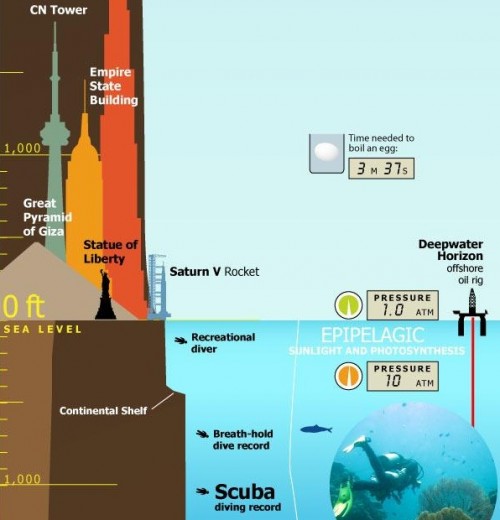
I just scrolled through a massive infographic that shows you a lot about the world — from the top of the atmosphere to the bottom of the deepest ocean trench.

It’s all to scale, so along the way, you can see great comparisons between the tallest buildings in the world, the deepest depths of submarines, and the jaw-dropping truth behind just how deep that BP oil well was drilling.

Here’s a snippet from the centre, click on it for the full image:

The full image is not just a great infographic, but also I think a clever way to make use of the way that browser windows scroll. It’s vertical. Very vertical. It is approximately six inches wide … and 12 feet tall.

(via Our Amazing Planet)

When ampersands go wrong (& comments!)

This is the newest addition to my daily blog-check: ShitAmpersand.com

Yes, it’s a posting of the worst examples of typography — as exemplified by the & symbol.

I’m no type designer, but I know enough about type design to know that, when you’re constrained by the limits of x-height and regular descenders, you can bust loose with the ampersand. It’s where all your creativity can really be expressed (that and swashes, but no one really cares about swashes).

Anyway, I have a feeling that typographers express themselves in ampersand designs kind of like drunks — there are happy drunks and there are angry drunks. And there are awesome ampersands and, well, shit ampersands. Like this one:

Gigi: I had Calamari for a starter last night it was very nice. In future that dish will be forever ruined after witnessing this ampersand.

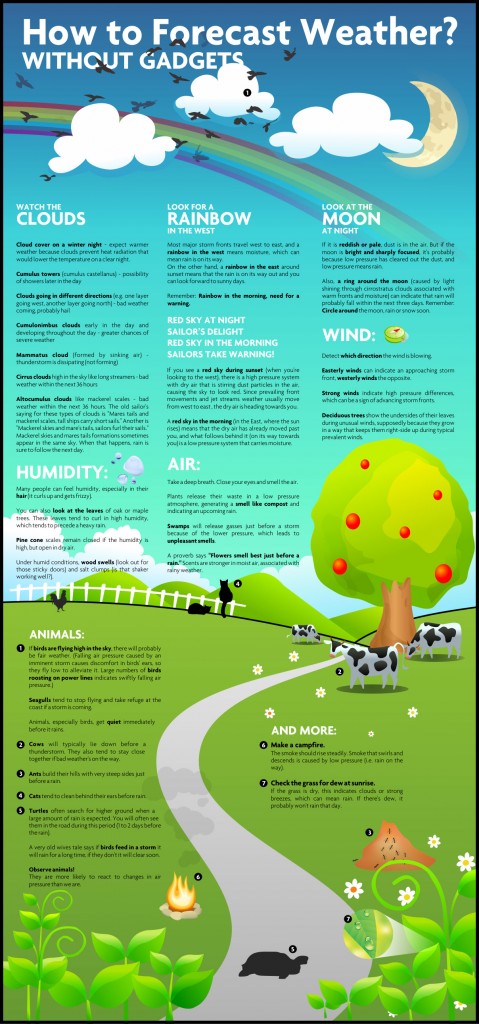
Screw the meteorologist, forecast weather yourself

Don’t trust the weather forecast? No one really does. It’s easy to complain when the forecast is wrong, but that’s what meteorologists get for pretending they can tell the future up to 14 days in advance.

Anyway, if you’ve decided to shun the professionals because they can’t get the job done, here’s a clever little hint sheet to help you predict what weather’s coming your way next:

(Click on it to see the image full sized.)

Frankly, I would have a lot more respect for weather forecasters if they dropped the precise numbers and got fuzzier in their forecasts. I would have an easier time believing a forecast of “probably the low 20s, with a much colder night” instead of “high of 22, low of 6.”

(via Marisys)

Keeping tabs on your time travellers

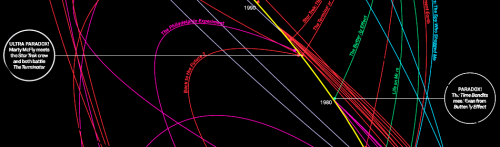
The good folks at Information is Beautiful have a nice infographic on time travel in popular fiction. In it, they’ve plotted the back-and-forth time jumps of people like Marty McFly, the crew of the starship Enterprise, and Bill and Ted (on their excellent adventure).

Here’s a snippet:

See the whole timeline here. The infographic is included in their book. There’s a post about the infographic, too, which reveals that it took three designers 34 drafts to get it all right.

So that’s why I liked it even better when they did a subsequent post, looking back at the process of creating the infographic.

I love behind-the-scenes stuff like this — I love to have the curtain pulled back so I can see the process behind the creativity. There’s tons of creativity in there, but seeing how professionals zero in on the good ideas and weed out the bad is instructive.

As they point out, the hardest part is the “temporal bias” — that fictional time travel tends to either start or finish somewhere near the 20th century.

A history of the fallout shelter sign

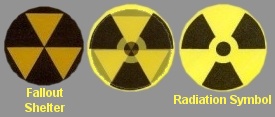
When I first took a look at the sign for “fallout shelter” — which, by the way, isn’t familiar to me — I figured it was based on the atomic energy symbol, or radiation symbol.

Then, in the first paragraph of this History of the Fallout Shelter Sign (on the excellent Civil Defense Museum website, which I found via Draplin), the author writes how it also looks like three arrows pointing down.

Of course, when I read that, I looked again at the sign, and the first thing I saw then was three arrows pointing IN, and I read “pointing down” as meaning “pointing in,” as if pointing down through a tunnel.

Then I looked again — and I saw three arrows pointing straight down — and now I can’t unsee it. It’s a bizarre switch in my head.

What do you see?

Despite the arrow triangle, that plastic may not be recyclable

Kathleen Meaney teaches at the College of Design, North Carolina State University. One day, she found out that, despite the arrow triangle symbol on the bottom of her yogurt container, it wasn’t able to be recycled:

In 1988, the Society of the Plastics Industry developed a resin identification code — a numbering system from 1 to 7 — categorizing different types of plastic. The code is centered in a triangle made of arrows chasing each other. This mark is commonly misidentified as the recycling symbol. Though the system was instituted to “facilitate the recycling of post-consumer plastics,” the chasing arrows graphic is meaningless. Plastic imprinted with the arrow symbol doesn’t indicate that the material is made from recycled content nor that the plastic can be recycled, misleading many.

Did it surprise me that the “recycling symbol” at the bottom of my yogurt container had nothing to do with its recyclability? Yes. (As it turns out, my city doesn’t take #5s.)

So, what does a professor do? Well, she turned it into a class.

The result is a number of thoughtful ways that a grocery store could encourage people to be more recycling aware — from the door, to the shelves, to the cashier and even the receipt.

It’s a great post — check out these stickers for a freezer compartment, designed by student Caitlin Garrison:
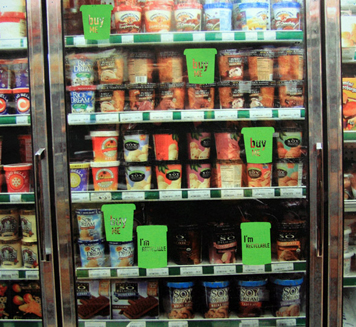
Says Meaney: “Some freezer containers can be recycled. These charming “buy me” door decals help identify them.”

Another concept I liked was this postcard mailer, encouraging better meat packaging. Of course, I’m not sure about the eco-friendliness of mailing out thousands of pieces of glossy paper to promote your cause, but I suppose it could be worse — the message, designed by David Mitchell, is very clever:
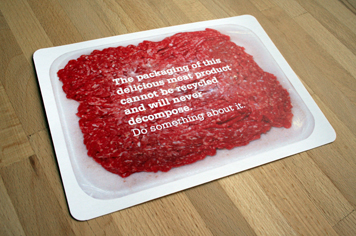
And, as Meaney points out, “This postcard campaign puts pressure on the manufacturer without boycotting the product. You like their product, not their packaging.”

One thing she says is that a “polluter-pays” mentality seems to have the biggest effect. It’s what she says they use in Germany, where the manufacturer is responsible for the entire lifecycle of a product — including its final disposal. That means there is a ton less packaging produced in the first place — “Toothpaste doesn’t come in a box,” she writes. “A bottle is reused 25 times before being recycled.”

Great design work from her class. I’d love to see some of them show up at my local stores (not holding my breath, though).

Give your dad this tie for Father’s Day

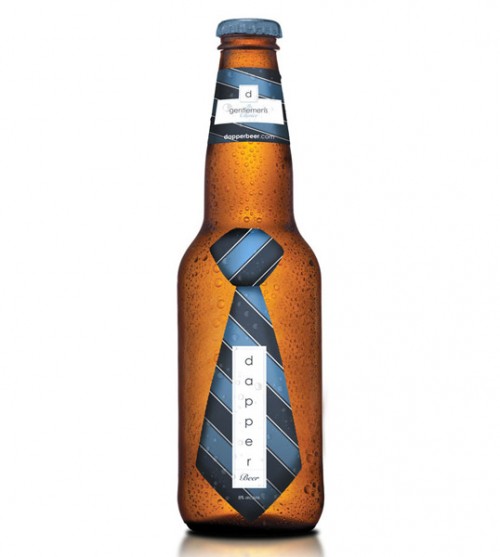
I know, I know, it’s not even Mother’s Day yet, and I’m posting about Father’s Day? But I just came across this neat idea for packaging that I think would make a great gift, some Sunday in June. Check it:

That’s right, Dapper Beer features a tie on the label, nicely, ahem, tying together two father-y stereotypes. Put a hammer on their other beers, and you’re set.

I’m not actually sure if this is a microbrew you can buy, or if it’s a one-off project for a guy making beer at home who happens to work at a design agency (it was designed by David Day and Associates) but I love the concept. They even have a six-pack box designed.

I could see different ties denoting different brews — skinny ties, paisley patterns, bow ties — and a whole line of beers that aim for a sophisticated look.

(Found at Lovely Package.)

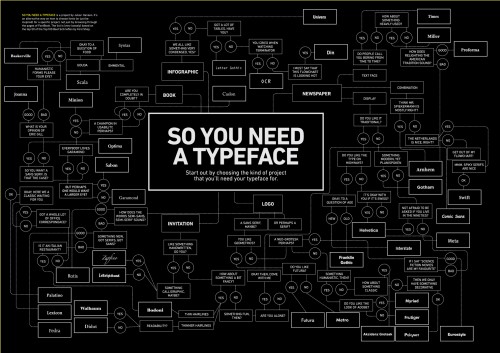
So … you need a typeface?

Click on the image to see it full size. It’s worth it — probably worth keeping around, if you want to quickly pick an appropriate look for your next type-based project, but don’t want to just scroll through endless lists in the “paragraph” style sheet.

It’s a student project by Julian Hansen, and I also liked his near/far poster for a documentary film festival.

It was featured on the new-to-me design blog Inspiration Lab, but I found it via Coudal.

Behind the scenes of pre-CGI graphics work

Because my parents eschewed cable television while I was a grower, and because HBO wasn’t available in Canada, anyway, I don’t think I’d ever seen this opening sequence from the 1980s until now:

It was entirely done without the use of computers. I’m trying very hard to learn Final Cut right now, and I am amazed at what it can do, but no matter how difficult Final Cut is to master, I can only imagine how hard it would be to do the same thing with ultra-detailed models and camera work.

The people at HBO saw it as such an achievement, actually, that they produced a little behind-the-scenes film about the making-of:

Crazy cool!

(Via Logo Factory, which calls it “retro logo porn”)

I love these vintage-style movie posters

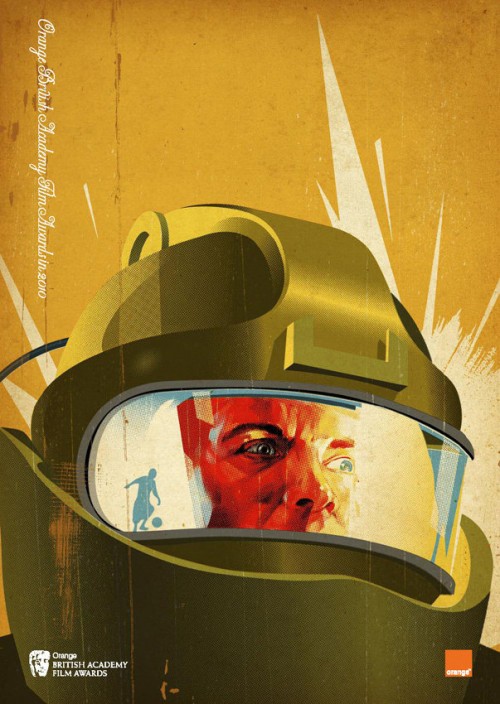
Tavis Coburn, with design agency Dutch Uncle, was commissioned to do up some posters for the 2010 BAFTAs, which he did in delightfully retro style. I love this one for the Hurt Locker, which looks like it was ripped from the cover of a deliciously pulp sci-fi paperback that I might have purchased for 75 cents from a used-book store as a pre-teen:

He also did Up In The Air, Precious, and An Education, but I think my second-favourite was the one he did for Avatar.

Coburn’s bio, on the Dutch Uncle site, says that his “unique style is inspired by 1940s comic book art, the Russian avant-garde movement, and printed materials from the 1950s/60s.”

Why, I think that’s a recipe for awesome.

Older posts «