Kathleen Meaney teaches at the College of Design, North Carolina State University. One day, she found out that, despite the arrow triangle symbol on the bottom of her yogurt container, it wasn’t able to be recycled:
In 1988, the Society of the Plastics Industry developed a resin identification code — a numbering system from 1 to 7 — categorizing different types of plastic. The code is centered in a triangle made of arrows chasing each other. This mark is commonly misidentified as the recycling symbol. Though the system was instituted to “facilitate the recycling of post-consumer plastics,” the chasing arrows graphic is meaningless. Plastic imprinted with the arrow symbol doesn’t indicate that the material is made from recycled content nor that the plastic can be recycled, misleading many.
Did it surprise me that the “recycling symbol” at the bottom of my yogurt container had nothing to do with its recyclability? Yes. (As it turns out, my city doesn’t take #5s.)
So, what does a professor do? Well, she turned it into a class.
The result is a number of thoughtful ways that a grocery store could encourage people to be more recycling aware — from the door, to the shelves, to the cashier and even the receipt.
It’s a great post — check out these stickers for a freezer compartment, designed by student Caitlin Garrison:
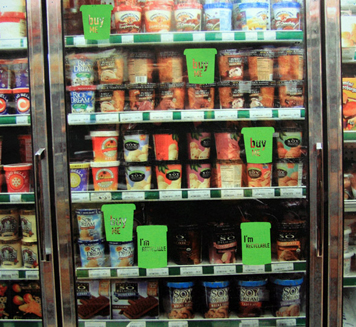
Says Meaney: “Some freezer containers can be recycled. These charming “buy me” door decals help identify them.”
Another concept I liked was this postcard mailer, encouraging better meat packaging. Of course, I’m not sure about the eco-friendliness of mailing out thousands of pieces of glossy paper to promote your cause, but I suppose it could be worse — the message, designed by David Mitchell, is very clever:
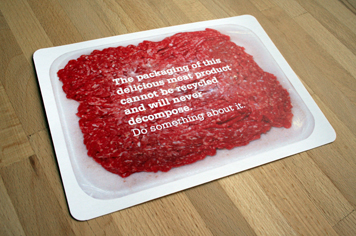
And, as Meaney points out, “This postcard campaign puts pressure on the manufacturer without boycotting the product. You like their product, not their packaging.”
One thing she says is that a “polluter-pays” mentality seems to have the biggest effect. It’s what she says they use in Germany, where the manufacturer is responsible for the entire lifecycle of a product — including its final disposal. That means there is a ton less packaging produced in the first place — “Toothpaste doesn’t come in a box,” she writes. “A bottle is reused 25 times before being recycled.”
Great design work from her class. I’d love to see some of them show up at my local stores (not holding my breath, though).