A news team does their own satire of social network ‘reporting’

I don’t mind a little banter between the on-air personalities, and I know they have to push other avenues of getting the news, like the station’s website, or Twitter feed or whatever, but this spoof of the social network explosion in news coverage feels pretty spot-on.

Better? It was produced by the actual Fox news team in Dallas-Ft. Worth.

According to a blog on the Dallas Observer, the video (which was originally posted to the station’s Facebook page) appears to have been produced for the Lone Star Emmys.

Boom. Roasted.

(via tdw)

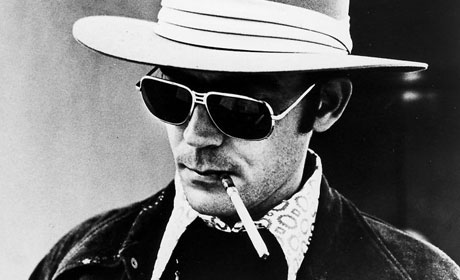
Hunter S. Thompson applies for a job at the Vancouver Sun

He’s a founder of what they call “gonzo” journalism, and most of his works come close to the truth without actually being accurate at all. He’s famous. He’s idolized by many.

But in 1958, Hunter S. Thompson was still struggling, and hadn’t yet made a name for himself. So he applied for a job at the Vancouver Sun.

The Ottawa Citizen published his cover letter:

Vancouver Sun

TO JACK SCOTT, VANCOUVER SUN

October 1, 1958 57 Perry Street New York City

Sir,

I got a hell of a kick reading the piece Time magazine did this week on The Sun. In addition to wishing you the best of luck, I’d also like to offer my services.

Since I haven’t seen a copy of the “new” Sun yet, I’ll have to make this a tentative offer. I stepped into a dung-hole the last time I took a job with a paper I didn’t know anything about (see enclosed clippings) and I’m not quite ready to go charging up another blind alley.

By the time you get this letter, I’ll have gotten hold of some of the recent issues of The Sun. Unless it looks totally worthless, I’ll let my offer stand. And don’t think that my arrogance is unintentional: it’s just that I’d rather offend you now than after I started working for you.

I didn’t make myself clear to the last man I worked for until after I took the job. It was as if the Marquis de Sade had suddenly found himself working for Billy Graham. The man despised me, of course, and I had nothing but contempt for him and everything he stood for. If you asked him, he’d tell you that I’m “not very likable, (that I) hate people, (that I) just want to be left alone, and (that I) feel too superior to mingle with the average person.” (That’s a direct quote from a memo he sent to the publisher.)

Nothing beats having good references.

Of course if you asked some of the other people I’ve worked for, you’d get a different set of answers.

If you’re interested enough to answer this letter, I’ll be glad to furnish you with a list of references — including the lad I work for now.

The enclosed clippings should give you a rough idea of who I am. It’s a year old, however, and I’ve changed a bit since it was written. I’ve taken some writing courses from Columbia in my spare time, learned a hell of a lot about the newspaper business, and developed a healthy contempt for journalism as a profession.

As far as I’m concerned, it’s a damned shame that a field as potentially dynamic and vital as journalism should be overrun with dullards, bums, and hacks, hag-ridden with myopia, apathy, and complacence, and generally stuck in a bog of stagnant mediocrity. If this is what you’re trying to get The Sun away from, then I think I’d like to work for you.

Most of my experience has been in sports writing, but I can write everything from warmongering propaganda to learned book reviews.

I can work 25 hours a day if necessary, live on any reasonable salary, and don’t give a black damn for job security, office politics, or adverse public relations.

I would rather be on the dole than work for a paper I was ashamed of.

It’s a long way from here to British Columbia, but I think I’d enjoy the trip.

If you think you can use me, drop me a line.

If not, good luck anyway.

Sincerely, Hunter S. Thompson

According to the Citizen, HST’s boss at the Sun would have been Jack Scott (whom he addressed the letter to). Scott, says the Citizen:

… was a Sun columnist who was appointed editorial director in September 1958 …. The “tart-tongued” Scott “unleashed all of his formidable flair for spectacular stunts” in his new role, which included sending the football editor to Formosa (now Taiwan) to interview Chiang Kai-shek, the leader of the Republic of China, and the women’s page editor to Cuba to cover the aftermath of the revolution.

He was promptly demoted in March 1959, summing up his brief stint with, “It was a ball while it lasted.”

Sounds like they would have gotten along just fine.

For the record, I think HST’s criticisms of journalism still stand.

Free course for online journalism

Photo: That’s a completely different kind of newspaper “web”. Source: Winnipeg Tribune archives, 1957.

I’m intrigued by the idea of an open-source, peer-to-peer “university” as a way to both learn and to perhaps share my own knowledge, and now there’s a course that’s tailor-made for me — “Open Journalism and the Open Web.”

Says the syllabus:

a solid six-week online curriculum that will benefit both “hacks” and hackers (that’s journalists & programmers, in plain English). Each week the course will focus on a different topic, and each week the participants will be joined by a different subject-matter expert (or two) from the field of news innovation. The course readings, online participation, and a seminar are expected to require roughly 4-6 hours per week.

The six subjects include the basics of both journalism and coding, project management, collaboration, datasets, maps and open sources.

Very interesting!

There are only 40 seats, and to weed out people who aren’t serious, they’ve set a “sign-up task.” I’m seriously considering it.

(via Boing Boing)

Warning labels for journalism

It’s oft been said (Hemingway?) that the one tool a journalist requires is a good bullshit detector. That’s because, in an idealized world, the task of the journalist is to take the all of the myriad information that’s flying around, sort it from the chaff of rumour, advertising and innuendo, and present to his or her readers a “truth” that they can trust.

Oh, idealism.

Of course, journalism’s never been like that, though many journalists have struggled mightily. But one of the consequences of the Internet and our info-filled society is that it’s forced just about everyone into a similar role.

Surrounded by information — much of it misleading, or downright false — we’ve all had to develop our own internal bullshit detectors. Judging by some of the chain emails I get, some people are worse at this than others.

However, it’s impossible to simply rely on journalists to be good gatekeepers anymore. In the first place, there’s too much information flying around; we’re bombarded with it, continually.

And secondly, journalisms itself is being squeezed — more and faster deadlines, smaller budgets, and fewer people, all dealing with the same info-onslaught.

So, sometimes, though I loath to admit it, the ideal of journalism suffers. Sometimes, it’s just not up to snuff. Sometimes, we journalists basically copy a press release and call it a story. Sometimes, we don’t have time to dig up the dirt, or to challenge our sources.

And, as British comedian Tom Scott figured out, the public should be warned:

It seems a bit strange to me that the media carefully warn about and label any content that involves sex, violence or strong language — but there’s no similar labelling system for, say, sloppy journalism and other questionable content.

So he made labels, which he’s been sticking on the free commuter papers in London. Here’s a couple of my favourites:
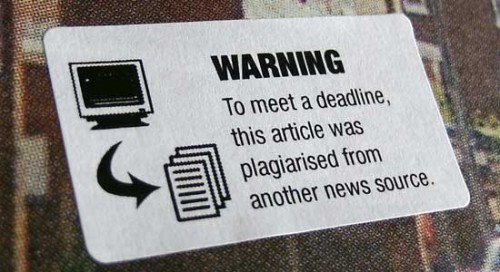
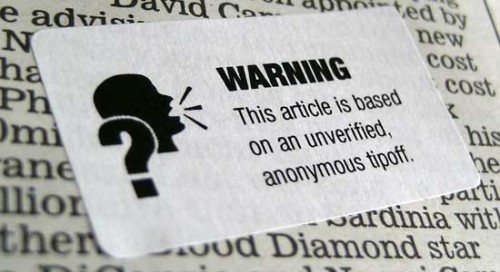
I also liked “WARNING Journalist hiding their own opinions by using phrases like “some people claim”” and “WARNING To ensure future interviews with subject, important questions were not asked.” which I see all the time.

There’s a bunch more, and he’s helpfully provided a pdf that you can download from his site (mirrored here) so you can print your own on a sheet of stickers.

Boing Boing suggests using them as part of a journalism course. Hmmmm.

Weirdest book title ever?

Lately, I’ve been on a kick where I’ve been reading (almost exclusively) novels about journalism. There are lots, apparently because many journalists not-so-secretly dream of being novelists.

As soon as I saw this one — “Dwarf Rapes Nun, Flees in UFO” — I knew it would make its way to the top of my list.

Best of all, copies are going for a cool $0.01 on Amazon.

Straight Ls are never good enough

Related to my last post, about Brianna Smrke, the high school student who got 100% in all her courses during her senior year, one thing in the Toronto Star article kind of stood out for me.

I suppose the reporter probably asked something like “Where are you dumb?” but hopefully phrased it more politely. Anyway, the paragraph that made the story goes like this:

Smrke, however, admits to needing a little help in one area: “I always get made fun of because I can’t always tell my left from my right without having to check. . . . That’s probably the most shocking thing about me,” she said, laughing. “I subtly put my hands down on my pants and make Ls” to figure out which is which.

Now, I’ve always had a problem with people who think they need to do this. Can’t tell left from right? Yes you can. And your L trick is stupid.

Go ahead, put your hands up and make Ls — or put them on your pants, subtly, like Smrke does. I’m guessing your palms are out, or down, correct? Because that’s the only way this works. If you happen to make Ls with your hands, and you’re looking at your palms, the L will be on your right hand.

So, if you can remember up and down — or palms vs. backs of hands — you can remember left and right.

(Aside: I read somewhere that right-handedness is determined genetically, but if you don’t have the gene for right-handedness, you basically have a 50/50 chance of being either right- or left-handed.)

The adventures of a bored journalist

Like many jobs, journalism can be very exciting. But it can also feature long stretches of tedium. People deal with that tedium in different ways.

One of the things my mother taught me was that, if you’re bored, you can try making up a little game to help you with your task. It never worked with the dishes, but I think the key is to make your game somewhat subversive.

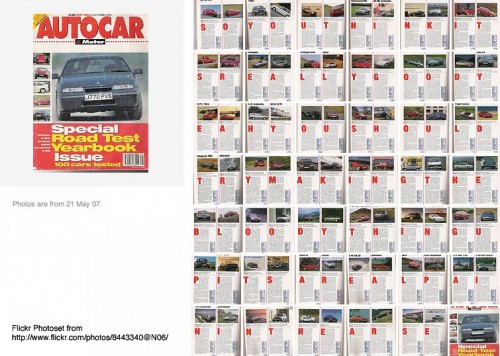
That’s what Top Gear star James May did, when he used to work for Autocar magazine. He was fired in 1992 for his little game, which came to him when he was faced with putting together a ridiculously boring supplement.

The game? Using drop caps to spell out a hidden message:

If you add the right punctuation, it says “So you think it’s really good, yeah? You should try making the bloody thing up. It’s a real pain in the arse.”

Which, I’ll bet, is true.

Confession time: I’ve done the same thing myself. Although never with drop caps.

You can read a little bit more about the episode on his Wikipedia page, from which I got the image.

(thanks, Andrea!)

A pub crawl … in Snuggies

Who knew that there was a Snuggie-vs-Slanket contingent when it came to pub crawls? I wish that I could:

a) organize a faux-blanket-wearing pub crawl
b) video it
c) post it on a newspaper site as a video story

Go San Diego Union Tribune!

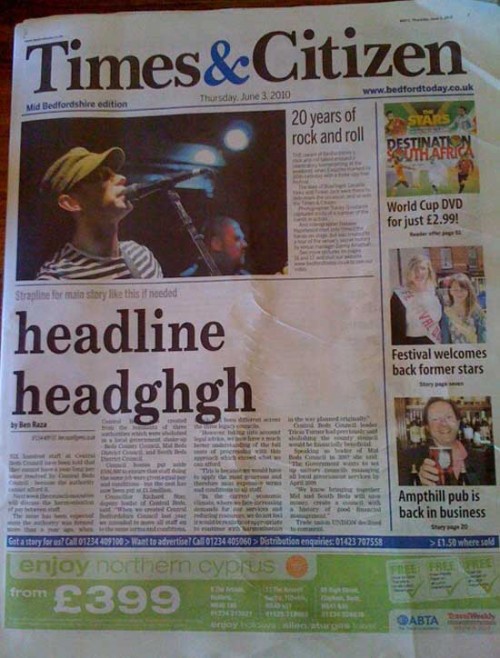
This makes me feel all headghgh

Oh, I feel for the good folks at the Bedford Times & Citizen.

But what do I feel? Something between sympathy and schadenfreude, I suppose. (via)

In related newspaper news, film and TV prop departments re-use their props!

There are a lot — a LOT — more examples in this Picasa gallery. (via)

I, too, make a better reporter than I would a criminal

I’ve had my share of embarrassing moments — some of them even as a reporter. Mostly, for me, it’s been when a long interview has droned on and on, and I’ve suddenly been caught daydreaming, unsure how the sentence just ended, with someone staring at me, expectantly waiting for an astute followup question.

Oh, there have been a few headline, um, foul-ups. But at least it’s never been like this:

Man, you have to feel for the guy. He’s really trying!

I like that he’s the one who posted this video, too.

What it’s like to be a hack

I really enjoyed this behind-the-scenes essay by a copywriter — albeit, an unusual one.

Jason Toon works at Woot, a company that sells only one thing (a different thing) every day, and usually at a pretty good price. He writes the ad copy that appears with each of these products, and they are usually funny, isightful, and, well, different.

Today, for example, Woot is selling a pair of mice, once white, one pink. Instead of just giving the specs for the mice, though, Toon has written a little story about his-and-her mice, atop a wedding cake. It goes from endearing to odd and then all the way to pathos.

He does that every day. Except, of course, when the site has what it calls Woot-offs: a time when they sell maybe a dozen or two products, one after the other, in a single day. Those require a little more than the usual amount of work, and Toon didn’t think he could do it.

Turns out, he can:

That morning would have looked like any other to you. Me, at my desk, pondering the minutiae of some hard drive or LCD monitor or robotic vacuum cleaner. You wouldn’t have seen the crushing weight of the 25 product descriptions I had to write before I could claim my next sleep. I felt like I could barely breathe. I tried to commit every detail of my comfortable desk to memory, to savor during the unbearable hours at whatever my next job would be. I started typing, a doomed man, my doomed fingers dancing a macabre funeral march on the keyboard.

Along the way, I’d gained an enormous respect for hacks and hackery (in the old sense of cranking out anonymous creative work by rote, not in the computer-age sense). I’d always flattered myself with the self-designation of an “idea man”, a superior intellect whose brilliant visions were too valuable to waste his time actually carrying them out. But as I pounded out those two dozen joked-up pieces of marketing ephemera, my awe only grew at the comic-book illustrators and pulp novella writers and dance-craze tunesmiths who just got the job done, in the days when their professions earned them no respect and not much more money.

In a sense, although he doesn’t say so explicitly, he’s also describing journalists, or even bloggers. Not every word I write is golden — far from it — but there is a certain sense of accomplishment in just sitting down, banging something out, and Getting It Done. And then looking back over what you have written and noticing, with a professional’s eye, that maybe you did happen to turn a nice phrase here and there.

It’s not Shakespeare, but it’s something.

Read “The Hack Hustle: The Inspiring Story of the Slacker Behind the Woot-off”

What it’s really like to be a cop — as recorded in hundreds of hours of secret tape recording

Now this is a classic magazine scoop — but it’s from the Village Voice. I’ll let the lede speak for itself:

Two years ago, a police officer in a Brooklyn precinct became gravely concerned about how the public was being served. To document his concerns, he began carrying around a digital sound recorder, secretly recording his colleagues and superiors.

He recorded precinct roll calls. He recorded his precinct commander and other supervisors. He recorded street encounters. He recorded small talk and stationhouse banter. In all, he surreptitiously collected hundreds of hours of cops talking about their jobs.

Aside from small talk and locker-room banter, as well as juvenile jokes like “cocking the books” (drawing lewd penises inside other cops’ memo books), the officer also revealed a pressure-cooker culture where officers and their supervisors were under intense pressure to look really, really busy, but also to record fewer crimes.

The result? More “stop-and-frisks” but also not actually investigating real complaints.

The Village Voice has done a wow job of putting it all up — including two long articles and selections from the recordings themselves.

I haven’t finished it, but it’s gripping stuff, so far.

The NYPD Tapes, Part 1

The NYPD Tapes, Part 2

If newspapers were comprehensive with corrections

So, if newspapers are fanatically devoted to being correct with everything you do, and if they want to be absolutely sure that incorrect information is corrected as soon as possible, how come we don’t see something like this every day:

Correction

Incorrect and misleading information appeared on Page Two of yesterday’s paper. Although the forecast called for a high of 7 C, the actual high temperature turned out to be 3 C, and the sky was overcast instead of partly cloudy.

This compounds last week’s error, which called for yesterday’s high to be 21 C. A recent cold front wiped out all the forecasts from Wednesday through Saturday, along with plans for a staff picnic. We regret the error.

Actually, I would love to see tracking of how accurate weather forecasts are. I know people have studied this in the past, but I’d like to see weather sites archive and promote their accuracy. It should be relatively easy in a database-driven world.

Related: Under the rubric of “People in glass houses” and also “schadenfreude” I kind of enjoy visiting Regret The Error, a website devoted to chronicling the very best of newspaper and magazine corrections.

The Gulf of Mexico oil spill, explained by Al-Jazeera

Perhaps Western news organizations have produced their own video infographics, but Al-Jazeera’s was the first that I saw.

I’m glad to see an English Al-Jazeera, by the way, because I think it’s important to encourage a diversity of voices in the media. From what I’ve read, it was originally staffed with journalists pinched from the BBC, and I believe that news culture still exists.

Which, I suppose, is more than you can say for Fox.

Excellent visual reporting of a court gag order

Yesterday, a woman accused in the abduction and death of a child appeared in court. Or, was scheduled to. But nothing that actually happened in court can be reported, thanks to a sweeping gag order imposed by the judge.

Media are arguing against the gag, including this excellent editorial, but I’m not going to get into the free speech vs. fair trial argument here. I just want to note how the Toronto Star, with a simple graphical element, drove home the point of censorship.

In Rosie DiManno’s column, she writes about how the whole town knows the details — people talk, after all. They gossip and compare notes, and phone each other. The coffee shops must be abuzz.

But none of that can appear in print. So, where the relevant details in a well-reported column might go, DiManno (or a designer) has put long black boxes instead.

It’s a classic visual image, one that screams censorship, and it’s a great, elegant way to make the point of the column. Good job, Star. I would love to see how you handled this in print, but I think you’ve done an excellent job online.

Older posts «