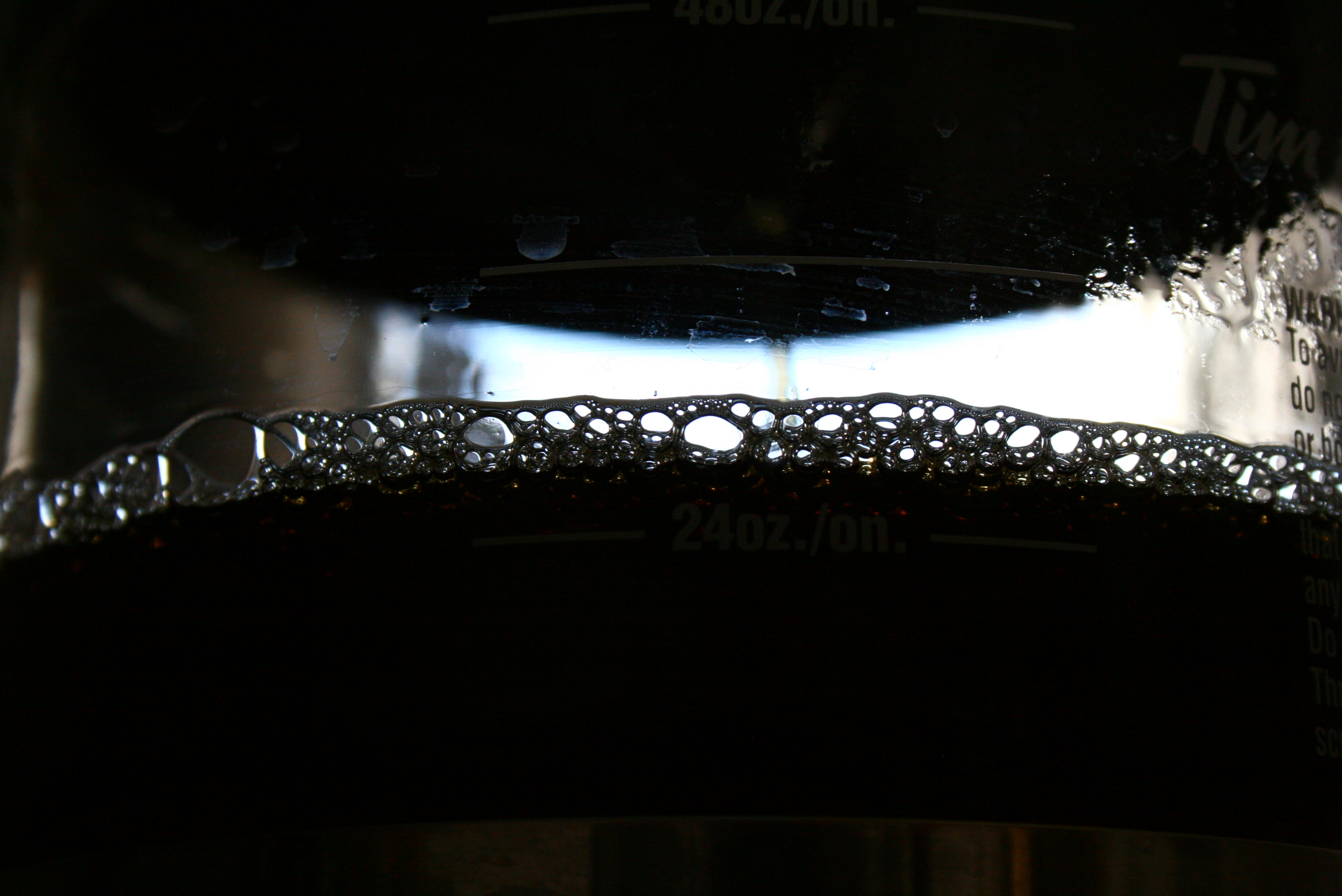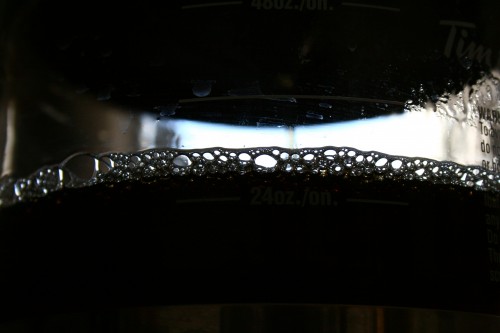
Every morning, if you like, you can imagine me, crouched, staring blank-eyed at the drip-drip-drip of coffee being brewed, just like Amy’s photo, above.
Of course, these days, we have an insulated carafe, so we can bring the coffee upstairs and satisfy our internet and caffeine addictions at the same time. But, for me, part of the coffee experience is the sense of anticipation. Actually, because I have kind of a sensitive mouth, and I don’t use any cream, the coffee is generally too hot when it’s first poured, so I have to sit there, fuzzy-headed, while it steams away some of that heat.
Then I can drink it.
It’s strange to remember that, until relatively recently, I didn’t drink coffee in the mornings. For most of my life, still, I didn’t drink it at all. Then I started going out in the evenings, with friends. We had sort of an artistic salon thing, going on, at a 24-hour restaurant. I preferred soft drinks, but coffee was half the price — and free refills, all night long. I soon switched.
Now, strictly because of Amy, I’m a morning coffee drinker. I used to let the shower wake me up, but my morning routine has changed. Coffee has changed me — in some subtle, some important ways.
But hasn’t it changed all of us?
That’s what a great three-part series (1, 2, 3) on Anthropology in Practice is arguing. Says Boing Boing, summing it up:
In 1991, coffee-drinking seemed to be on its way out in the United States. From a peak consumption of 3.2 cups per day per person on average in 1962, coffee consumption was down to measly 1.75 cups. There were good reasons for this: Nobody liked the cheap, nasty sludge generally available and the entire experience reeked of Grandma.
Enter advertising giant Ogilvy and Mather, working for Maxwell House.
Their suggestion: Segment the product by quality, value and personal image—ideas that all ended up leading to the thriving coffee market of today. Just when we thought we were out, they sucked us back in. (Meanwhile, the parallel rise of coffee and decline of tobacco could be a sociology thesis, in and of itself.)
Part One of the series looks at how coffee stormed back to become one of the world’s most vital drinks.
Part Two, structured like a flashback, I guess, tackles the history of the bean and its trade.
Part Three, which I find most interesting, explores coffee’s role in the rise of our “culture of productivity.”
The cultural aspect really intrigued me, and I could have easily read a post four times as long. Consider this, for example, in which coffee is compared and contrasted to alcohol:
Perhaps we can apply [the] term “ritualized inebriation” to coffee consumption as well. We consume coffee as a means of performing the tasks we need to complete in the setting of the workplace. And if we all do it, then it normalizes the behavior and helps us believe that we are achieving optimal levels of productivity.
Coffee and booze. Two sides of my favourite coin.