Posts tagged: americans

Conversation starter: What if the tea party protesters were black?

Here’s a provocative question: What if the tea-party protests was made up of angry black people instead of angry white people?

It’s asked, with examples, in this blog post. In part:

Imagine that hundreds of black protesters were to descend upon Washington DC and Northern Virginia, just a few miles from the Capitol and White House, armed with AK-47s, assorted handguns, and ammunition. And imagine that some of these protesters —the black protesters — spoke of the need for political revolution, and possibly even armed conflict in the event that laws they didn’t like were enforced by the government? Would these protester — these black protesters with guns — be seen as brave defenders of the Second Amendment, or would they be viewed by most whites as a danger to the republic?

To be clear, although I don’t agree with any tea partier I’ve seen yet, I support their right to protest until they drop from exhaustion. But have you noticed that the people who scream loudest about needing tolerance are often the people who are least tolerant themselves?

Congratulations, Americans, on your new health-care coverage

The U.S. House of Representatives has voted to pass universal health care legislation, by a count of 219-212.

As a Canadian, I find it reassuring that you guys are finally coming around. Universal health care, Canadian-style, isn’t perfect. Neither is the British version, the French version, or the version tried by every other industrialized country.

But, frankly, it’s pretty good. I suspect that you’ll look back on this in a decade or so with as much bewilderment as you do on anti-miscegenation laws.

Next up, gay marriage? And, if you can do something about decriminalizing marijuana, you realize that you could leap-frog us, right?

So that’s what they think of us

I stumbled across a radio station in Chicago the other day that is looking at adding a homegrown Canadian CBC show to their mix. They experimented with the new show for a week, and asked their listeners to respond on their blog.

The show is Q, which I listen to semi-regularly, and which I thoroughly enjoy (warts and all) and which enjoyed 15 minutes last year when they had an interview kerfuffle with Billy Bob Thornton:

The radio station experimenting with Q is WBEZ.

On their blog, they’ve attracted about 200 comments so far on the trial. Some are in favour, others are not. Many of the commenters seem to be fairly familiar with other CBC Radio shows, like Definitely Not The Opera and The Vinyl Cafe, too.

Pride’s cheap these days

Loyal reader Colin sends in this gem — pulled from the discount bargain bin (at the Real Canadian Superstore, natch):

not_so_much

(Of course, as dedicated shoppers will know, it’s not the price that counts, it’s the value you get for your money.)

A close reading of the fine print on the reverse side explains what I had pretty much guessed: “This compilation copyright 2001.”

Now, let me be clear, I don’t mean to diss American patriotism or pride. But I do think, from my perch here in the north, that after eight years of jingoism, many ‘Mericans are relieved by Obama’s more nuanced view of the world (less “Team America: World Police”, please!).

Mind you, you’d never know it, from the constant media coverage of the lunatic fringe.

This breakfast sausage got him in a lot of trouble

A man in Virginia has been arrested for indecent exposure, for making coffee naked.

In his own house.

The guy insists he didn’t realize that he could be seen, and that it was early and dark. And he was, you know, in his house.

This story from the New York Daily News says:

But a woman and her 7-year-old son happened to be strolling through his front yard and saw the 29-year-old having breakfast in the buff through his window

The Telegraph also picked up the story, but they just said the woman and child saw him in the window. I want to know, exactly how close to the house was the woman? Were they actually in his yard, like the first story said? In that case, the woman should probably be told to stop trespassing.

How big was the window? Could he be seen from across the street? Who knows, but the outcome of this incident should not have been to arrest the guy. He’s in his own house. But the police are insisting he wanted to be seen, which strikes me as odd. Usually, if a guy wants to be seen naked, he goes outside, or dons a large raincoat. But making coffee in his own house? I’m not convinced.

A brief discussion on the difference between the left and the right

Over at Salon, Glenn Greenwald has a brief blog post pointing out two new logos for two new-ish organizations and/or projects.

First he points out that the ACLU is working on a “national security” project called “Keep America Safe & Free.” Pretty patriotic — overly so, if you ask my opinion as a Canadian.

But that’s the left side of the political spectrum. Over in the other corner, Liz Cheney and Bill Kristol are working on their own, very similar project. I believe it has similar aims of “national security” though of course their objectives and methods probably differ in the details. Oh, those messy, messy details.

Still, they’re similar. They both want national security. And so it’s not too surprising that they chose a similar name. They call theirs “Keep America Safe.”

A laudable objective, certainly.

But isn’t there something missing in the Cheney/Kristol version?

(Of course, I’m aware that this is a flawed argument. All it would take is for me to start a national security project called “Keep America Safe & Free & Fun” and using that same logic, we could argue that the ACLU hates fun. But it’s still a telling display of priorities.)

America: land of endless invention and irritation

TryAndStopUs

Love it or hate it, there’s one country that everyone has an opinion on — The United States. I think that’s because of a weird dynamic between the promise of freedom, and pursuit of happiness and the American Dream of its self-image when contrasted with the quite-obvious impossibility for everyone to achieve those promises.

Nowhere else is the “creative destruction” of rampant capitalism quite so vehemently defended, for example — in idea and in idealism, if not always in practice.

As a Canadian, the whole concept of America as an elephant next door has been absorbed into my psyche since birth. I’m not American, but I’m somewhat defined by Americanism nonetheless. I’m a little bit fascinated by it, and often frustrated.

Experiencing a culture is the best way to get a bead on it, obviously, but analysis of American culture is so thoroughly dominated by Americans that it’s sometimes difficult to get what you might term an unbiased opinion. So I was enthralled to read the final essay of the BBC’s North American editor. Having lived in The States for the past six years, he’s returning home. And he’s penned a blistering broadside — with love — at the country he’s leaving behind:

America shines a light on the entire human condition …. America speaks to the whole of humanity because the whole of humanity is represented here; our possibilities and our propensities.

Often what is revealed is unpleasing; truths that are not attractive or wholesome or hopeful.

On the last day we spent in our home in north-east Washington, they were holding a food-eating competition in a burger bar at the end of our street. The sight was nauseating: acne-ridden youths, several already obese, stuffing meat and buns into their mouths while local television reporters, the women in dinky pastel suits, rushed around getting the best shots.

America can be seen as little more than an eating competition, a giant, gaudy, manic effort to stuff grease and gunge into already sated innards.

John Webb has “mixed feelings” about America, because despite it’s obvious faults, he really does love it, he says. Actually, he contends that it is because of those faults that America still has greatness:

To make it big, there must be something creating the drive, and part of that something is the poverty of the alternative, the discomfort of the ordinary lives that most Americans endure and the freedom that Americans have to go to hell if that is the decision they take.

A found a similar — and more enchanting — message at the New York Times. Using visual storytelling in a way that has to be seen to be appreciated, Maria Kalman tries to exhort people to find that drive, to reach for something better, to create. To invent:

They don’t exist in some natural state. They must be invented by people. And that, of course, is a great thing. Don’t mope in your room. Go invent something. That is the American message. Electricity, flight, the telephone. The television. Computers. Walking on the moon. It never stops.

Now I just have to find something to invent!

Celebrity culture taken to another, creepier level

Hey celeb-stalkers! Are you desperate to have a baby that looks like your favourite celebrity, but don’t want to go to jail trying to get their sperm?

Then California Cryobank has the solution for you!

Researched and selected from the limitless expanses of the internet, CCB Donor Look-a-Likes can be actors, athletes, musicians, or anyone else famous enough to be found on the web. Worried you don’t know enough pop-culture or watch enough TV to recognize the names? Not to worry… CCB Donor Look-a-Likes link directly to photos of the 2-3 celebrities our staff has deemed each donor most closely resembles.

You don’t have to worry about your favourite celebrity issuing a pesky restraining order, or their annoying wives and girlfriends getting in the way, with California Cryobank’s Donor Look-a-Likes!

Roger Ebert critiques the “news”

It was posted almost ten days ago, but I just came across an interesting article by Roger Ebert for the Chicago Sun-Times.

In it, Ebert examines the bully-style tactics of Bill O’Reilly and how he, and other “news” figures like him are changing the way people not only receive their information, but the information itself.

I am not interested in discussing O’Reilly’s politics here. That would open a hornet’s nest. I am more concerned about the danger he and others like him represent to a civil and peaceful society. He sets a harmful example of acceptable public behavior. He has been an influence on the most worrying trend in the field of news: The polarization of opinion, the elevation of emotional temperature, the predictability of two of the leading cable news channels. A majority of cable news viewers now get their news slanted one way or the other by angry men. O’Reilly is not the worst offender. That would be Glenn Beck. Keith Olbermann is gaining ground. Rachel Maddow provides an admirable example for the boys of firm, passionate outrage, and is more effective for nogt shouting.

Ebert goes on to decry the way radio and television have changed — which struck me as a comment on “the good ol’ days” that I have no sympathy for — but his analysis of O’Reilly, and others like him, is spot on. The bottom line, in Ebert’s mind, is that the polarization in the media has to stop. I would have to agree.

Optimism and creativity in light of the recession

An NYU student by the name of Nyle has been making the rounds on the web for his version of the Lil Wayne song “Let the Beat Build.” The video is really cool because it was shot all in one take with no dubbing; it was completely live. And, in the words of Gawker, where I saw the video, Nyle wrote “refreshingly optimistic lyrics about creative ambition in the New Depression.”

The song and video really didn’t grab me until the horns and strings came in, but after that it just gets better.

You can find an interview with Nyle here.


First Guns

People talk about Michelle Obama’s arms. A lot. And I personally don’t get it. It’s almost like a new sex symbol, like how ankles were sexy when it was the only part of a women that would get exposed.

Well, those arms are finally taking to the blogosphere:

Everyone’s been writing about us. Now we’re speaking out. We’re Thunder and Lightning, the First Guns.

The First Guns have spoken.

A shift in students’ reading habits

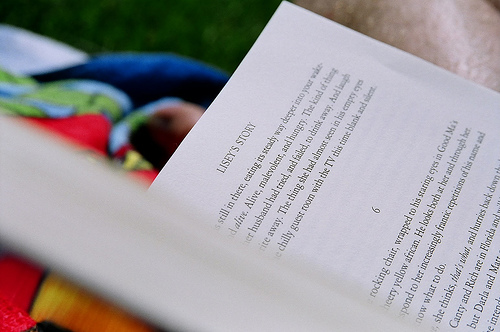
Lisey's Story by, yes, Stephen King. Photo by Amy Breen.

Lisey's Story by, yes, Stephen King. Photo by Amy Breen.

Ron Charles has an article in the Washington Post about the sad state of college students. Charles laments how students these days (even literature students) read drivel like Twilight and are no longer politically active in their reading.

Basically, he’s concerned that young people, “away from home for the first time, free to enjoy the most experimental period of their lives” are instead picking up books best suited for “13-year-old girls” rather than books by people like Hunter S. Thompson or Sylvia Plath.

I can’t help but read the column and see Charles as an aging baby boomer, who was a teenager during the incendiary 60s, and who can’t understand the apathetic nature of today’s youth. I hate to tell him, but this isn’t the 60s anymore. The culture has shifted, the attitudes have shifted. I think most college students in the world today don’t feel that they can affect change.

But as for not caring about literature? Maybe it’s different in the states, but in my experience (going to university as a literature student) the people I take classes with care very much about literature, and read the so-called classics.

But they also read things that Eric Williamson — a professor Charles quotes in the article — would call “inferior texts.”

Says Williamson:

There is nary a student in the classroom — and this goes for English majors, too — who wouldn’t pronounce Stephen King a better author than Donald Barthelme or William Vollmann. The students do not have any shame about reading inferior texts.

And there’s nothing wrong with that. Personally, I love Stephen King. But I wouldn’t call him an inferior writer to someone like Barthelme; he’s just a different kind of author. It doesn’t make him any better or any worse. My book shelf at home is a mismatch of titles, from East of Eden, to The Satanic Verses, to The Shining. The kind of ”high art” elitism that says if you’re serious about literature, you can only read Hemingway or Dickens, truly bugs me.

Charles doesn’t seem to understand that there aren’t as many politically charged authors anymore. And maybe a lot of students read nothing but Stephanie Meyer, and scoff at Milton, but I believe that they are the minority, and that reading “fluffy” books isn’t necessarily a bad thing.

Loop-hole in the law allows drive-thru daiquiris

I wish this was allowed in Manitoba. In Louisiana, you can’t serve open liquor to someone in a car. So they’ll sell you the drinks in a sealed jug, the glasses and the straws separately. Wink.

Fun article here, but I’ve added the video below:

Happy Mardi Gras!

Yup, it’s Fat Tuesday! Let’s all call in sick to work, drink absinthe, listen to jazz and read “A Confederacy of Dunces.”

Oh, you can’t? Well, try on this for size: archival video from New Orleans’s Mardi Gras in 1941. No beads, no boobs, no sound. But in colour!

(Thanks, BB)

Goodbye, United States of America. We hardly knew ya!

Do you know who Andrei Amalrik is? See, my point exactly. He successfully predicted the collapse of the USSR. He was off by just half a decade. That was another valuable lesson for me, which is why I will not give you an exact date when USA will turn into FUSA (“F” is for “Former”). But even if someone could choreograph the whole event, it still wouldn’t make for much of a career, because once it all starts falling apart, people have far more important things to attend to than marveling at the wonderful predictive abilities of some Cassandra-like person.

… says the guy who is predicting that the US as we know it will collapse. He’s got a book, but most of what you need to know is in this loooooong blogpost (the text of a speech he gave). Many interesting comments, too.

Read it when you have two hours.

He does sort of skim over the hows and whys in his talk (maybe he gets more into it in the book) but his essential point is that the US is going to collapse for the same reasons that the USSR did: “a severe and chronic shortfall in the production of crude oil (that magic addictive elixir of industrial economies), a severe and worsening foreign trade deficit, a runaway military budget, and ballooning foreign debt.”

Much of the talk, though, is how to survive — even thrive? — in a post-collapse world.

Not that I think, necessarily that this will happen, but you did hear that California’s going bankrupt, right? Things are not what they used to be.

(PS. This guy is (probably) not a crackpot. His theories were also somewhat shared by prominent Canadian thinker Gwynne Dyer.

Discussion question: Does the election of Obama change theories like these?

(Photo by Flickr user Marxchivist)

Dansette