Posts tagged: uplifting

The best “Top 10 of the decade” list I’ve seen

As we’re barraged by fearful coverage of the Christmas Day “crotch-bomber’ and also by inane lists of the decade’s best films, books and celebrity fashion, I’m indebted to Juan Cole for his list of Good News Stories From the Muslim World That You Never Heard Of.

It includes some positive developments in terms of women’s rights, democracy, and improved economies, and is a welcome relief from all the thinly-veiled (pun intended) Muslim-bashing that runs underneath a lot of the OMG! Terror! coverage that seems to swamp us.

What happens when the wild animal you’re trying to photograph tries to teach you to hunt?

You get great photos, that’s what!

Amazing video from National Geographic photographer Paul Nicklen, who went to Antarctica to photograph leopard seals. One of them “adopted” him and tried to teach him how to hunt penguins.

(via BoingBoing)

Use Facebook? Check out peace.facebook.com

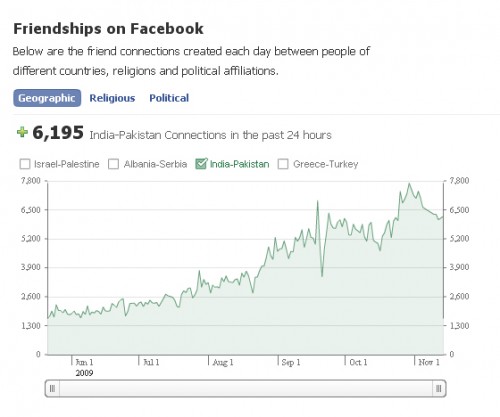
I was kind of touched when I found what was going on at peace.facebook.com. There, the social networking site is featuring a selection of graphs that highlights the connections they make between people. They’re showing how people who may fall on opposite sides of some geopolitical or cultural fence can still be friends.

facebookpeace

Because the graph shows how many connections are made per day, the India-Pakistan connections, above, are exploding. Even a flat line would actually mean steady growth (ie. 2,000 new connections, every day)

Facebook may be the biggest part of this so far, but it’s just the beginning of the so-called “Peace Dot” initiative.

A project out of the Stanford University “Persuasive Innovation Lab,” Peace Dot aims to showcase how companies are increasing the levels of peace in the world. Any company or organization that wants to is encouraged to add a page to their site: peace.yoursitename.com instead of boring old www.yoursitename.com.

I’m wondering what could go at peace.absurdintellectual.com.

This is the very early stages of Peace Dot, and I’m excited to have found it. There’s a list of participating sites at the Peace Dot website, where you can find out a little bit more.

Man’s battle with cancer pays off — at 50 to 1

Ha! Now that’s called motivation to live a little longer! From the BBC:

Jon Matthews, 59, from Milton Keynes, was diagnosed with mesothelioma, a cancer linked to asbestos, in 2006 and told he had months to live.

He placed two bets, each with a £100 stake at odds of 50/1, that he would be alive in June 2008 and in June 2009.

A third wager will earn him a further £10,000 if he lives until 1 June 2010.

The widower will collect his second lot of £5,000 winnings on Monday

Said the insurer:

“Never in 30 years in the business have I been so pleased to pay a winning client £10,000, with, I trust, a further £10,000 to come next year.”

Well done, all. Nice feel-good story — and the capstone is that Matthews plans to give the money to charity.

It’s all about the little things

After a long, exceptionally boring day at work last week, I got into my car, settled in, and turned the ignition.

The radio came on, and the sweet sound of the Band song The Weight came wafting through my speakers.

It just so happened my favourite lyric was being sung at that very moment.

“Its just ol’ Luke, and Luke’s waitin’ on the judgement day. Well Luke my friend, what about young Analee? He said do me a favour son, won’t cha stay and keep Analee company.

The Band - The Weight

Optimism and creativity in light of the recession

An NYU student by the name of Nyle has been making the rounds on the web for his version of the Lil Wayne song “Let the Beat Build.” The video is really cool because it was shot all in one take with no dubbing; it was completely live. And, in the words of Gawker, where I saw the video, Nyle wrote “refreshingly optimistic lyrics about creative ambition in the New Depression.”

The song and video really didn’t grab me until the horns and strings came in, but after that it just gets better.

You can find an interview with Nyle here.


New park highlights Afghani challenges

afghan-park

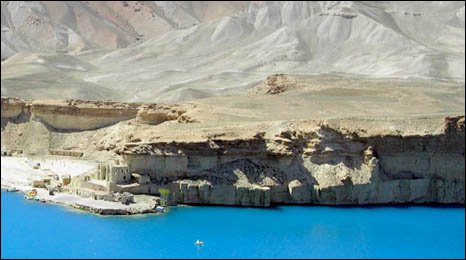
Although there’s still a war on, Afghanistan’s National Environmental Protection Agency has declared the area known as Band-e-Amir to be the country’s first national park. The BBC calls it a “spectacular region of deep blue lakes separated by natural dams,” adding, however, that much of the wildlife has been lost, and that challenges remain:

In the stillness of the high, thin air, the blue and turquoise waters are often like glass, perfectly reflecting the slopes around them, says the BBC’s Alan Johnston, who has visited Band-e-Amir.

However, this quietness may be occasionally punctured by the damaging local practice of fishing by blasting the lake waters with hand grenades, he adds.

Originally, Band-e-Amir was going to be declared a national park in the 1960s, but conflict got in the way. It’s since been submitted to the UN for recognition as a World Heritage site, according to Wikipedia.

Do a Google images search for some spectacular scenery!

Great sunsets, thanks volcano!

image_068

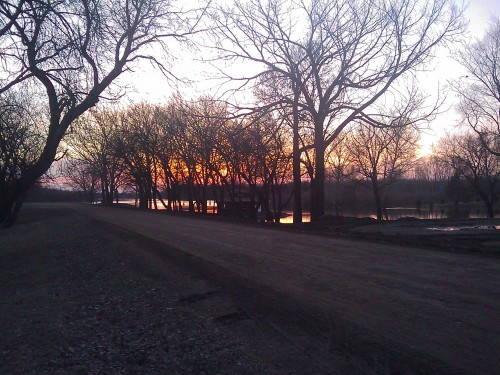
I took this picture the day before yesterday, when Amy and I went on a lengthy bike ride — first of the season! My crappy cell phone camera doesn’t even begin to capture the depth of colour that was in the sunset. And, when I tried to take some pics with Amy in the foreground, it white-balanced on her face, and further washed out the vibrant reds, oranges and yellows of the sunset.

Really, it was incredible.

Because we live in the Prairies, we’re often blessed by wonderful sunsets, and people who visit here can be taken aback. But lately it’s seemed extra-beautiful — and I just found out why. It’s lingering effects from the eruption of Mt. Redoubt, in Alaska. The dust in the air makes sunsets more spectacular than normal:

The brilliant reds and orange of a sunset come from the way sunlight is scattered by particles in the air. Mount Redoubt’s eruption released aerosols, sulphuric acid and tiny particles of dust into the stratosphere, a layer of the atmosphere 20 to 30 kilometres above the earth’s surface.

The presence of those fine particles so high in the sky means the colours can linger longer after the sun has already set, a phenomenon known as an afterglow.

“You need a volcano that has the energy to inject that fine aerosol and those particles into the high atmosphere,” [University of Winnipeg geography professor Bill] Buhay said. “Normally the mixing happens in the lower atmosphere.”

As an aside: One of my earliest memories is hearing my mom talk about the dust caused by the eruption of Mt. St. Helens, and remarking that at least it would lead to beautiful sunsets.

The Real Australian Superdog

Every year the Royal Manitoba Winter Fair promotes the circus-on-four-feet known as the Superdogs. Trained within an inch of their lives, these pups run, jump and do tricks to the delight of kids young and old.

But they’re nowhere near as “super” as the real super dog pictured above: Sophie Tucker. (Yes, that’s her name, apparently, honouring a vaudeville entertainer.)

This pooch may not jump through hoops or run rings around other dogs in an arena: as far as I know, she only has one trick — but it’s a doozy. This Sophie’s trick is that she can turn into Robinson Crusoe.

On a boat trip with her owners off the Australian coast, Sophie was knocked overboard by choppy water. “Devastated,” her family searched for an hour, but couldn’t locate her. Tearfully, they gave her up for lost.

Via the Los Angeles Times:

Sophie … went into survival mode. She swam five nautical miles to St. Bees Island, where her wild instincts kicked in — she spent the following months surviving on a diet of wild goats and gaining infamy among the island’s few human residents.

When rangers captured the dog, and the couple learned that a wild cattle dog had been captured, they took a long-shot chance and called. Travelling to the island, the dog, although described as “vicious” after months of living on her own, recognized her former family immediately and is back to being a house-dog.

Now that’s a good-news story.

Too cool: Floating cannonball

Where can I get a bathtub full of Hg?

(viz BB)

Jaw-droppingly amazing goal

I don’t post much sports on here, so when I do, you can be sure it’s worth a look. I cannot believe how incredible this goal was. Since I don’t follow Brazilian soccer, I’m taking all my info from this New York Times post on the subject, but I’ll summarize:

  • That incredible striker is 30-year-old Edinaldo Batista Líbano, known as “Grafite”
  • That was his second goal in three minutes, and it put his team up 5-1 with about 12 minutes to go
  • This means his team has now won eight straight (nine unbeaten) putting them in a tie for first
  • They’ve done it at least partly on Grafite’s league-leading 20 goals so far this year

But seriously — that was an incredible goal. Watch it again.

UPDATE: Original video was removed, so I’ve found a replacement. Ignore the first 10 seconds, which is an ad.

Neat video of skyscraper-climber training at home

If I had seen this video when I was about 12 years old, I think my mom and dad would have had problems with me climbing on banisters, door frames and other projections in the house.

The guy in the video, Alain Robert, bills himself as “The French Spiderman“. You may recognize him as that dude who’s always getting arrested for climbing skyscrapers.

Newspaper Death Watch: Musical edition

Read the related posting from the East Bay Express on their site, here. Note the date, obviously.

The song was originally written by Jonathan Mann of Rock Cookie Bottom, who writes, records and posts a song every day. He’ll also do custom ringtones for $10.

The Force is strong with this one

Slick moves from Darth Vader, as cobbled onto a hula-girl dashboard decoration.

(From Boing Boing, which really is a directory of wonderful things)

Citizen scientists/obsessives and all that we owe them

I saw a story on CNN earlier today that really made me think. It talked about 90 years worth of hand-written notes that average people had taken while bird-watching.

Now, every year (sometimes more than once a year) I do a brief story on the annual Bird Count, in which people head out into the area around where they live and tally up the numbers and the species of birds that they see.

While I’m not nearly that interested in birds specifically to join them on that quest, I can definitely see the value in having that information recorded. We keep track of so many things — from the weather to the stock market to how many bushels of wheat we produce — it just seems like we should also be keeping track of how many birds are around.

But that’s nobody’s job, really. It’s not “economically significant” or something. So it falls to an ever-shifting cadre of dedicated volunteers. And, in the aggregate, they come up with some really great data.

CNN tells of a similar project, over a century or so, in which amateur ornithologists recorded their observations on note cards. Those note cards, though, have been in danger of getting tossed out ever since the program wound down — until now:

Now, for the first time ever, the paper files are being scanned, transcribed and converted into a digital database for online access.

“These cards, once transcribed, will provide over 90 years of data — an unprecedented amount of information describing bird distributions, migration time and migration pathways, and how they are changing,” Zelt said.

The collection contains data on about 900 bird species, some of which — the Guadalupe storm-petrel, Labrador duck, Guadalupe caracara, great auk, Carolina parakeet and passenger pigeon — have gone extinct.

Although the article focuses on how scientists will be able to mine the newly-digitized data for information on climate change, I can see hundreds of scientifically interesting uses.

It also reminded me of a similar story that I read a while back, about a family who kept records of a lake’s biodivirsity through several generations. It took me a while to track it down, but I found it in the New York Times:

Every week to 10 days, by boat in summer and over the ice in winter, he crossed the lake to a spot about a mile and a half from Bolshie Koty, a small village in the piney woods on [Lake] Baikal’s northwest shore. There, Dr. Kozhov, a professor at Irkutsk State University, would record water temperature and clarity and track the plant and animal plankton species as deep as 2,400 feet.

Soon his daughter Olga M. Kozhova began assisting him and, eventually her daughter, Lyubov Izmesteva, joined the project. They kept at it over the years, producing an extraordinary record of the lake and its health.

That kind of information — regular and precisely tabulated for decades on end — is absolutely irreplaceable. It’s the kind of data that scientists try to approximate when they drill ice cores.

Lake Baikal, by the way, turns out to be a really interesting lake to study — it’s got fantastic biodiversity, including a fish that disintegrates into oil when exposed to sunlight (sadly, not called a vampire fish) and freshwater seals. It’s also smaller than any of the North American “Great Lakes”, but because it’s so deep, it actually contains more water than all of them put together. In fact, it contains a full 20% of all the world’s freshwater.

What’s neat now is that these old scientific records, when finally entered into a computer, can be — for the first time — subjected to detailed statistical analysis. It’s really a gold mine for researchers, and I’m genuinely thankful to the people who are dedicated enough to do this.

Closer to where I live, by the way, there’s the Criddle/Vane homestead, which has long-term plant and entomological records from the Canadian Prairies.
Dansette