Posts tagged: art

Neat art installation

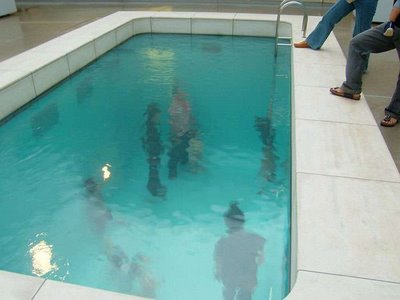
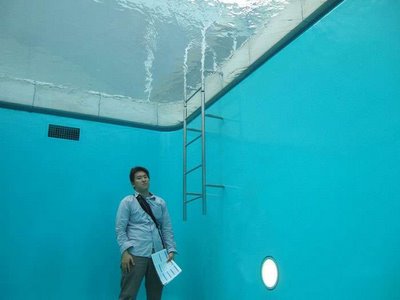
This is practically old news, but what the hell. Artist Leandro Erlich created a really cool faux pool for the Museum of Art of Kanazawa in Japan:

It’s been a permanent installation at the museum since 2004. Elrich created the effect by using two layers of clear glass with water in between them, followed by a layer of water on top.

I imagine that it would be incredibly surreal to be standing in a pool, under water, looking up at people. I think I would be slightly claustrophobic, and just a little paranoid that the water would come crashing down on me.

Elrich has a lot of interesting art installations at his website, like the Lost Garden.

(via TDW, via Dude Craft, via Crooked Brains)

Ah, the things technology can do

Who knew The Girl with the Peal Earring was so badass?

Vintage paperback covers

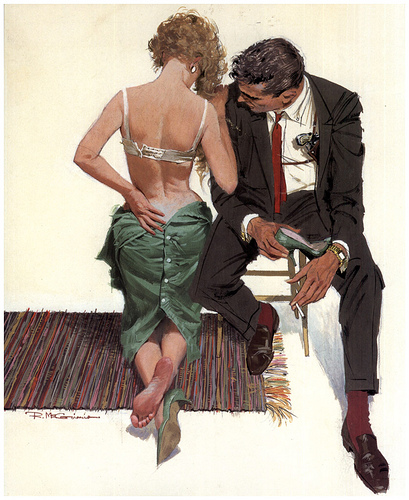
Based on a throwaway comment by Grant earlier today, I was reminded about a post I’ve been meaning to make about Robert McGinnis. Even if you are unfamiliar with this American artist’s name, you are more than likely familiar with his work.

If you have ever seen one of those old painted movie posters for a James Bond movie, with Bond holding his gun in that famous pose of his, you’ve likely seen McGinnis’ work. He originated that pose. Not only did he work on the posters for Thunderball and You Only Live Twice with a partner, he was solo artist for Bond on the posters for Diamonds Are Forever, Live And Let Die, and The Man With The Golden Gun.

On the other hand, if you are more of a bibliophile, you are more probably familiar with his work on paperback covers. He did what was possibly hundreds of them. While some were the typical romance novel covers, he seemed to have the most fun on those that involved a tough guy, a gun and a woman (who tends to be partial naked, preparing to get naked or completely naked). These are the covers for pulp detective novels that are so much fun.

Here’s a link to a Flickr gallery of his work, but be warned that some of the images are NSFW. There’s another one here that has more of his movie posters and is proabably a better choice if you’re at work.

What if paintings could come to life and sing?

French band Hold Your Horses! has come out with a cool video for their song “70 Million” where they re-create famous paintings, all the while singing along and playing their instruments.

It looks like they had a ton of fun making the video, and are pretty shameless about some of the poses. It doesn’t hurt that the song is pretty darn catchy, too!

(via)

The strangely compelling art of Basil Wolverton

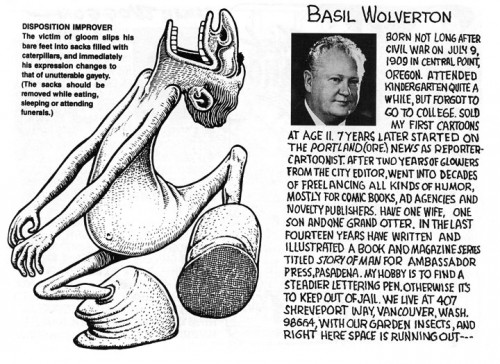
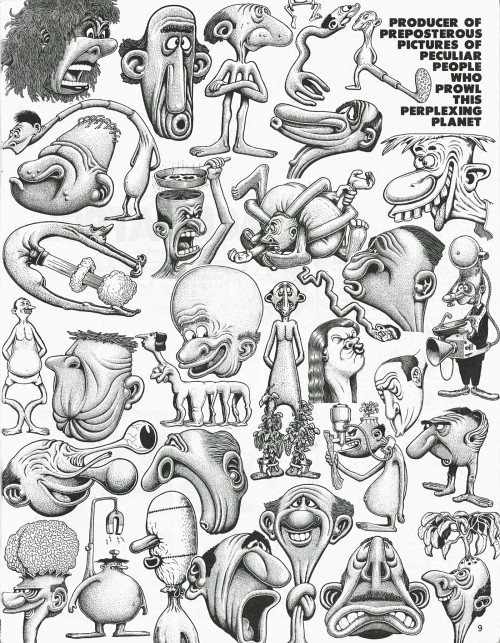
There’s not much I can say about Basil Wolverton that others haven’t said better and earlier. You may recognize his work from Mad Magazine, as I did, or perhaps from the work of the many artists he inspired.

I just happened across the poster below, which I love, and which generated this post. Click on it for a full-size image:

In Detroit, a house completely encased in ice

Wow — a group of artists in Detroit (where the foreclosure crisis is at its worst) are working to enclose a house completely in ice.

When you talk about “frozen” assets, you’re talking about money and possessions that you can’t use. This makes a legal and economic term absolutely physically real.

They’re getting positive reactions from the neighbourhood, as this video makes clear:

Check out the Ice House Detroit blog here.

Now I don’t know how to feel about the possibility of an economic meltdown.

Exploding picture frame reassembles iteself

I love the repetitive assembly/disassembly of this clockwork-driven exploding frame. Labled “Prototype 2″, it appears to be a work in progress (here’s Prototype 1) and I can’t wait to see what the final outcome is.

Personally, I’d like to see it as a clock, moving in slow motion, with pieces exploding during the hectic day and then settling down for a quiet night’s sleep (or vice versa, if you wanted to make a statement about nightlife or dreams or something).

How to work for minimum wage — and tax free!

(minwagebackground18

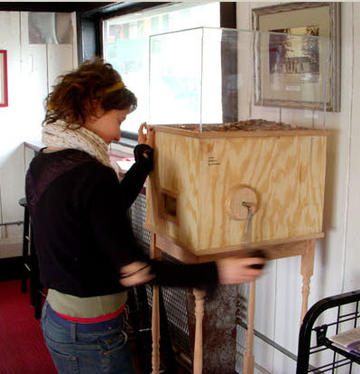
This art project made me laugh with recognition. Not only does it capture busy-work essence of most minimum-wage jobs, it really makes the point of how low-paying they are:

The minimum wage machine allows anybody to work for minimum wage. Turning the crank will yield one penny every 5.04 seconds, for $7.15 an hour (NY state minimum wage). If the participant stops turning the crank, they stop receiving money. The machine’s mechanism and electronics are powered by the hand crank, and pennies are stored in a plexiglas box.

Now, some quick back-of-the-envelope calculations:

Poverty activists where I am have long been agitating for a $10/hour minimum wage. That would be 1,000 pennies per hour. But, because there are 3,600 seconds in every hour, that’s still only a penny every 3.6 seconds. Try cranking that crank for a minute and a half, and I’ll bet it seems like the longest minute a a half of your life. Also, congratulations, you’ll have earned a whole quarter.

(via Boingboing)

Found metal turned into cool art

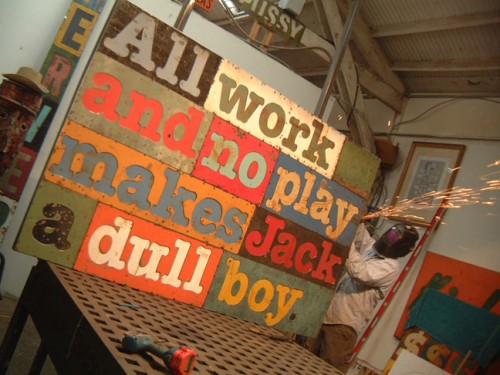
allwork_ddb

From BuckinghamStudio.com:

David Buckingham roams the windblown alleys, abandoned factories, gritty industrial areas, dodgy neighborhoods, and low deserts of Southern California in search of the cast away, the discarded, the forgotten: old 55-gallon barrels, wheelbarrows, tool boxes, road signs, tractor parts, car doors, gas cans, etc. These battered relics are carted to a dusty studio in downtown Los Angeles where they are muscled into works of art with a bewildering array of power tools and sheer force of will. All colors are original as found; David Buckingham is no painter.

I think I like “Charlie Don’t Surf” — one of a selection of movie quotes that he’s done. But there are loads of others.

He’s even got a video, if you poke around a bit.

A website that falls apart — because you looked at it

Temporary.cc sounds like an html version of the Heisenberg Uncertainty Principle. Basically, it’s a webpage that, with each unique visitor, deletes a bit of itself. When I visited, it was about 3/4 malformed code, with some chunky blocks of colour at the very bottom. As more and more people visit, it will eventually disappear entirely.

But, the questions that it raises live on. Am I partially responsible for the demise of this webpage? Should I feel guilty? Is it really a static webpage at all? Or should it be more properly thought-of as a slow-motion animation, where you can only see one frame at a time, and which requires collaboration to advance.

The designers say:

These deletions change the way browsers understand the website’s code and create a unique (de)generative piece after each new user. Because each unique visit produces a new composition through self-destruction, Temporary.cc can never be truly indexed, as any subsequent act of viewing could irreparably modifiy it.

Eventually, like tangible media, Temporary.cc will fall apart entirely, becoming a blank white website. Its existence will be remembered only by those who saw or heard about it.

Find a penny, pick it up, and maybe it’ll actually be worth something. Maybe it’ll be made from solid 18K gold!

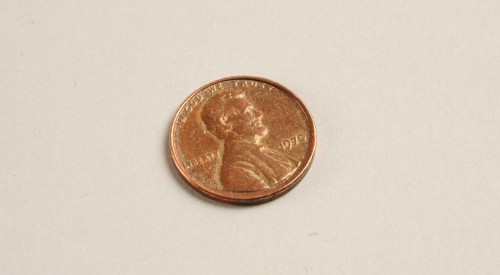
daws_counterfeit_penny_web

Like many people, I often eschew the humble penny. I have even argued for getting rid of it, in the past. The penny above, for example, is pretty unremarkable.

Except, that is, for the fact that it was made by artist Jack Daws out of solid 18K gold. They’re plated with copper so that they look and feel like regular pennies; however, they weight a little heavier, and the casting process made them a tiny bit smaller than a normal penny.

When he cast the gold pennies, in early 2007, he used about $100 worth of gold. Of course, the price of gold has skyrocketed since then, so the pure metal value of the “penny” might be several hundred dollars by now.

As pieces of art, Daws was selling the one-cent pieces for $1,000.

But then he decided to take it one step further. Armed with a golden penny and a handful of regular money, Daws went to LAX in March, 2007 — and spent it. From the New York Times:

He carefully put the counterfeit penny, dated 1970, down on the counter, counted out enough change to pay $11.90 for a Hustler magazine and left. He got a cup of coffee and sat down on a seat with the newsstand in sight, and watched for an hour wondering if any of the travelers had walked off with his golden penny and where it would end up at the end of the day.

It could have ended up forgotten in the bottom of a drawer, or melted down at a bank, or just lost or forgotten. But maybe it ended up in circulation, with dozens, perhaps hundreds of hands touching it, perceiving it as nearly worthless, and then passing on hundreds of dollars worth of gold to another stranger.

Would he ever know?

Well, a couple of weeks ago, a graphic designer in Brooklyn tracked his phone number down and left him a voice mail: “I think I found your gold penny.” From the Times story again:

Late this summer, when [Jessica] Reed was paying for groceries at the C-Town supermarket in Greenpoint [Brooklyn], she noticed the penny because the gold color had started to peek through. A fan of unusual coins, she slipped it back into her change purse and tucked it into the recesses of her mind.

Then recently, while doing research about a 1924 Mercury-head dime, she remembered the penny and typed “gold penny” into Google, which returned information on science experiments to give a penny a gold color. She added “1970” and found an item about … Mr. Daws.

She’s thinking about having it framed, which I think would make an awesome piece of art, along with a great conversation piece.

I’m certainly never going to look at a penny the same way again.

In case you’re interested, the gallery page (with original news release about the penny being placed into circulation and some other art pieces) is here. And I’m pretty sure that the graphic designer who found it, Jessica Reed, is the person being profiled here, and that she runs an unusual blog called “Pictures of Cake.” As far as I can tell, she hasn’t posted about the penny yet. Maybe she’ll bake about it.
An art installation like I’ve never seen

Commissioned by the Liverpool Bienniel, this art installation was created by Richard Wilson, and is called Turning the Place Over.

From the description on the Liverpool Bienniel website:

Turning the Place Over consists of an 8 metres diameter ovoid cut from the façade of a building in Liverpool city centre and made to oscillate in three dimensions. The revolving façade rests on a specially designed giant rotator, usually used in the shipping and nuclear industries, and acts as a huge opening and closing ‘window’, offering recurrent glimpses of the interior during its constant cycle during daylight hours.

The construction programme started in February 2007 and involved the careful deconstruction of the façade across three floors of the building, which was then reconstructed and fixed to the enormous pivot installed at the heart of the building. This astonishing feat of engineering is stunning audiences on many levels. Disturbing and disorientating from a distance, from close-up passers-by have a thrilling experience as the building rotates above them.

I can imagine this would be a pretty incredible sight to see in person. I was sitting here in awe just watching it on my computer.

Admittedly, I don’t know much about conceptual art pieces like this (or much about art in general), so I don’t really understand the why’s of making something like this, but it sure looks cool.

(via Today and Tomorrow)

Comic covers, before and after

Excellent blog that I’ll be checking regularly, called Covered. It’s a series of classic comic book covers, each presented as an original (like the 1987 Uncanny X-Men, above) as well as reinterpreted by a different artist (such as Aaron Conley’s take, below). Some of the covers are similar, others are wildly different — all are worth a view.

xmenafter

Fantastic art from cast-off cassette tapes

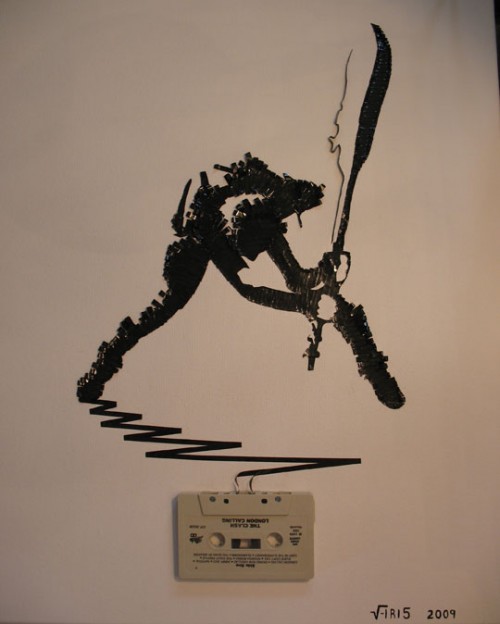
ghost-in-the-machine-the-clash

Artist Erika Simmons is a Georgia-based artist who, among other things, unspools the magnetic tape inside cassettes and turns them into portraits of musicians. I was struck by the Clash one, above, but she’s also got fantastic ones of Bob Dylan, Jimi Hendrix and Michael Jackson.

One of her most recent pieces is a portrait of The Dude made out of a Big Lebowski VHS tape.

I read a cool interview with her at Go Media Zine, where she explains a little about how she creates this art (draw the portrait in glue, cut the tape as little as possible) as well as the inspiration:

The cassette tape series came out of a desire to explore a theme of recursion… tangled hierarchy. Where is the music? On the cassette tape? In the head of the musician portrayed? Where does one begin and the other end? But you don’t have to look at it in that way to enjoy it. I tried to make something fun and easy-to-understand, but with deeper things to think about, if you so choose.

She’s got a website of her own, but it links to her Flickr page for her full portfolio. There’s also an online store, if you’re interested in owning an original (MJ will set you back $2,000 but she doesn’t do prints, so this is one of a kind).

Bringing two of my loves together

I love photography, and I love music. It would be hard to say which I love more, or if it’s even possible to pick one over the other.

Laurie Scavo seems to have the same passions that I do, and instead of picking one, she has melded the two together in a new artistic project.

Her website, Stolen Lyric, is a series of photographs with a line of a song imposed over the image. She also includes the song and artist that the lyric is from. The photos and the song can look kind of random, but at other times speak to each other, enhancing the other in a way.

I’m partial to her latest image:

The line is from a great Pete Yorn song, Strange Condition. Here it is:

Pete Yorn - Strange Condition

Scavo says on the site that she will do commissioned work, and that the images are made to fit into a record frame (a design style that Grant is partial to).

(via music blog I Am Fuel, You Are Friends)

Dansette