Would you like a slice of pizza pi?

It’s a double-wheeled pizza cutter shaped like the symbol π, and it’s doubly awesome because when you slice up a pizza, you’re literally exploring the relationship between a circle’s circumference and its diameter.

Now, I know it’s too late for Christmas, but maybe that special math geek in your life needs a Valentine’s Day gift?

It’s $18 at Think Geek.

(via Coudal)

Solve multiplication problems with an isometric grid

I’m not sure if this is a real improvement over the traditional way of doing multiplication by hand — you’re just counting up line intersections instead of adding up columns of numbers — but it sure is pretty!

(via Gizmodo)

Use algebra to calculate precisely how much to spend on Christmas gifts

If you hate Christmas shopping but love mathematics, you’re in luck. Over at Wired, Garth Sundem has detailed a formula that you can follow so that you spend exactly the right amount of money on each person’s gift. Then you don’t end up buying your brother-in-law a $50 gift and running out of cash before you get anything for your girlfriend.

He says:

1. Define your total budget. Be realistic. For this example, I’m using $500.

2. List everyone for whom you need to buy a gift.

3. Now next to each person’s name, give them an importance rank from 1-10 (10 high).

4. Sum all the people, multiplied by their ranks. It should look something like this 10(wife)+8(kid1)+8(kid2)+3(dad)+3(mom)+1(in-laws)+4(nephew)=37(total)

5. Set your total equal to your budget: 37(total)=$500

6. Solve for (total): total=$13.50

7. Multiply this “total” by each person’s importance to see how much you should spend. In this example, your wife gets 10*13.5=$135, and your kids get 8*13.5=$108.

With only $500 in your pocket, and without time at this point to dilly dally with another shopping trip, you’ll be forced to stick to it.

Of course, this only works if you can follow your budget perfectly. If you instead find the perfect gift for someone but it’s a few bucks higher than you’re “allowed” to spend, it will throw all the other gifts out of whack.

Also, in any realistic universe, finding a gift that is to-the-penny exact on your budget will be much more stressful than shopping in the first place.

I would add some fuzziness. Also, this would be interesting to figure out after Christmas, when you reconcile the receipts, and see how close you come to the ideal budget.

A bottle opener for math geeks

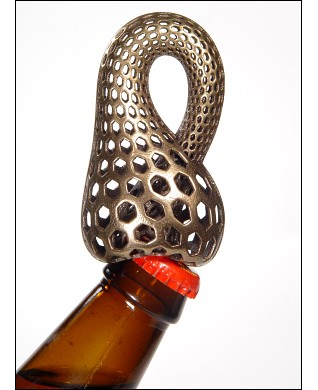
A Klein bottle is like a Mobius strip in three-dimensions, but that’s not really accurate because a Mobius strip is actually a two-dimensional form expressed in three dimensions, and the Klein bottle is actually a four-dimensional form expressed in three dimensions.

Essentially, the inside of the bottle is also its outside. If you were able to perceive the Klein bottle in four dimensions, it wouldn’t plunge into itself (there would be no self-intersections).

The “no inside, all outside” of the bottle is what makes it cleverly perfect for opening a beer bottle. Or, as Bathsheba Sculpture puts it:

The problem of beer That it is within a ‘bottle’, i.e. a boundaryless compact 2-manifold homeomorphic to the sphere. Since beer bottles are not (usually) pathological or “wild” spheres, but smooth manifolds, they separate 3-space into two non-communicating regions: inside, containing beer, and outside, containing you. This state must not remain.

A proposed solution Clearly the elegant course is to introduce a non-orientable manifold, which has one side and does not divide 3-space. When juxtaposed with the beer-bounding manifold described above, it acts to disrupt the continuity thereof, canceling the outdated paradigm of distinction between interior and exterior. This enables the desired interaction between beer and self.

Implementation The Klein Bottle Opener shown above is an example. It is palm-sized, durably constructed in stainless steel, effective, and blissfully ergonomic.

Q E D You need one.

You can buy these, at Bathsheba Sculpture. And they actually work. But they are a jaw-dropping $78, which is insane for a bottle opener, but I suppose the price is actually fairly reasonable for a fourth-dimensional object.

(via Scienceblogs)

Short Film Friday: 7×13=28

Ok, this is a cheat. It isn’t really a short film, but part of a longer work.

On the other hand, I’m tired and this makes all sorts of sense to me. Plus, it stands on its own and it is hilarious.

There’s something to be said for humor that is smart and funny and doesn’t instantly go for the easy fart joke. (Not that I don’t like the occasional fart joke…)

Realistic lottery simulator

Like to play the lottery? Try the new “Incredibly Depressing Lottery Simulator” at Cockeyed.com.

Play here.

It simulates the Mega Millions lottery, which uses slightly different rules than the Lotto 6/49 that I’m used to, but I’m sure the chances of winning aren’t that different.

I picked five numbers, and let it run as if I were playing those same numbers twice a week for the rest of my natural life. It cost me $10,400 and I won back just over $600 of that.

Woo-hoo?

Is it barrels of oil? Or gallons?

One of the things that has persistently annoyed me about the BP oil hemorrhage has been that we just don’t know how much oil is gurgling out. Partly, that’s because it is inherently difficult to measure the volume of an oil-and-gas mixture at the bottom of the ocean. But, frustratingly, there’s been no consistency on units.

As a British company operating in American waters, I suppose I’m not surprised to hear it described in Imperial units. So the Washington Post, for example, reports that:

BP’s latest plan calls for capturing 1.2 million gallons of oil a day by the end of the week. The company’s current capacity is 756,000 gallons a day …. BP has outlined plans to capture 2.1 million gallons per day by the end of the month.

But, being that this is oil, I’m also not surprised to hear it described in barrels. So Reuters, for example, reports that:

Under its new collection plan, BP hopes to increase its capacity to capture oil from around 15,000 barrels a day now to 40,000-53,000 barrels by the end of this month and 60,000-80,000 by mid-July.

Sigh. Are those numbers equivalent? Luckily, WikiAnswers has, um, an answer:

There are 55 gallons in a drum and 42 gallons in a barrel. Originally there were 40 gallons to a barrel. However, that was changed in the mid-19th century to give a little extra so consumers wouldn’t feel “cheated.” A little over 23 gallons of gasoline can be refined from a barrel of oil. Other products (jet fuel, lubricants, etc.) make up the rest.

Therefore, 40,000 barrels is about 1.7 million gallons. So I guess it’s roughly the same, but there’s still no good way to compare the numbers.

Also, since there are a little less than 3.8 litres in a gallon, you can do the math and figure that each barrel contains about 160 litres of oil.

If you’re interested, then, you can take some of the latest estimates and calculate the metric equivalent. So if the oil hemorrhage under the Gulf of Mexico is spewing 40,000 barrels per day, then that would work out to be be about 6.4 million litres of oil per day.

A day is a long time. That’s more than 74 litres of oil each and every second.

Since April 20.

Happy Pi Day — tasty, tasty π

March 14 — or 3/14 in the notation — is Pi Day. It’s a day to celebrate the mathematical and geometric constant known as pi (or more properly π). And pi, of course, is 3.1415…. (it continues forever).

If you slept through high school geometry, π describes the relation between a circle’s diameter and its circumference. That is, if you have a wheel that’s got a diameter of, say a foot, each full rotation of that wheel will go about 3.14 feet.

Wikipedia has a fuller discussion, and graphics. And the, to really burn your brain, you can wiki-hop on over to their treatment of other irrational and transcendental numbers (π is both).

Some people suggest that you should mark March 14 as Pi Day by memorizing the digits of π — do it here, in a “fun” online game.

Others suggest that you should also mark Albert Einstein’s birthday.

Most popular, of course, is the phonetic celebration — celebrate π by eating pie.

That sounds right to me. Now, hmmm, what kind of pie? I suppose I will have to sample a few. Perhaps three and a bit?

Curling, but with math

Ah, the Winter Olympics, when all kinds of weird sports come out of the woodwork. Truthfully, I think there are places in the world where two-man luge is just a part of life, and they have high-school teams and everything. And if you don’t believe me, well, I played on my high school curling team — and just try to explain that to a Floridian.

So, if you’re having trouble following curling at the Vancouver Olympics, I understand. It’s definitely one of the more strategic sports at the Games, in fact it’s sometimes called Chess on Ice. Even with my small background in the game, and even with the assistance of the analysts, I can’t always follow the rationale for one shot over another.

Now, let’s add algebra.

A blog called Curl With Math, written by an Albertan, does just that. It’s supposed to actually explain curling using baseball-like statistics, but it will obviously only work for that small subset of the world that loves both university-level mathematics, and sports.

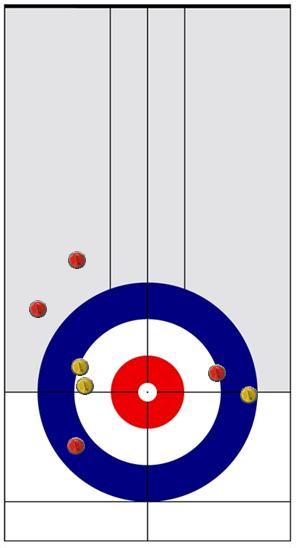
As an example, from the recent BDO Grand Slam, the blog looked at the quarterfinal match between eventual winner Kevin Martin and (ex of my hometown) Mike McEwen. Here we are in the seventh end, with McEwen already trailing 6-3, although he has the hammer:

In the 7th End, McEwen is behind 6-3 with hammer but after a jam on Kevin’s run-back attempt, is looking at scoring 3 and possibly even 4. Mike makes a draw around the corner guard to sit four and Kevin, as expected, attempts a double on the two open McEwen stones. Martin surprisingly noses the top rock leaving yellow sitting two.

Mike Harris states there is a double for four if he wants to attempt it. He does and misses, scoring only two. If McEwen simply draws for three, WP = 25%. Per earlier analysis, Mike may believe it to be even less, given his competition. If he is able to score 4, they would be 1 up without hammer playing the final end and WP = 60%. Interestingly, Martin is 12-20 or 37.5% when down 1 with hammer in the final end; very much in line with the average. Needless to say, the triple does not have to be made often for this to be the correct call. The miss, however, needs to be thick to get three and as is often the case. I’ll spare the reader the formula, but even if McEwen makes the same mistake 30% of the time and only gets the double 10%, it is still a break even decision.

If you are nodding your head as you follow that, you’re a candidate for the much-more-involved posts — the ones that do involve formulas. Check out the blog — he hasn’t done any Olympic analysis yet, but I’m sure it’s coming.

How to turn a sphere inside-out

Amy got me a great book for Christmas — The Math Book (she was inspired by the BoingBoing gushing, here). It goes through the history of math and spends a page on each of 250 different concepts. I’ve been reintroduced to prime numbers and early numerical paradoxes, but I’ve also learned a whole heck of a lot.

Some of it is beyond me, frankly, but author Clifford Pickover does a fantastic job of making each concept accessible to anyone who’s willing to think a little bit. Or, just to dream and let their imagination run a little wild.

There’s been tons already that I think I’d like to blog about, but the one that I read last night and sticks in my head is about turning a sphere inside-out.

Sure, you could poke a hole in a tennis ball, say, and then pull the inside part out through the hole, but that’s against the rules. Mathematically, for a sphere to turn inside out, there can’t be any holes and there can’t be any creases or pinching. Luckily, a sphere can pass through itself. (I tried visualizing a soap bubble, if two bubble films could come together and then come apart on the other side, like water waves, say.

So, can you inside-out a sphere? Turns out you can — but it’s not easy. If you’ve got a few minutes, these videos show you how its done and take you through it.

Happy Odd Day!

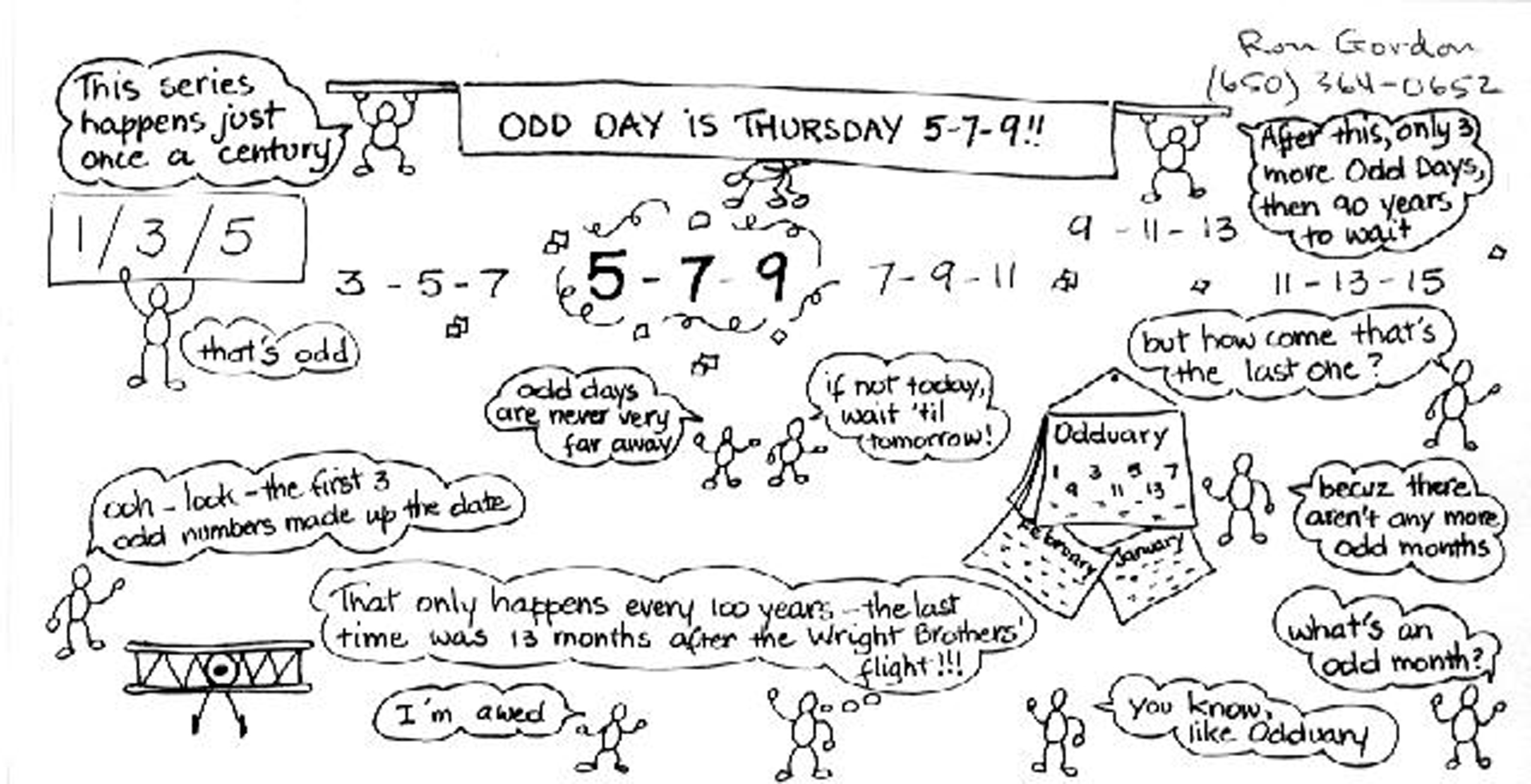
Odd Day cartoon from the Odd Day site

What is Odd Day, you ask? Well, according to the Odd Day website:

Three consecutive odd numbers make up the date only six times in a century. This day marks the half-way point in this parade of Odd Days which began with 1/3/5. The previous stretch of six dates like this started with 1/3/1905—13 months after the Wright Brothers’ flight.

This is, as Grant pointed out, based on the way dates are written in the States (month/day/year) as opposed to how we Canadians would write it (day/month/year).

First there was 1/3/5, which was followed by 3/5/7. We’re on 5/7/9 today, next will be 7/9/11, then 9/11/13 and lastly 11/13/15. And then that’s it for ninety more years!

Odd day is largely promoted by a California teacher named Ron Gordon who also promoted Square Root Day. Even though I have a general distaste for all things math, I appreciate that Gordon is trying to make it more fun and interesting.

The Odd Day site is pretty cute and it provides some fun facts:

Things to do on Odd Day: It’s a great day to do your odds ‘n ends, give a friend a high-five, root for the odds-on-favorite, read the Wizard of Odds, watch the Odd Couple, say aaaahd in the doctor’s office, look for sea odders, find that missing odd sock, and beat the odds.

Odd Days are the unsung numerical peace-keepers—if it wasn’t for odd numbers, all the even numbers would bump into each other!

The simplest way to celebrate Odd Day?—just share it with a friend. Greet them with the news of the day (they’ll be awed)—and they, in turn, can tell another. It’s kind of like a secret that you can’t help sharing. A little math, a little smile, a little fun—that’s Odd Day!

An Odd Ode:

As Odd as it is, the day will be fine,
You see, it’s the numbers 5,7, and 9.
Three odds in a row to tell you the date,
We’ve only three more, then a 90-year wait.

(Image courtesy of the Odd Day site. Click for full size)

Fun with math

Did you ever stop to think that maybe everything we know is wrong? What if we have a flaw in our thinking at such a basic level that we can’t even see it? Where would that leave us?

In that vein, allow me to prove that 2 equals 1:

a = b

a2 = ab

a2 - b2 = ab - b2

(a + b)(a - b) = b(a - b)

a + b = b

2b = b

2 = 1

There you go. Our mathematical system is fundamentally wrong.

Or is it?

Kudos to the first person to explain this simple mathematical proof in a way that anyone can understand…

What is the airspeed velocity of an unladen swallow?

It’s a classic question:

Luckily, math nerds have tried to come up with an answer:

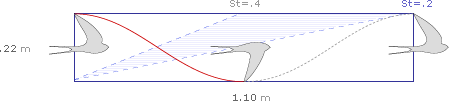
A 54-year survey of 26,285 European Swallows captured and released by the Avian Demography Unit of the University of Capetown finds that the average adult European swallow has a wing length of 12.2 cm and a body mass of 20.3 grams.4

Because wing beat frequency and wing amplitude both scale with body mass,5 and flight kinematic data is available for at least 22 other bird species,6 it should be possible to estimate the frequency (f ) and amplitude (A) of the European Swallow by a comparison with similar species. With those two numbers, it will be possible to estimate airspeed (U).

swallow_st2

Whew. And that’s just part of it. I wouldn’t spoil the answer, except that the answer has just spawned a number of great debates.

Lest you think that this is a poor use of time, I’ll remind you that questions can have consequences:

I will forever be grateful that, on its 25th anniversary, I got to see this movie on the big screen in a real theatre.