Posts tagged: cheese of the week

Cheese of the Week: Zerto fresh mozzarella
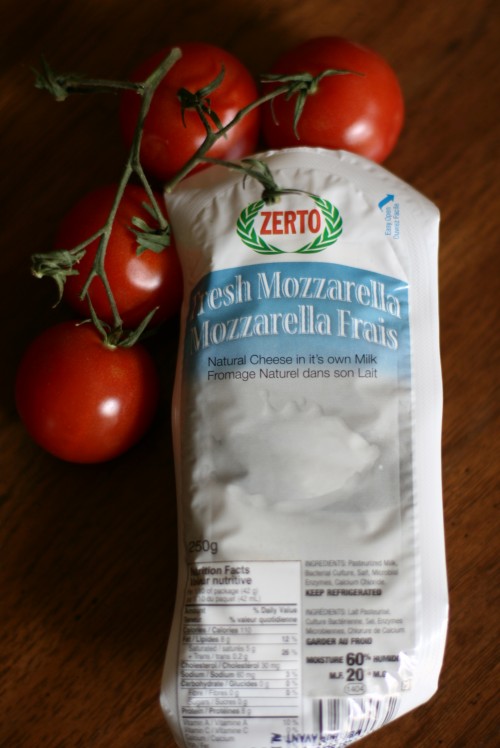
Along with cheddar, mozzarella is probably one of the most widely eaten cheeses in North America, if not the world. It’s found in almost everything. Partly, that’s because it is such a mild, pleasant cheese that nearly everyone likes it. But mozzarella also has a wonderful set of qualities that make it useful in loads of cooking situations: It’s firm enough to hold its shape and to cut or to grate; It’s stringy and can be pulled apart; And it’s a great melter, if you want to put it on, oh, I dunno — pizza.

But for this week’s Cheese of the Week, we didn’t just want to pick up some random grocery store cheap mozza. Instead, we were struck by the care and apparent authenticity of this cheese, which was billed as “natural cheese in its own milk.”
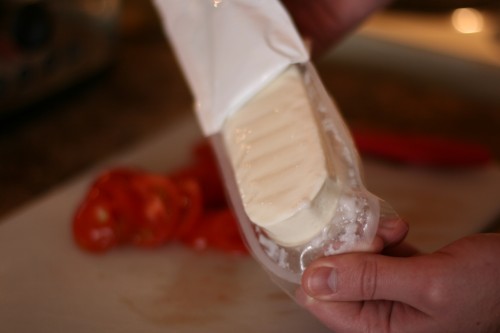
Peeling back the packaging revealed a wet-coated cheese that, indeed, spelled fresh. I mean that in a good way. It had a bright, milk-like smell, if you could say it had a smell at all. There wasn’t really all that much whey in the package, just enough to keep the cheese moist, and it wasn’t at all slimy.

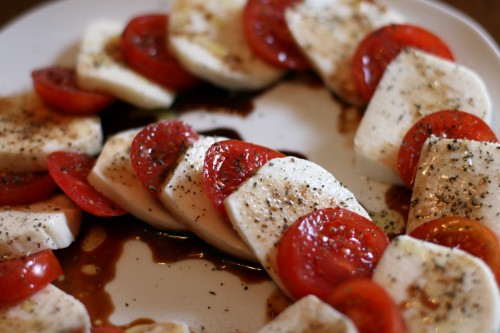
Fresh mozzarella, combined with the fresh spring air outside, and the fact that we had some delicious tomatoes that needed to be used up, made our next step obvious: caprese salad. One of the simplest recipes we know, a caprese salad is simply cut-up mozzarella slices alternated on a plate with tomato slices and drizzled with balsamic vinegar. We also like to add a little salt and pepper, some basil, and a little olive oil to the dressing.
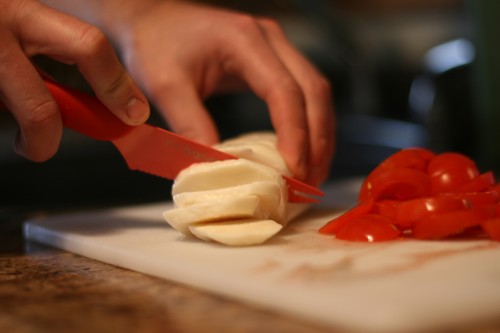
Cutting the mozzarella was actually more difficult than I had expected, even with an ultra-sharp, nearly brand-new knife. This cheese was firm and spongy, and it required a fair bit of force to cut through the striations that are natural to mozzarella.

A few snacks along the way worried us that this mozzarella was maybe a little too mild, too fresh — it verged on flavourless. It was too much skim milk, not enough cream, I commented. Amy said she preferred saltier mozza (but Amy prefers everything with additional salt).

It sure was a good-looking cheese, though — quite white, but with enough colour to it that it didn’t look washed-out or bleached. Paired with bright red tomatoes, drizzled with oil and balsamic, then spiced, it looked amazing.
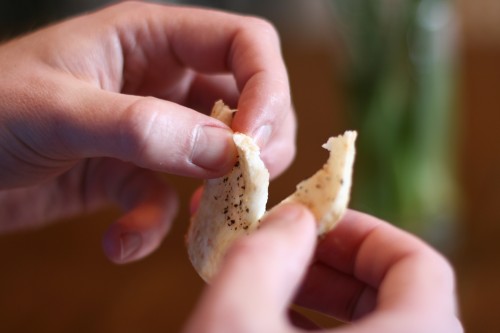
I picked up one of the pieces to see how it stood, on its own. You could peel it apart, almost like one of those “Cheese Heads” string cheese sticks, if you picked at it enough, but biting into it, it had a classic mozzarella give — almost like a very firm gelatin — before your teeth cut through.
Although very, very, very mild, this cheese actually worked really well when paired with a fresh tomato and a ton of spices, plus vinegar. I had worried that the sharp vinegar, the salt and the very tomato-y tomato that we had might overwhelm this poor cheese, but it’s almost as if the humble mozzarella craved a little bit of competition.

The salt and the balsamic really brought out the natural mozzarella flavour, and we found that this cheese was an excellent neutral base on which to accentuate the rest of the ingredients.
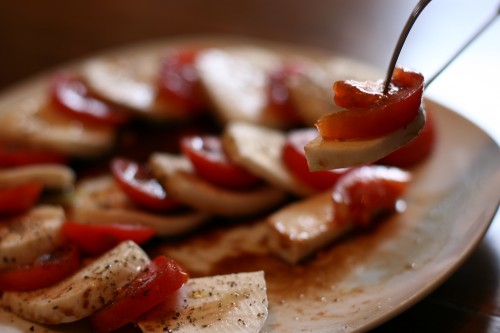
Yum! Delicious! This salad did not last long.

If we had had to try this mozzarella on its own, perhaps with soda crackers, we probably would have been disappointed. If we had bought this mozzarella to shred it for pizza, or to melt it on toast, we probably wouldn’t have cared much for it.

This fresh, still-in-its-own-milk mozzarella deserves something a little sprightlier. It deserves something like a caprese salad. And there, it shines.
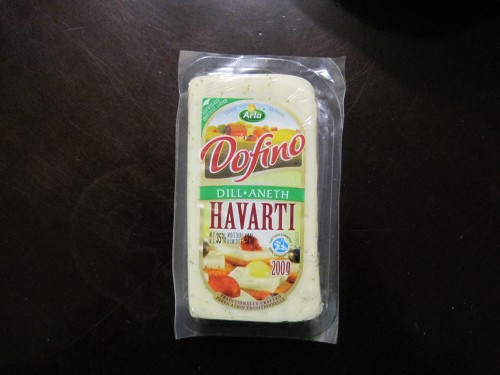
Cheese of the Week: Dofino havarti dill

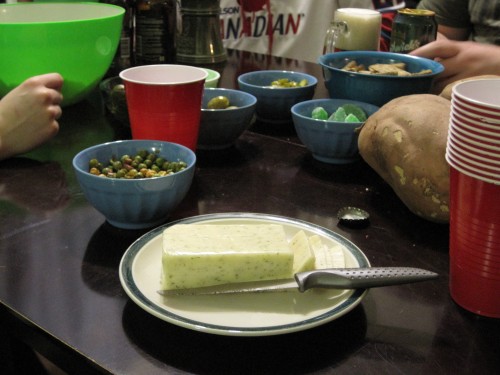
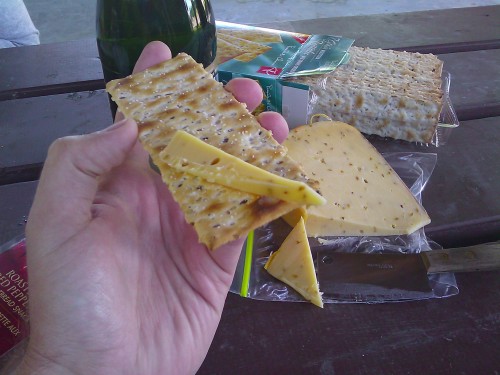
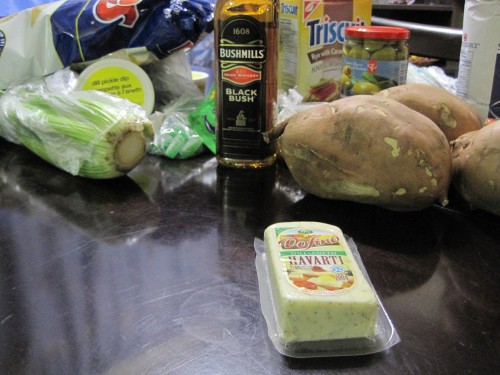
As part of our St. Patrick’s Day shenanigans, we went out shopping for snacks, and ended up buying just about anything that was green or green-related. That included this havarti cheese, which qualified because it had specks of dill in it. Oh, you want to see it in context? Here’s a partial:

So, in between the homemade yam fries and the chips-and-dip-and-food-colouring, we also sliced up this cheese. There was some debate about trying to colour the cheese with the food colouring, but we decided that it wouldn’t have worked very well. Maybe a cream cheese, but not a havarti.

Like most havartis, this specimen has a bit of an oily sheen at room temperature and it quite soft and spongy, making it a bit of a challenge to slice. Luckily, this titanium knife had an exceptionally sharp edge, and the poor havarti never stood a chance.

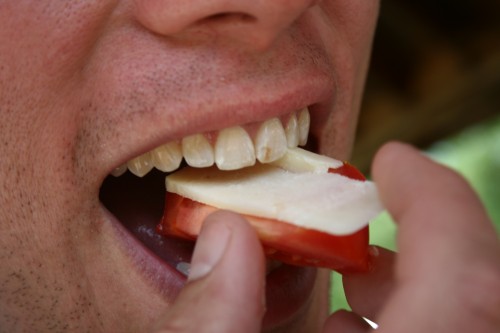
Amy, here resplendent in her commemorative Potato Famine T-shirt, takes a sample bite of the havarti dill on a rye Triscuit with caraway seeds.

Although our brains were addled by green beer and Irish whiskey, even stone-cold sober there wouldn’t have been much to write about this cheese. It’s got a very mild taste, and the addition of a tiny bit of dill doesn’t do much either to add or detract from the taste.

It was pleasant, sure, inoffensive. That’s havarti. Often, so is dill. Paired, they make for a very milquetoast cheese.

In fact, the most standout memory I have of the whole episode is one of the guests, Nicole, commenting that her new favourite cheese was edam. Sorry, havarti dill, but when you’re upstaged by a second-hand cheese comment, that’s really saying something.

Cheese of the Week: Caronzola

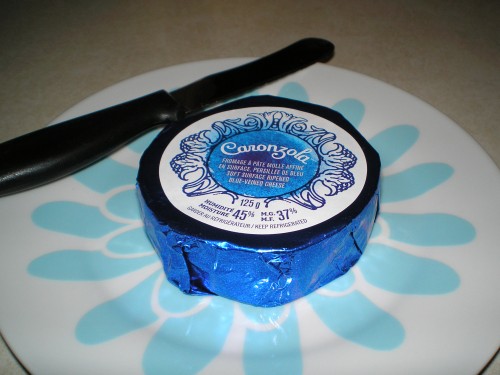
I was walking past the cheese counter in a lacklustre mood when, suddenly, this bright, sparkly blue package caught my eye. I’d never seen this shimmery foil-wrapped cheese before. It was the only one of its kind in the stack of cheeses, and I couldn’t find a price tag on it, or on the shelf above it.

But the price didn’t matter — I had to have it.

Caronzola. What kind of cheese was that? Obviously a gorgonzola homage, but I whipped out my phone to Google it and all I got was a social networking profile for one Caron Zola.

Mysterious! Alluring.

I had to make it mine.

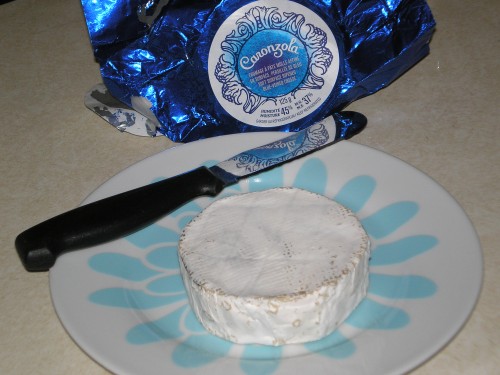
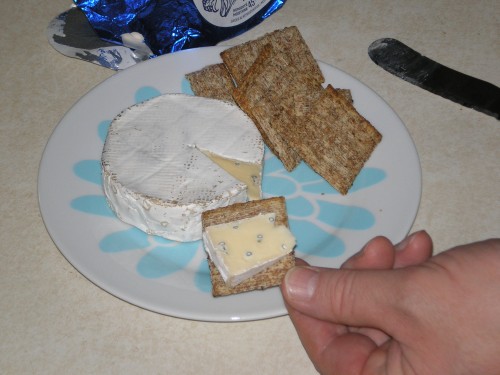
Bereft of its evening-gown attire, the Caronzola lay there, coated in a white rind, looking for all the world like an average, ordinary, everyday brie or camembert — and yet, there was something enigmatic about it.

The words on the package said “blue-veined”, but there was nothing blue about this cheese. And yet, that sparkly package hinted at something out of the ordinary.

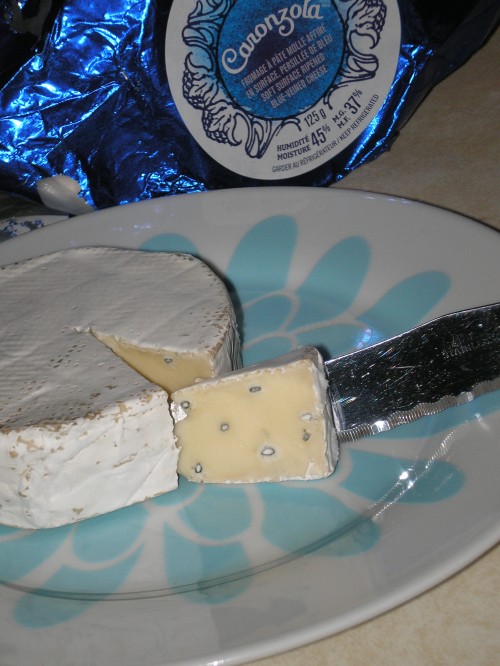
Aha! Despite the modest exterior, the plain white rind, the exciting package was right — this was a cheese with a surprise inside!

Streaked with blue, the cheese revealed itself to the knife as a hybrid: part brie, part blue.

It looked for all the world like a brie, but it was so much more. It was stiffer than a brie, for one thing, almost aged. And of course, the blue veins running through it gave it a distinctive blue-cheese-aroma.

And yet, it wasn’t overpowering. Someone has gone to great trouble to make these two very different cheeses play well together.

Thinking of the pungent nature of blue cheese, we popped it on a sturdy, salty Triscuit. But we didn’t need to. This was a very mild blue cheese — hardly blue at all, you might say. And yet it wasn’t very brie-like either. The nuttiness was there, but the harsh, almost ammoniac flavour wasn’t. And, as I said at the start, it was much firmer — without the tendency to get liquidy that some really nice bries do.

I couldn’t believe how brie and blue could come together, and produce something so different, yet so mild, and so enjoyable. Definitely a cheese that you could serve as a conversation-starter, or if you wanted to introduce a new cheese-o-phile to the world of blue.

Cheese of the Week: Cape Vessey

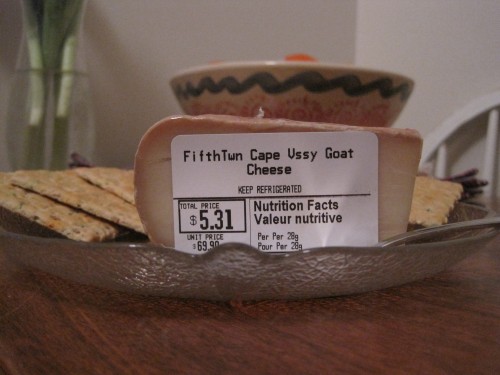
Amy picked me up a wedge of this cheese, and at first I couldn’t believe my eyes — the label said “FifthTwn Cape Vssy Goat Cheese” and I was convinced that this was either a case of massive typo, or (more likely) that it was a Welsh cheese.

In fact, it put me in mind of a night out, years ago, in a Quebec City bar, where we had gone to see the Watchmen. According to our tickets, the opener was a band called “Wepping Yile” but when they got up on stage, the singer had a few laughs about that. Turns out their real name was Weeping Tile — and the singer was a not-quite-yet-famous Sarah Harmer.

Years later, I saw Harmer at the Regina Folk Festival, and after her main stage show, she came and sat in the crowd — just a few feet away from me. I wanted to say hi, and ask her if she remembered the Wepping Yile incident, but I never worked up the nerve.

Anyway, as it turns out, the “FifthTwn Cape Vssy” has suffered a similar fate. I’m guessing there is a limited number of allowed character on the label printer, because a few seconds with Google has brought up the proper name of this cheese: Cape Vessy, and it’s produced by an artisan cheese company called Fifth Town.

Oh, and they’re not Welsh. They’re Canadian. They’re from Ontario — actually, and somewhat confusingly, they’re from Prince Edward County. They’ve even been profiled in the Globe and Mail.

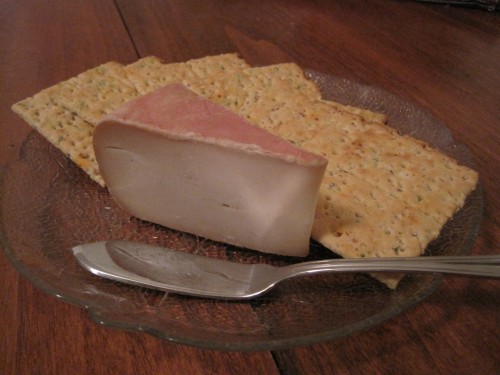
The cheese, at first glance, looks a lot like some other semi-soft, washed-rind cheeses that I’ve sampled before — and the immediate smell upon was opening the shrink wrap was pretty reminiscent of pungent cheeses, like the Oka.

But the smell dissipated pretty quickly (although it stuck around on your fingers). And even Amy wasn’t scared off by it.

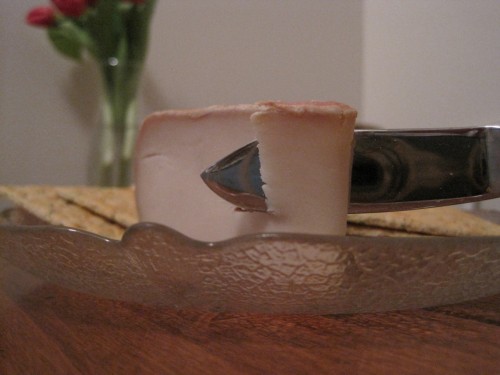
I thought this cheese would be a little softer, but it has a nice firmness to it — it was almost too firm to cut with this knife. The rind, although distinct from the ‘flesh’ of the cheese, was easy to cut through and didn’t deform the cheese underneath while pressing down — even with a fairly dull cutting instrument.

The soft colour of the cheese was pleasing to the eye — not too yellow, nor too white.

Amy took the plunge on the first bite. It was a pretty great cheese, actually!

As a goat cheese, it has an earthy flavour, very rich and ripe, but this cheese took that goatness and presented it in a very mild way. And although the smell, like I said, was initially pungent and stuck to your fingers, the flavour wasn’t overpowering. Rather, it was a very accessible variety of goat cheese.

The mild flavour did have a tendency to build as you ate it. And the firm texture became almost creamy in your mouth — spreading like a cream cheese, actually, if you let it linger, though you never would have been able to do that with a knife.

We enjoyed this cheese on rather plain stoned wheat crackers, which allowed the full depth and complexity of the flavour to come through. We accompanied it with Kilkenny beer — an Irish cream ale that I’m not normally that fond of, but which went pretty smoothly with this cheese.

If you don’t normally like strong cheeses, or goat cheeses, this would be a good introduction to the style. It’s distinctive without being overwhelming. A definite buy-again.

And, if you’re interested, Fifth Town is North America’s greenest dairy. It’s a LEED-certified Platinum, which is the highest level of environmental certification possible. It’s heated and cooled using a geothermal system, and at least partially powered by a wind turbine and solar panels. The cheeses are aged in man-made underground caverns, which are naturally cool and damp, rather than in a refrigerated above-ground room.

Actually, here’s another Globe and Mail feature — all about how environmentally friendly they are.

Good stuff — and good cheese.

Cheese of the Week: Manchego sheep cheese

I do not think I have ever had pure sheep cheese before. And if I have, it’s only been feta (to which, you may be interested to learn, only up to 30% goat’s milk may be added).

And I don’t think I’d ever even heard of Manchego cheese before, so I knew this would be an interesting evening, when Amy and I picked it up.

She wasn’t sure about it — it looked a little bit too much like a Parmesan, she though, and it was in that section with all the other hard cheeses that you have to grate. But I countered that the cheese had much more give to it than those other cheeses, and I was pretty sure we could slice it and enjoy it without resorting to the grater.

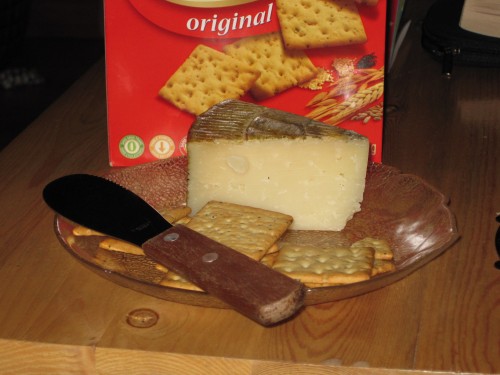
When we unwrapped it, it did have a characteristic Parmesan-like smell, but not overpowering. It also had a “pressed” appearance, like all the whey had been forced out, leaving it slightly dry and flaky looking, but not in an unpleasant way.

Slicing into the cheese was easy — it had a firm resilience, but it wasn’t as solid as a Parmesan. It was strangely soft and crumbly for its firmness, actually.

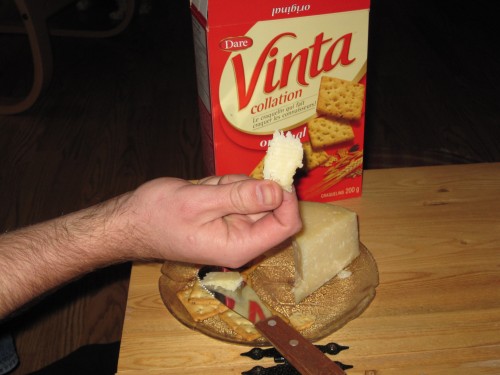
On crackers — and with wine — this was a very, very good cheese. All present were impressed. It had a Parmesan-like taste and texture, but almost as if the Parmesan had been mixed with feta. It was salty, but not overly salty. And it had a cheese-like smell, but not one that also smelled like adolescent-male socks.

As a slicing cheese, it wasn’t perfect; it was difficult to keep thin slices together, and it was fairly crumbly.

But it held its own against a deep red wine, and yet had a discreet enough taste that you could eat it on a cracker without being overpowered.

This is a versatile cheese.

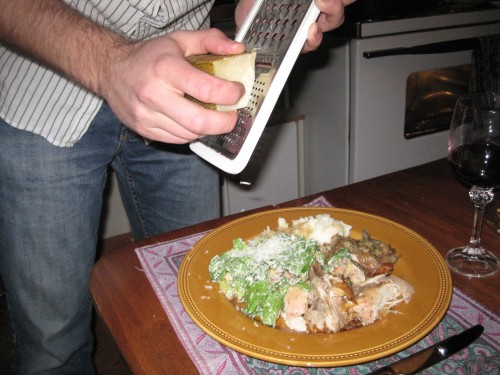
And you know, in the end, I grabbed a grater to try it on a Caesar salad, instead of grated Parmesan.

Boy, was I glad I did. Even against the Caesar dressing, this cheese held its own on my palate, and it added a twist to the flavour that stood out without overly, well, standing out.

It grated nicely, too.

Highly recommended for those of my readers who wish to branch out from their standard cheeses into something that’s quite a bit different, and yet aren’t ready for a “funky” cheese like gorgonzola.

Cheese of the Week: Jarlsberg

cIMG_3648

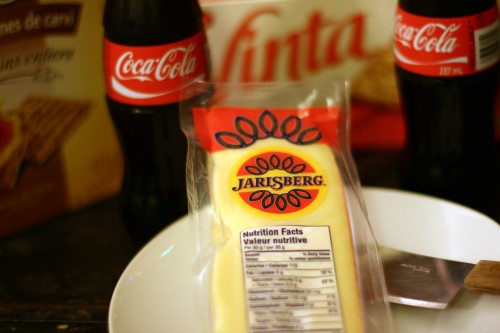
Ahh, straight from Oslo, it’s a cheese with holes in it that’s not a Swiss cheese. It’s Jarslberg, a cheese that’s almost as fun to say and to spell as it is to cut up and eat.

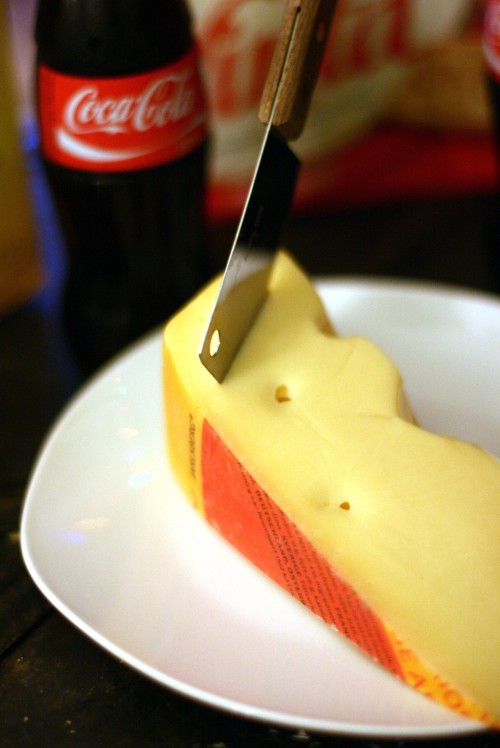
Amy and I thought a nice big wedge of Jarslberg would probably make a perfect late-night snack, so we picked up some crackers to go with it, and I managed to snag a couple of real, actual glass bottles of Coca-Cola as well. Maybe it’s not super-fancy, but it seemed like just what we were craving.

cIMG_3651

Immediately upon peeling back the plastic and sinking a knife (a mini cleaver, actually, perfect for cheesing) into the firm flesh of the cheese, we knew that we had made the right decision. There wasn’t a pungent smell. There wasn’t a weird consistency. There wasn’t any mold. There was just a plain wax rind — one that came off easily — and a pale yellow cheese that had pleasing holes in it.

There weren’t quite as many holes as in the stereotypical Swiss-style cheese, but this was a cheese that was definitely pock-marked. And seeing as how we had bought it in a wedge, it was about as “cheesy” as you can get. This is a real-life cheese that cartoon mice would fight over.

Or, actually, it’s a knock-off.

Apparently, you see — at least, according to the official history at jarlsberg.com — the cheese is a modern re-invention:

In 1830, the Swiss came to Norway’s Jarlsberg and Laurvig County (known as Vestfold County today) to teach the Norwegians to make cheese. These foreign master cheese makers were famous for making cheese with holes. There was active production in Norway until 1832. The cheese disappeared but the tale of its delicious taste was still in memory.
In 1956, the academic community at the Agricultural University of Norway at Ås undertook the task of reviving the cheese recipe from 1830. Professor Ole Martin Ystgaard and his team developed during his research a semi-hard, medium-fat cheese with holes, successfully combining the cheese-making traditions with modern technologies. The new cheese was named Jarlsberg after the county, where the earlier version had been made at the beginning of the 19th century. A new cheese category was established.
The export of Jarlsberg started cautiously in 1961. Today, TINE BA exports a total of 12,500 tonnes of Jarlsberg, with the USA, Canada, Australia and the EU being our most important markets.

And we here in Canada thank those hard-working scientists!

cIMG_3653

Jarslberg cuts like a dream. It is firm enough to hold its shape, but it’s not so hard that you have to grate it. A child could cut this cheese. In fact, a child would probably clamour to cut this cheese, since it’s so fun to cut through, and to have the knife follow a straight line (one of my cheese pet peeves is when your knife jags to the inside or out, maing slices into wedges). The best part, though, is feeling the blade of your knife give way under each bubble of a hole in the cheese.

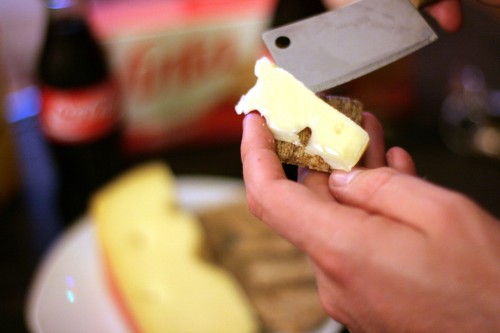
I placed this cheese onto a rye-flavoured Triscuit, but I have to admit that most of the cheese was eaten all by its lonesome. The mildness of the cheese requires less of a cracker than the hearty Triscuit.

cIMG_3658

But, it’s still pretty good. And let me tell you that the fizziness of the Coke is a not-to-be-sneezed-at accompaniment to this fine cheese.

Jarlsberg, as you might expect, tastes a lot like Swiss, sort of nutty, but it has a character all its own. I found it almost sweet — and difficult to stop eating. Amy had to take it away from me, in the end. Although it looks shiny, I never found it to be greasy, nor did it “squeak” like oily cheeses sometimes can.

I saved some of this cheese in the fridge, and I am eagerly looking forward to melting it on a sandwich. I think it would go really well with turkey or ham — and maybe a sweet orange pepper.

Good cheese!

Cheese of the Week: Oka (in a box)

cIMAGE_170

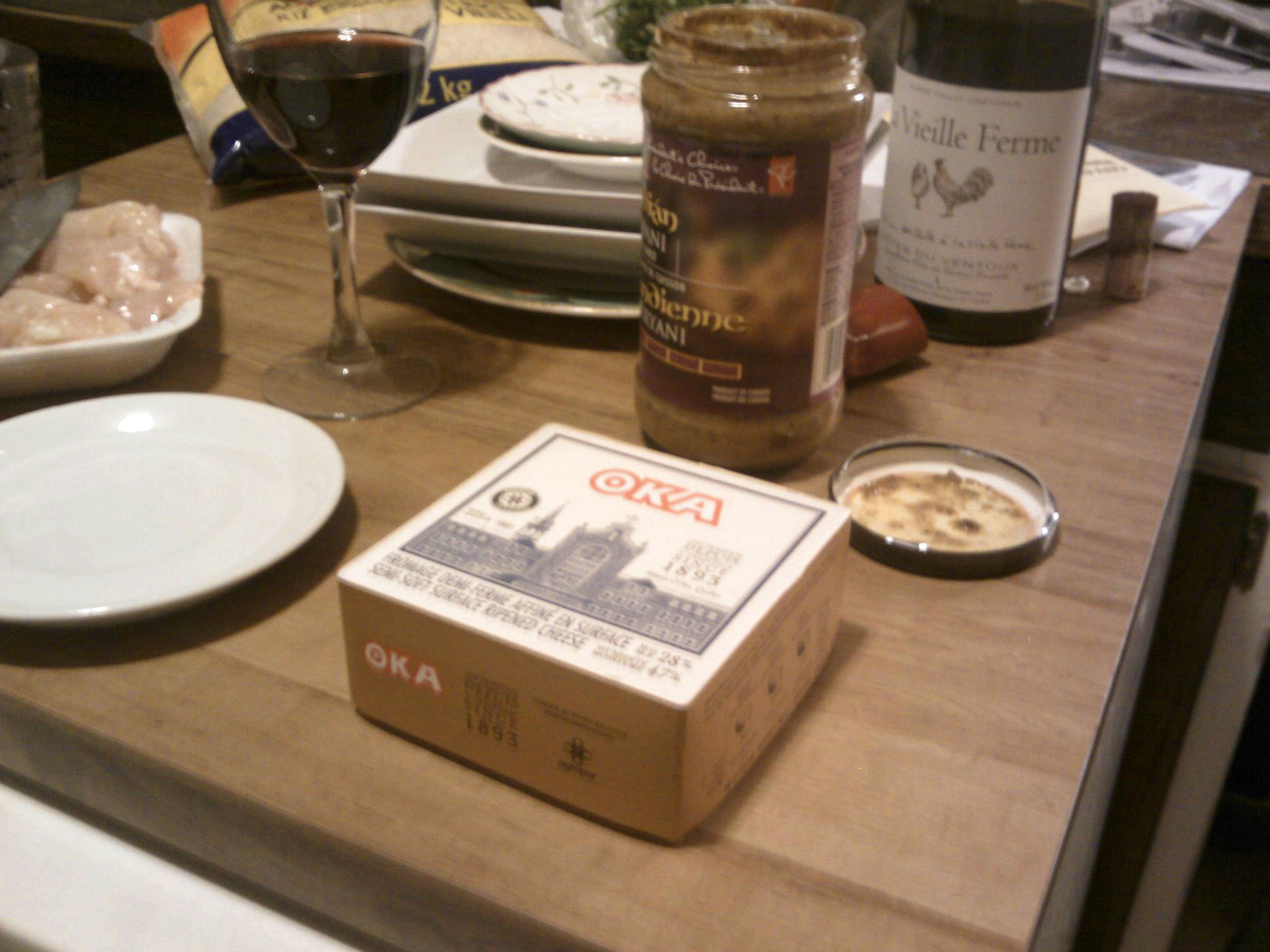
I let Amy pick out the cheese of the week while we were shopping for supper supplies yesterday, and she didn’t disappoint me. She picked up a small cheese that came in a fancy looking box, and I was immediately on board.

Oka cheese, according to that box, is a Trappist-style cheese made since 1893 by monks in Quebec, where it is given a special surface wash and aged for over 35 days. Impressive! Also on the side of the box was a “ripening guide” that told us how best — and when best — to enjoy the cheese:

  • three months before the best-before date it is mild, with a buttery yellow rind and a fine texture
  • two months before the best-before date it is refined, with a golden yellow rind and a fine texture
  • one month before the best-before date it is ripe, with a copper orange rind and a more consistent texture

When we bought it yesterday, Aug. 17, the best-before date printed on the side was “09AUG20″. So we were prepared for a pretty ripe cheese.

cIMAGE_172

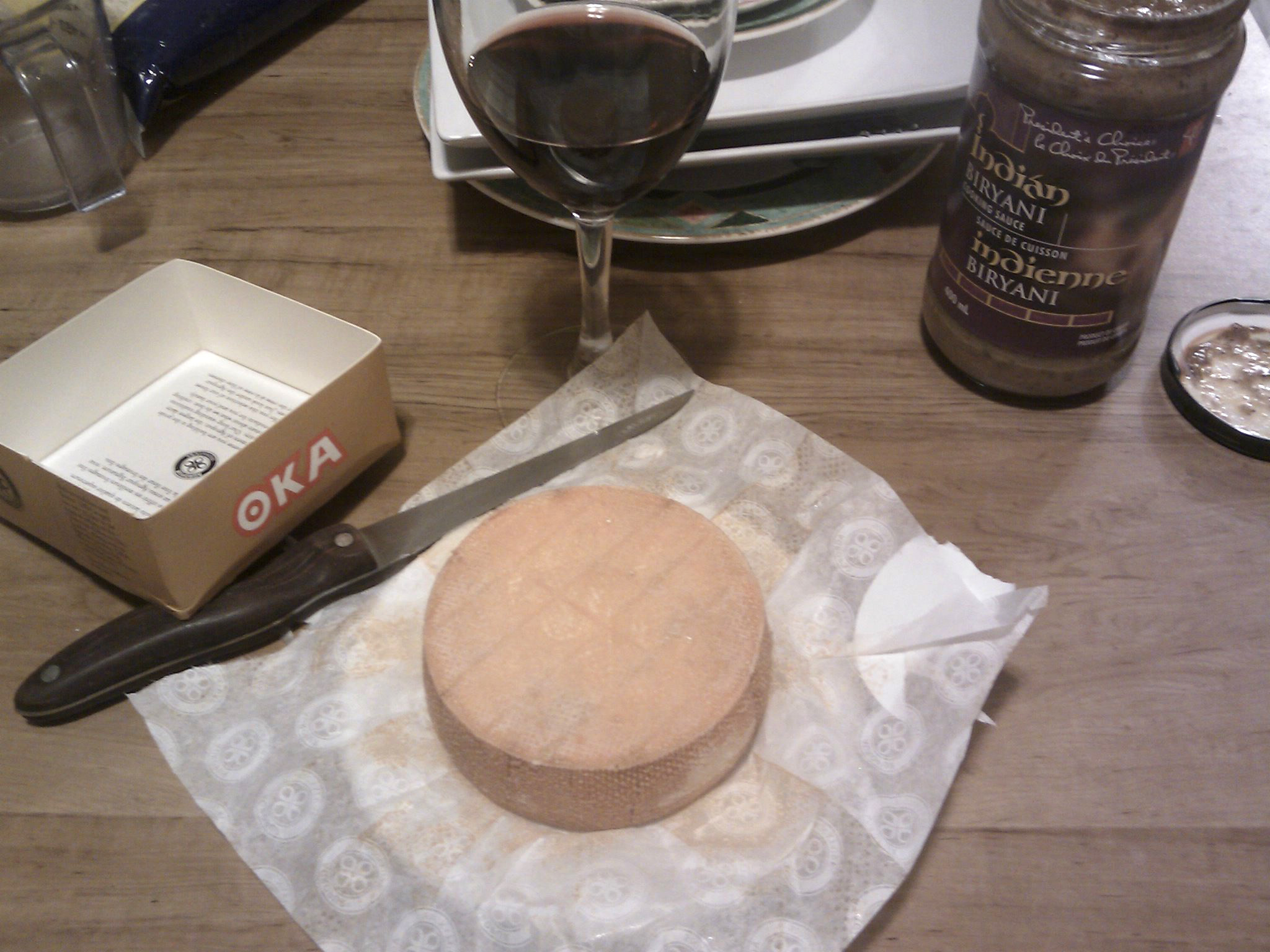
Although the colour on my camera-phone isn’t perfect, the rind wasn’t as orange as perhaps it could have been — more of a deep orangey tan.

The texture, though, on the rind was noticeable immediately: it looked covered as if by grains of sand, almost pebbly. It looked, come to think of it, like very old, almost-used-up sandpaper, with only a few grains of sand per square centimetre left.

Also, it had a very pungent odour. It is quite a smelly cheese, leaving a nasal impression akin to a boys’ locker room. On the box, this is referred to as a “unique aroma” that is “legendary.”

cIMAGE_174

Cutting into the wheel, you can see that it has a smooth, pale interior. It is a soft, yet fairly firm cheese, but the smell made us hesitate to taste it. Taking the plunge, I found it to be surprisingly mild on first impression, though the rind has a very odd grainy texture that sticks around after the rest of the cheese is gone and gives your mouth a strong, bitter aftertaste.

The box (again) promises ” the subtle, irresistible taste of butter and hazelnuts.” Well, perhaps if we had gotten to it a couple of months ago. But this close to the best-before date, the rind had gotten so overpoweringly bitter that the taste of the cheese itself was difficult to discern.

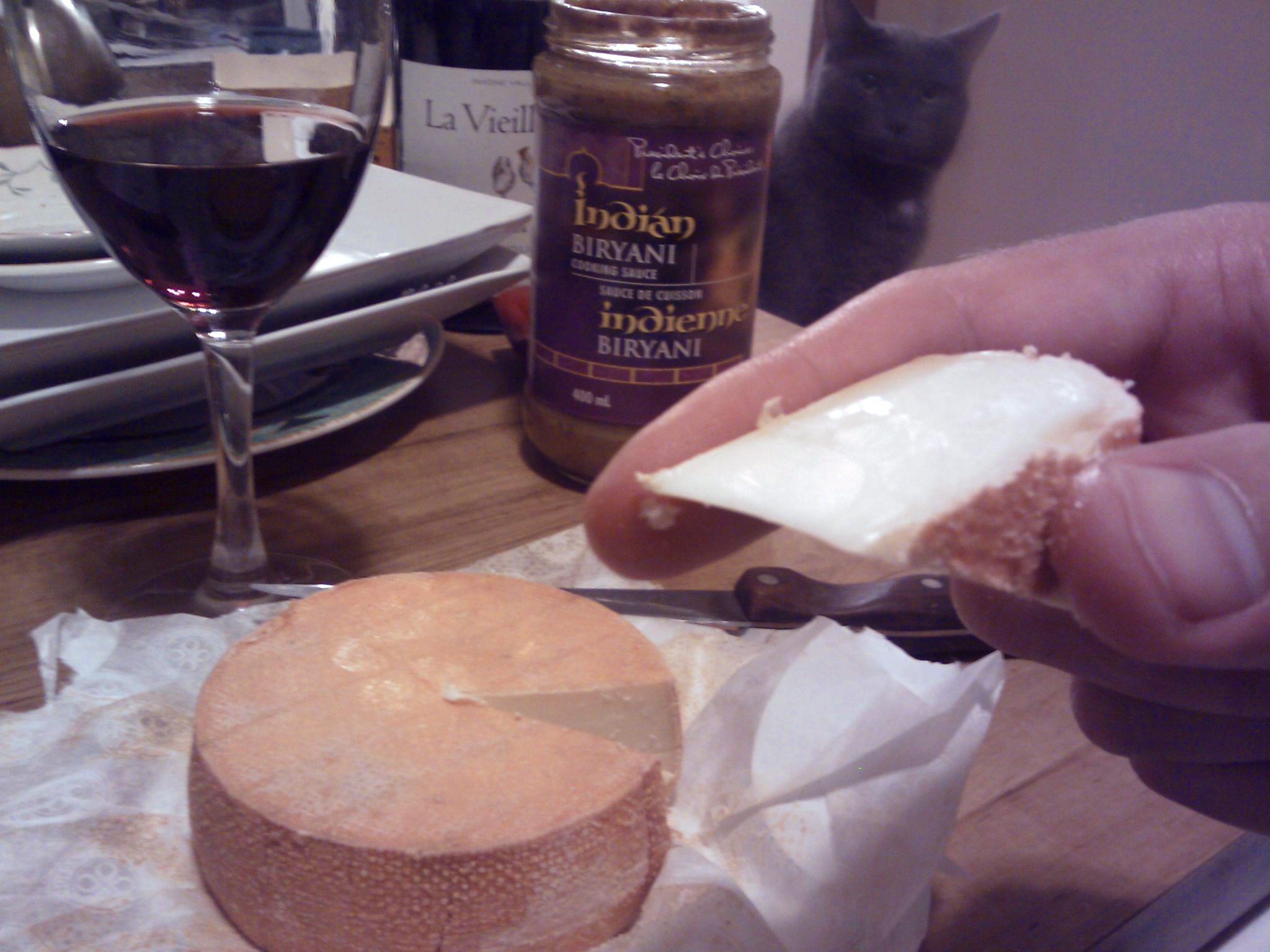
Now, it wasn’t so awful that we couldn’t eat it — I’ve finished the (small) wheel, actually. But this isn’t a beginner’s cheese. And I found that a good swallow of nice, French red wine can go a long way to tamping down the roughness of the cheese and making it fairly smooth.

Also, this is a cheese the benefits from being at room temperature for a while — let it warm up. You’ll hate that the smell wafts everywhere, but the taste gets milder and yet more interesting — it brings out layers of complexity that just aren’t there when you try it straight from the fridge.

Finally, I enjoyed this cheese substantially more when I cut it extremely thin. I think that minimized the amount of rind and maximized the surface area of the cheese inside.

Despite that, I think the rind is an important part of this cheese. You’d be cheating yourself of the full flavour if you simply cut it off and discarded it. And in this aspect, I agree with what’s printed on the box: “Savour along with its edible rind. The rind adds to the Oka experience.”

Indeed.

Cheese of the Week: ‘Co-op Gold’ Marble Cheddar

aIMAGE_158

I recently became a member of my local Co-op store, partly because I always get my gas at one of their outlets, just down the block from my house, and partly because I liked the idea of being a part owner and perhaps getting a cash cheque once a year, and partly just because I like to support local initiatives when I can.

So I’ve been doing grocery shopping there, when I remember (the grocery store isn’t as convenient for me as the gas station is, but I try) and I figured I should try some of their cheese.

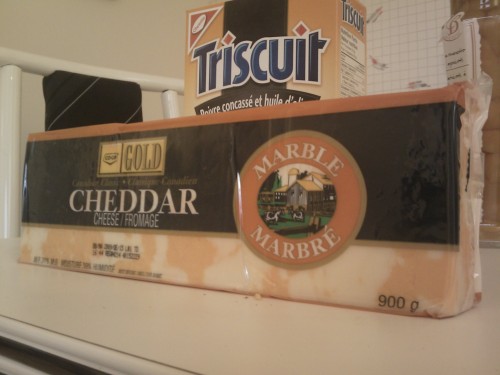
I like to try new things, and I like to pretend that I’m fancy, and that sometimes spills over into the cheeses that I review here, but sometimes I just like to carve off a huge hunk of cheap cheese and eat it. This two-pound block of marbled cheddar is perfect for that kind of cheese gluttony.

aIMAGE_159

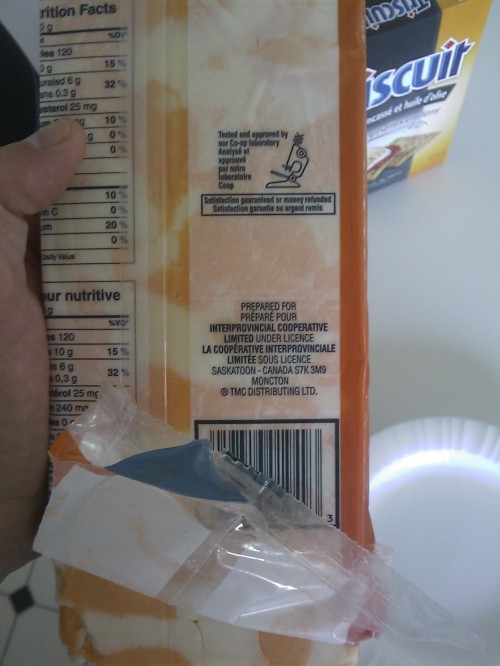
Although this is a store-brand generic, you can be assured that it’s quality. It has been “tested and approved” by the “Co-op laboratory.” I like the idea of scientists hunched over their microscopes, testing each huge blocks of cheese and giving each a yea or a nay before they are sliced into two-pound rectangles and individually wrapped.

I’m sure it’s not that, but I like the image.

aIMAGE_160

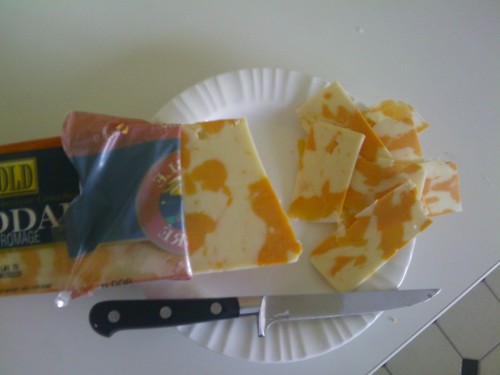
One thing that I like about marble cheese is that it reminds me of a cow — it has that same dappled pattern about it, even though I’ve never seen an orange-and-white cow. So you get the visual stimulation of “dairy” as you slice into it.

And really, marbled cheese is visually pleasing. I don’t know who came up with the idea of it, but they’re a genius.

I’ve loved it since I was a child, even if now I’ll often choose the “plain” orange cheddar on a cheese tray over marble, I’m not exactly disappointed when just marble is left.

aIMAGE_163

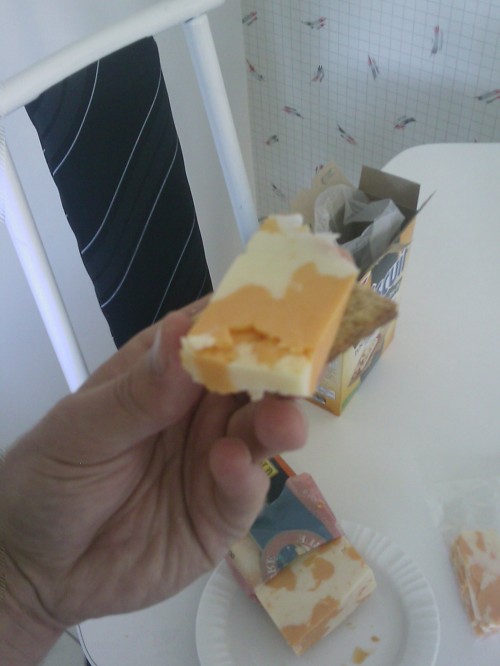
As you can see, this marble cheese is a tad crumbly, like most marbles are. Despite the best mechanical efforts, I’m sure, the Co-op Laboratories can’t quite get the white curds to stick together perfectly with the orange curds.

Overall, of course, the cheese is firm and holds together well. It’s easy to cut — not hard — but it holds its form well. I know from previous experience that it’s also a good cheese to melt, on sandwiches, say.

After leaving it out for a little bit, this cheese will develop a bit of an oily sheen, but as far as cheddars go, this marble was quite un-oily.

In my mouth, unfortunately, the cheese is depressingly bland. It feels and tastes slightly like flavoured wax — even the texture reminds me slightly too much of biting accidentally into a softened birthday cake candle.

However, as I alluded to earlier in the post, this is a cheese that’s well-suited to eating enormous amounts of. Because the taste is so mild, you can really cram it down your gullet and not get sick of it.

aIMAGE_167

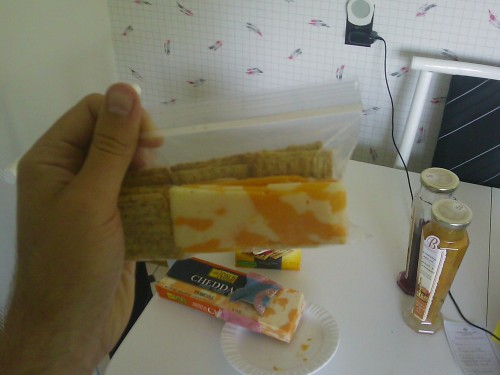
Also, because it is relatively oil-free, and because it firmly holds its shape even in pretty warm temperatures, this is a perfect cheese to take in a homemade snack pack.

You won’t impress the Queen with it, but it’s a good workhorse cheese for everyday lunches, and it’s always an eyecatcher in the fridge.

Cheese of the Week: Sobey’s gerenic Edam

IMG_2584

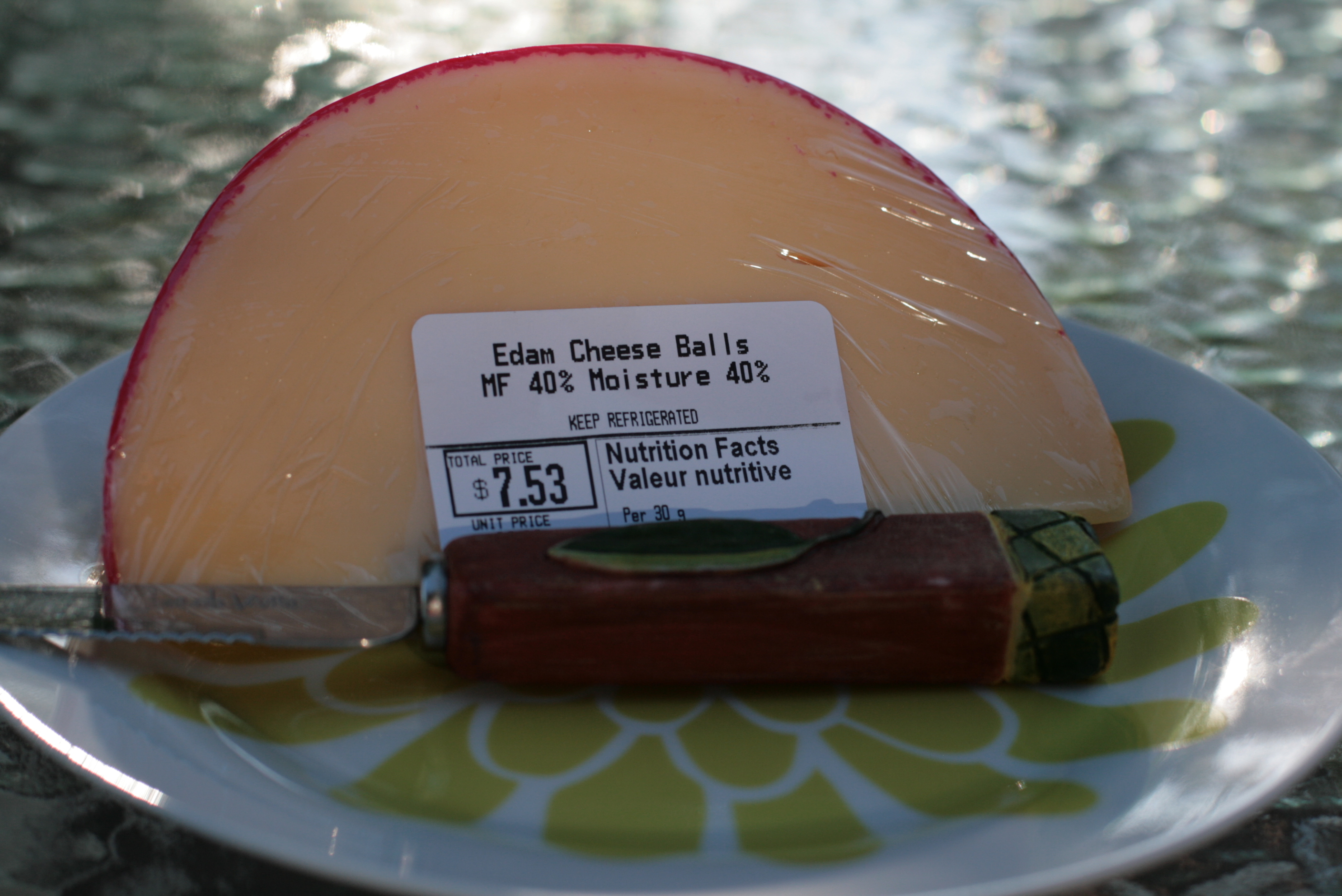
There is something that I find quite satisfying about peeling the wax off of cheese. Of course, the full ball of even a “baby” Edam is far too expensive (and too much cheese) for me. So this week, while browsing the cheese counter at my not-quite-local-but-close-enough Sobey’s grocery store, I picked up this nice wedge.

It’s a little bit tough, sometimes, to review cheeses that are generic store-bought varieties. I feel like they’re the mass-produced, not-quite-up-to-snuff versions of traditional products. I may as well be reviewing Cheez Whiz, right? But I also don’t want to get into the pretentiousness that so-often characterizes product reviewers — just imagine if I started turning my nose up at certain cheeses because they didn’t have the right “bouquet” for this variety!

No, I’m happy to stay grounded in what’s available here in western Manitoba — and while I’ll dip into the expensive, high-end cheeses from time to time, I’m at my heart the very opposite of a cheese snob: I will gladly eat whichever cheese happens to find my plate.

That said, I’ve tried Edam cheeses before, and I do like them, so I was eager to get into this one.

IMG_2585

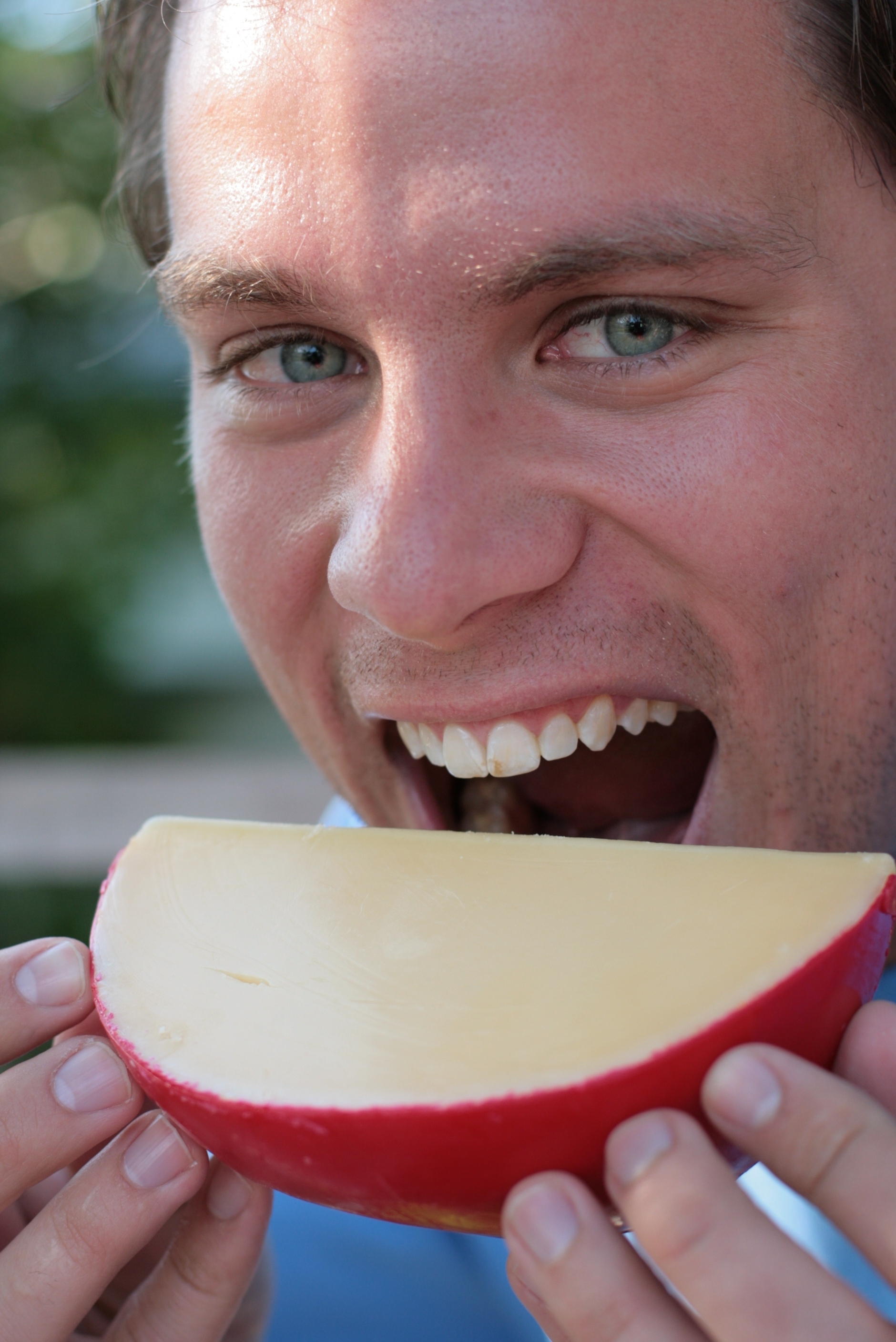
Mmm, okay — just because it’s shaped like a watermelon doesn’t mean you can eat it like one! Although, look at my well-manicured nails!

Obviously, I didn’t just bite into this wedge of Edam, since I was going to share it with Amy and her folks, but I have to confess I seriously thought about it. When I was a kid, I used to sneak cheese out of the fridge at night, and I would cut off big hunks and then steal back to my room, where I would gnaw at it, bite by bite.

I read once that an old cheese can actually hinder the bacteria that form cavities, so sometimes I would lie in bed, reading under my covers, stuffing my face with cheese, and then go to bed without brushing my teeth, which I’m sure did wonders for my morning breath, but I guess might have actually been okay, from a dental point of view.

Wait, when did Cheese of the Week become a confessional?

Anyway, I decided it would actually be polite to serve the Edam in the traditional manner.

IMG_2586

Cutting into the top of the wedge, you can see some of the sunlight bleeding through the top, thinner part of the Edam. Later, we tried to do a photo where the sun came through just the red wax that was left behind. In person, it was actually quite pretty — almost a stained-glass effect — but it was impossible to capture on camera.

Edam cheese is firm enough to cut without mushing, but it’s much softer than most firm cheeses. It’s even softer than a gouda, say, but like a gouda, I think it gets harder as it ages. Most of the Edams you’ll find come with distinctive red wax coverings, but some of the more-aged Edams have black wax, and I’d love to try one of those. I’m not sure if you can age it at home, or it the protective wax seals it up too much. I suspect some of the very old Edams can be quite hard (I read a possibly apocryphal story about Uruguay defeating Argentina in a naval battle by using old Edam as cannonballs once their traditional ammunition ran out) but this specimen was very easy to cut.

Actually, I’d say that this Edam just about perfectly manages to be super soft without threatening to melt or fall over.

IMG_2587

Traditionally, Edam is a very versatile cheese, but eating it on a cracker or bread is one of the easiest ways to enjoy its flavour, which is very mild and subtle. Also, this cheese had approximately no smell. It would also go fairly well with fruit, I’d imagine — something like a pear or an apple might respond well to its slight saltiness.

But you wouldn’t want anything that might overwhelm it. This is a soft-flavoured cheese with a buttery mouth-feel and a nice nutty flavour, and it deserves your full attention. Okay, it doesn’t need to be the focus of the conversation, like it sometimes is when I’m preparing Cheese of the Week. But this is not a cheese that’s going to stand up to to, say Caesar dressing or a juicy steak, so don’t even try. Set it out on a plate, cut it into small pieces, and enjoy it with a cracker — and maybe a glass of light-bodied red wine. That’s how we enjoyed it!

(Aside: According to what I’ve read, this cheese keeps well, even without refrigeration, and if you get the fully-covered-in-wax version, it would be a good choice to take hiking or camping. But I’d recommend eating it fairly quickly once you open the wax.)

Cheese of the Week: Primo Taglio Asiago

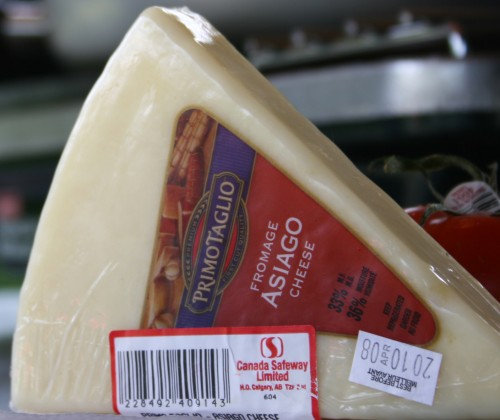
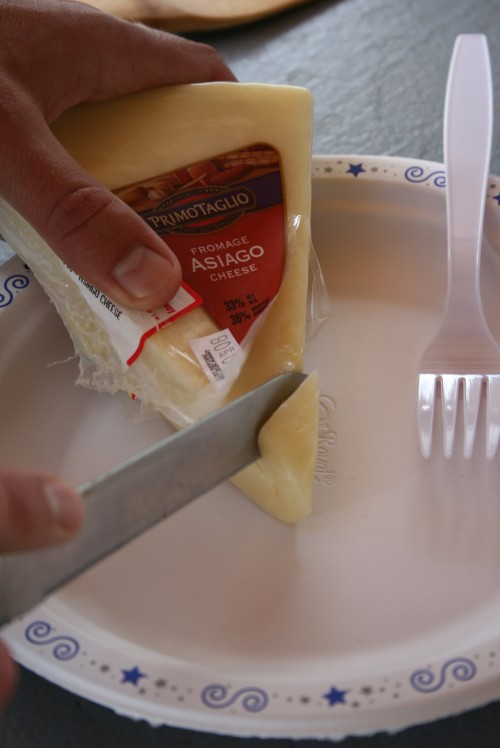
IMG_2324a

Ah, the first Cheese of the Week Challenge! A faithful reader had asked me if I could find him a good cheese for a hiking trip that he had planned. Well, none of the Bries or Borgonzolas I’ve reviewed in the past would really qualify as pack-me-in-your-backpack-and-leave-me-in-the-sun-for-a-week cheeses, so I thought I might use this opportunity to branch out a bit.

Amy and I spent last weekend camping for four days at the Winnipeg Folk Festival, so I knew I had a good opportunity to test out a hiking cheese in roughing-it conditions, but I also knew that I would probably be pressing my luck if I had asked Amy to let me do a stress test on, like, a dozen different cheeses to find the best one. Nope, I would have to find a good cheese and hope that it worked.

I knew from previous camping experiences that I would be looking for a fairly hard cheese. I wanted one that wouldn’t melt and go mushy in the heat of a tent (or a backpack). But it couldn’t be Parmesan hard — I needed a cheese that I could slice, not just grate. And, despite my fondness for some of the older cheddars, they have a disturbing tendency to sweat oil in the heat, and that made them no-go cheeses.

I’ll confess — I Googled. I found a lot of people recommending harder, aged Goudas and perhaps a sharp Jack cheese for outdoors expeditions, but on my own expeditions to grocery stores I found mostly processed Jack cheeses and Goudas that didn’t seem aged enough to last for four days on the trail.

Another suggestion was to take cheeses that were wax-covered. Those mini Babybel cheeses are an option, if you have loads of money. Other than that, cheeses that are fully covered in wax tend to be fairly large, and even the “baby” Edams are bigger than a softball. And, once you open the wax, I feared that they would quickly go downhill. Alternatively, if you have the right kind of wax and the right kind of patience, I found more than one place that instructed you to seal your own cheeses in your own wax. I was intrigued, but not that motivated, especially since they said that doing it wrong could allow mould to grow underneath the wax on your cheese.

After pressing cheeses in several grocery stores until I found one that was firm enough under my fingers to feel like it would stand up to the heat of the summer sun, and yet soft enough to be sliced, I settled on the Asiago cheese you see here. It’s the Safeway store brand, and I don’t know where it’s from or who made it originally, but it was pretty affordable. It stayed in our cooler for a couple of days, and it wasn’t very well cooled when we opened it. After that, it was on the warm side, and I can tell you that it withstood the temperature very well.

We decided to cook with it.

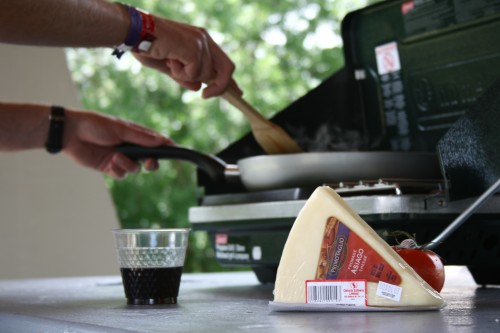
IMG_2322

While pan-frying a couple of steaks and some perogies, as well as enjoying a plastic goblet of wine-from-a-box, we debated how exactly we would eat this cheese. To be honest, my primary experience with Asiago cheese comes from some pizza places and, I think, Subway, which includes Asiago on its cheese-sprinkled bread option.

IMG_2325

You’ll notice a slight, oily sheen on the top, there, but it wasn’t very greasy, really. Amy says she didn’t even notice. Cutting into this cheese, you can see that a sharp knife will have no problem cutting off cubes or slices, although it does have a slight tendency to crumble or break near the bottom of each cut. It’s a fairly firm cheese, but definitely not overhard. I think it might be slightly more a grating cheese than a slicing cheese, but it’s really right at a nice sweet spot that makes it very flexible for the backwoods chef — at least from a physical manipulation sense. But how does it taste?

IMG_2327

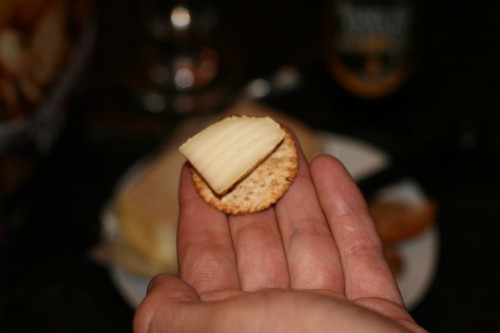
Mmmm, delicious! There is a slight rubbery, almost curds-like springiness to this cheese, but it’s nothing my adult chompers couldn’t handle with delight. The taste, now that we’ve come to this, is very much like Parmesan. Though less salty and a little less sharp, it’s an obvious cousin. You could use it in much the same way, if you grated it, on salads and pastas. But, of course, we weren’t making salad or pasta, we were making perogies and steak.

Melted on steak, the cheese was actually quite nice — it’s a very good melting cheese, in that it holds its shape well and isn’t too stringy.

IMG_2329

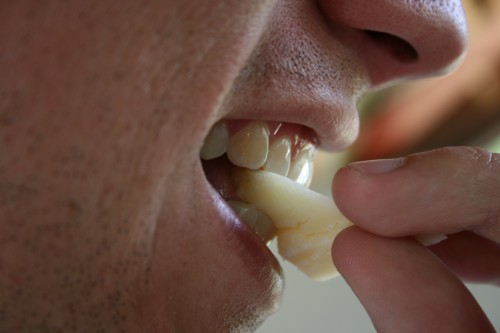
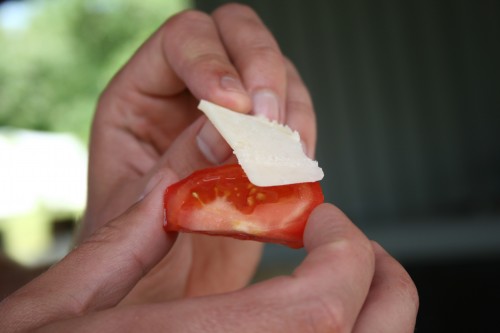
We also sliced up a tomato to go with the cheese — and it was a great pairing. Wait, you want another close-up of my mouth to prove it? Ohhh, kaaay.

IMG_2330

Mmmm, delish. I will also take this opportunity to point out my authentic “grizzled moutain man” stubble and to explain that the discolouration on my incisor is from the time I took a header off my bike while no-handsing in Grade 7 and now my half-dead tooth is barely held together with a spider’s web of cracks. But even that fragile enamel can slice through this Asiago with ease.

And, let me tell you that the Asiago-tomato combination works well. If had brought a little basil to sprinkle on top, I think it would have been delightful.

However, the cheese works so well melted, that I think if I were to, say, take it hiking, I would also make sure to take along maybe a baguette of bread, and with this cheese, a tomato and a campfire, you could make a darn fine toasted bruschetta.

Cheese of the Week: Arla Esrom

IMG_2121

I don’t think Amy always likes Cheese of the Week. Especially this week. You see, although sometimes the Cheeses of the Week are planned a ways in advance, sometimes (like this week) they’re not. And so I spring it on her, and she doesn’t always like the cheese, and then I borrow her camera, and make her fix all the settings for me — and she doesn’t even like the cheese!

That was especially true this week. Hovering over the cheese counter at the local supermarket, I wasn’t sure what to try. I’ve been asked by a reader to try to find a nice hard cheese for a hiking excursion, but there wasn’t anything there that caught my eye, unless I wanted to buy $20 or more in a wedge of cheese (I prefer the $5 wedges). Maybe next week.

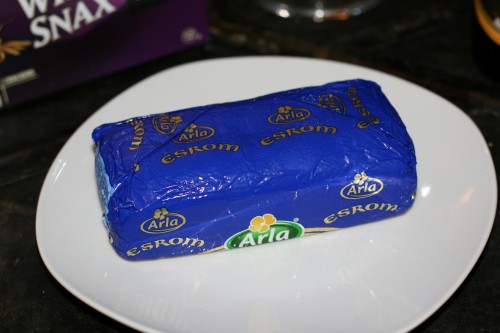
Then I noticed the bright foil blue of the Esrom cheese. ‘What the heck is Esrom?’ I asked myself. Then I asked Google, on my phone.

But, because using Google on my phone is always a little slow, and because it’s exceedingly frustrating when you’re at the back of a metal building that appears to have been built as a Faraday cage, I didn’t click through on any of the links. Instead, I trusted the mini-excerpts that came with the search results. I got words like “mild”, “buttery” and “Havarti.”

That’s how I sold the cheese to Amy, when she said that she was craving a snack.

IMG_2126

Holy moly was I unprepared!!

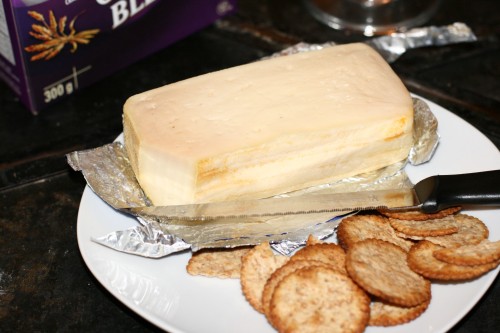
Unwrap the foil and cut a slice off this cheese as fast as you can, because it is a pungent little guy. It smells. It stinks. It fills a room with its unpleasant aroma. Even the next morning, after putting it away and washing up — and brushing my teeth — I think I still smelled it here and there. It is a smelly, smelly cheese. It has a distinctive smell that’s not really completely awful, but definitely unpleasant. I got used to it, eventually, but Amy never did. Let’s just say that this is best as an outdoors cheese.

IMG_2125

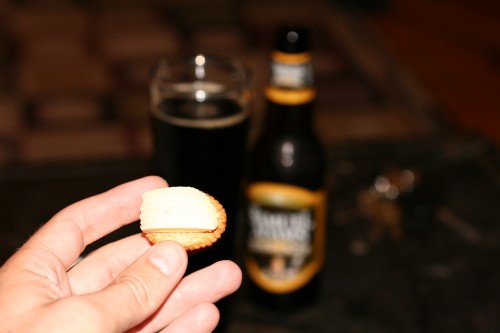
I was understandably hesitant to taste it. But I managed to pop it in my mouth. (As an aside, the crackers I chose, a generic baked wheat cracker, I chose specifically for their probably blandness, which I figured wouldn’t interfere too much with what I thought would be a Havarti-like mild cheese.)

Surprisingly, because I happen to know that the taste sense is connected to the smell sense, this cheese really does have a remarkably mild taste. It’s not exactly Havarti-like, and I wouldn’t call it buttery, exactly, but this cheese is deceptive, so I can see where others might get those characterizations.

I won’t go crazy here — it’s not a great-tasting cheese. Even on a bland cracker, it has trouble holding its own. But then again, it not only has to compete with the cracker, but with its own rank smell.

So, sure the flavour was, well, let me characterize it as inoffensive — which, considering the still-wafting odour, is a significant accomplishment. But I felt a little betrayed by the Goolging. So I Googled it again, this time with the benefit of a higher-speed Internet connection.

Aha! Wikipedia’s entry for Esrom cheese notes that it is “Trappist-style.” A few years ago, I went to a earby Trappist monastery where they still make cheese, and I do recall this bizarre combination of high smelliness, low taste. Someday I plan to go back and review it here.

But I also saw that Wikipedia said that an Esrom went well with red wines and dark beers.

IMG_2127

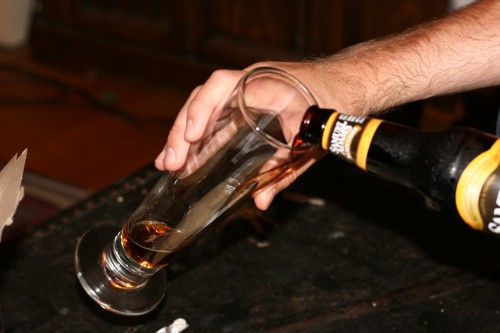
Since I just happened to have a Samuel Adams Black Lager chilling in my fridge, I decided to put the crowd-sourced, anonymous Wikipedia to the test. I poured myself a nice glass of Black Lager (it, by the way, is a farily easy-to-drink dark beer — not too challenging for a beginner to darks, but also with enough flavour and complexity to be enjoyable; technically, it’s a Schwarzbier).

Keen-eyed readers will note that this is the same glass I previously used for six-month-old eggnog.

IMG_2130

So, the verdict with a dark beer pairing?

Astonishing!

The caramel sweetness of the Sam Adams Dark Lager brings out an unheretofor flavour from this cheese that is simply a delight. No, it doesn’t do away with the nasty smell, which may still pervade my house to this day, but after a while, you do kind of get used to the smell, unless you’re deliberately looking for it, and in your mouth, with some dark beer swirling around, this cheese nearly explodes with flavour.

I think Amy disagrees on how wonderful it got, but, with slug of beer in the back of my throat, I basically couldn’t stop eating this cheese. Until, that is, the beer ran out.

At that point, we quickly wrapped up the cheese. In foil, and then in Saran Wrap. And then we put it away in the fridge. And then we rinsed the knife and plate.

Would I buy it again? Not soon — after all, I still have loads in my fridge. And there are better cheeses out there, for the same price or cheaper. But it was a fun experience, and I’m glad that learned how much better it could be. There’s a lesson in there — I should always have some wine or beer with these cheeses of the week!

Cheese of the Week: Frico spiced gouda

IMAGE_114

I had an idea this week that I could take a nice picnic-style lunch up to Amy during her break, and we could go to a nearby park, I would whip out Cheese of the Week, and we could perhaps even do a Cheese of the Week video in the great outdoors. The weather was beautiful, the light was amazing — it would have been perfect. Except, that is, for the gale-force wind, whipping about and getting into the microphone.

So pictures it was, same as every other week. The video will have to wait. But don’t worry — it’s a’coming!

Seeking shelter in a gazebo-style enclosure, we were mostly out of the wind, but not entirely. And, we quickly found ourselves surrounded by kids out for an afternoon in the park from their day care or last day of school. They were super inquisitive, and having determined that “lunch date” meant we were out being romantic, watched us rabidly to see if we would smooch.

Their minders made half-hearted efforts to keep them away from us, but you can’t corral 30 kids like that. They’re Hydra-like.

IMAGE_116

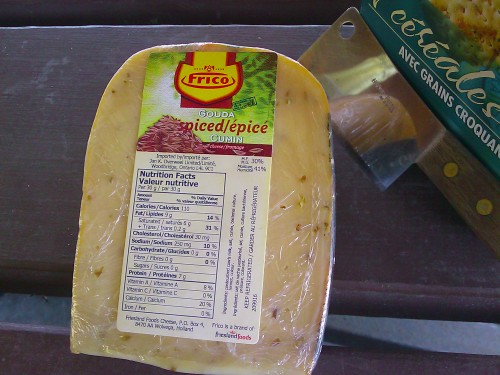
For the picnic idea, I thought nice gouda would be appropriate — they come in a wax coating, so they’re designed (in my mind) to be transported and eaten in the fields. Of course, I wasn’t about to take a 10-pound wheel of gouda, so I just bought a nice sliver of one — a spiced gouda, which caught my eye because it was imported from Holland, not a knockoff made domestically, and also because the spice was named — cumin — and not just alluded to as “spices” in the ingredients list. I hate that.

As a cheese, gouda is one of my favourites. It has a near-perfect consistency that isn’t too hard, nor too soft, nor too rubbery. It cuts into slices like a dream, but in a pinch, you can just nibble some off the ends, if you like. It’s got a taste that’s very creamy and slightly salty. A lot of commenters say that gouda can be a tad bitter, but I don’t get that at all. If anything, it has a hint of sweetness, something you might get from a tiny pinch of brown sugar.

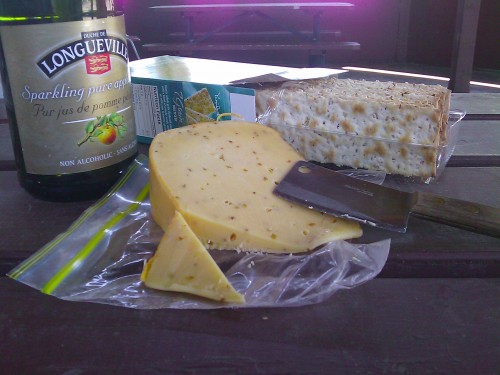
Of course, I figured it would go well with a fruity wine, but Amy was just on lunch break, so I decided to bring a bottle of faux-champagne — sparkling apple juice, with a cork that even popped. (This really got the kids excited — they asked if we were graduating.)

IMAGE_118

The deep cumin flavour of the spice was a really nice addition to this cheese. I’ve tried other spiced goudas, and some of them include carroway seeds, or mustard, or are smoked as well, but I think the simple cumin has a lot going for it.

I was hoping that the cumin seeded-gouda would go well with the 7 Grain flatbread-style crackers that I found, but the crackers were far too salty for this cheese. Luckily, you don’t need anything with it to appreciate a good gouda!

As a drink, I recommend the sparkling apple juice. I paid just $3.33 for a 750-mL bottle, and it was made in France. While that may sound expensive if you’re used to buying the apple drink in 1-L cartons for 79 cents, it’s a relative bargain when you consider that you might spend easily $3 for a 473-mL plastic bottle of juice at a gas station convenience store. As well, it went really perfectly with the cheese and with the picnic-style atmosphere that I was trying to create.

This cheese would also have gone well with seedless red grapes, if you had some. It needs something sweet for accompaniment, and I would ditch the crackers next time.

At the end of the picnic, there was still a fair bit of the wedge left, so I packed it up in the black reusable grocery bag that I used in lieu of a picnic basket, put it back in my car and promptly forgot about it.

Gouda, as it turns out, will ‘weep’ oil like there’s no tomorrow, if you leave it in the heat. Luckily, I had it in a zip-lock bag, so it didn’t get all over everything, but it was a pretty gross-looking cheese when I remember.

A few hours in the fridge, though, and the cheese was almost back to normal, although the outer wax covering had gotten very greasy. I was going to use it that night on a barbecued chicken burger, but I found some hot sweet Thai red pepper sauce that I decided to use instead. I was halfway through the burger when I thought to myself ‘You know, I bet gouda would have gone pretty well with this hot sweet Thai red pepper sauce.’ Next time, I might try it.

This was a solid gouda — and I was very pleased with it. Recommended!

Cheese of the Week: Cambozola

IMG_1397

I bought this cheese and last week’s Borgonzola at the same time — partially because I don’t think I’ve ever tasted a Gorgonzola, and partially because I laughed at names that sounded like Engrish rip-offs of Gorgonzola, and partially because Gorgonzola and Borgonzola and Cambozola are damn fun to say!

So this week, I kind of felt like I knew what I might be in for. Although Gorgonzola and Gorgonzola-style cheeses do have some variety (they can be creamy or crumbly, for instance) this week’s Cambozola looked and felt a lot like the Borgonzola.

Then we unwrapped it.

If last week’s cheese smelled “like mouldy basement” then this Cambozola smells like that same basement, a (moist) month later. And with your nose rubbed in it.

Within instants of having de-Saran-Wrapped it, a near-rotten smell was wafting through all the main-floor rooms of the house like a punch, wandering to hit you in the nose.

It wasn’t pleasant. It wasn’t awful — it wasn’t like a going-to-the-dump reek, or a taking-a-dump stench — but it was pretty bad. Luckily, you got used to it pretty quickly, but every now and then you’d get taken by surprise and it’d be “whoo! that is one stanky cheese!”

IMG_1403

Cutting into it (I don’t really recommend getting this close, that’s what telephoto is for), you can see that this Cambozola has a creamier, yellower texture and colour than the Borgonzola of last week. The mould is also much greener.

It seemed to cut like there was more of a crust on the outside, too. If the Borgonzola was akin to a Brie, this one had a rind on it that was more like a Gouda. There was no wax of course, just that it was much tougher on the outside. I wonder if it was aged longer?

IMG_1406

On a cracker, this cheese looks so unassuming, but remember, it’s got a potent smell. It’s not the worst cheese I’ve ever smelled — not by a long shot — but this was one to remember. Or to forget. And eating it meant that you had to bring it up to your mouth, right up under your nose. This was like an extreme sport — conquer your fear!

Was it worth it?

Oh my, yes!

Creamily, the cheese would sit perched on your tongue. It didn’t dissolve, or melt exactly, but it had a way of sliding down your throat that was actually kind of decadent. And the flavour was astonishingly mild for such a ripe-smelling cheese.

It wasn’t for everyone — if you can’t get past the smell, then it’s worthless to taste it — but in terms of just the flavour, it was a very nice and agreeable snack.

Like a blue cheese, the mould imparts a sour taste to the cheese, but it’s not nearly as sharp as most blue cheeses that I’ve tasted. It’s smooth and mild, almost buttery. I would say that it tastes a little like buttermilk, but it’s been so long since I’ve tasted buttermilk that I’m not convinced that I’m making the right comparison.

Of the two ‘zolas, I definitely preferred this one.

Would I buy it again? Well, that’s a complicated question. I certainly liked it, but you can lose friends with the smell.

Cheese of the Week: TreStelle Borgonzola

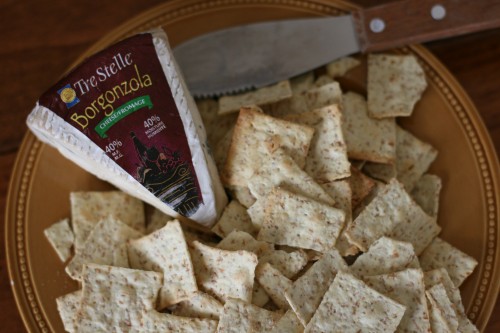
img_0740

Ah, Borgonzola. It sounds like a cheese that I’ve heard of, but it’s not. It’s like a knock-off of Gorgonzola. Apparently, Gorgonzola is a name restricted only to a small portion of Italy, and similar cheeses from other areas have to have other names. Hence, Borgonzola. I don’t know why the names sound so alike — to me, that’s like buying a sparkling wine called “Shampayne” but who knows, maybe there’s a good reason.

In any case, Gorgonzola can display a wide range of characteristics, from very creamy to very crumbly, so it’s not like you’d be confusing the brand.

And, actually, Borgonzola seems like a pretty good cheese. I’m not going to think less of Gorgonzola because I’ve consumed this cheese, that’s for sure.

But enough of the weird naming conventions. How about the cheese itself?

Well, I’ll tell you right off the bat. As one taster put it, this cheese smells “like mouldy basement.” It’s a semi-soft cheese that comes in a wheel and is covered with white bloom, so it’s like a Brie or a Camembert in that respect, but it has the veins of blue mold that typify blue cheese, too. It’s like a hybrid.

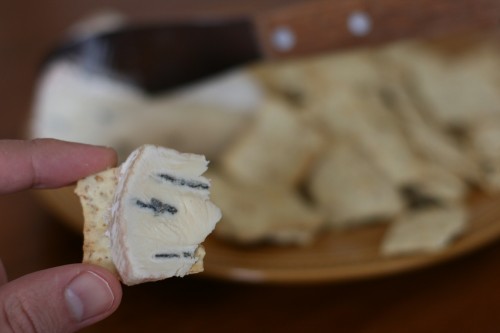
img_0741

If the smell and the almost-slimy texture don’t put you off, I encourage you to put this cheese on a cracker and pop it in your mouth. It works well on a cheese tray, but I have heard that it’s also served melted, on pizza, or mixed with short pastas, which I can imagine being very interesting.

By itself, the Borgonzola has a surprisingly mild flavour for a blue-based cheese. It’s not nearly as sharp or as sour as you might expect, and the smell does this cheese an injustice. As it warmed to room temperature, it got even better, coasting on the tongue and sliding nicely down the throat.

The official TreStelle website notes that this cheese was “a finalist in the Blue Cheese category for the 2000 and 2002 Canadian Cheese Grand Prix.” It’s not hard to believe. They also host a couple of recipes that call for Borgonzola, and I would definitely buy it again to try it melted and mixed with other flavours.

Next week, I’ve got another Gorgonzola knock-off lined up, a Cambozola, so it will be interesting to compare and contrast.

Future cheeses of the week: Make your own mozzarella and blue!

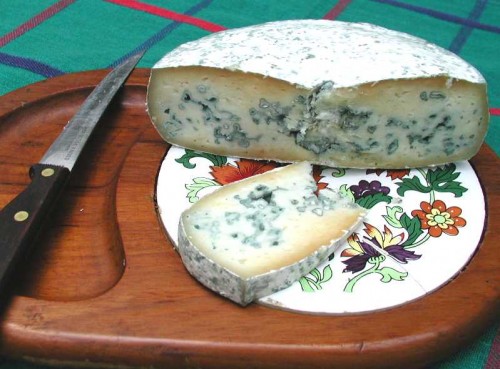
17_blue_cheese_after_2_mos_p5110355

I feel blessed to have stumbled across a site that gives step-by-step instructions to make your own cheeses. It starts with basic simple farmer’s cheese, but it progresses to more complicated cheeses, like mozzarella and even blue cheese. The full list is here (he also includes things like homemade ginger ale and limoncello).

I can’t wait to try this!

(The ginger ale in particular looks easy.)

Dansette