Posts tagged: economic downturn

Score one for the environment

General Motor’s last hope for the sale of Hummer has come to an end.

According to the Washington Post:

Sichuan Tengzhong Heavy Industrial Machines Co. said Wednesday it pulled out of the deal to buy the company from General Motors Co. Tengzhong failed to get clearance from Chinese regulators within the proposed timeframe for the sale, the Chinese manufacturer said.

Although GM will be winding down the business, their spokesman Nick Richards said they would still hear last-minute bids.

Personally, I hope Hummer just becomes a distant memory. I always found the vehicles incredibly unseemly. They don’t seem to serve any purpose on a city road other than to say, “Hey! Look how much money I have!” They take over the road and are total gas guzzlers.

I realize that even though there won’t be any new Hummer’s, it doesn’t mean that they won’t still be on the road, or that people won’t be able to buy them used; I also realize that without Hummer, there are still hundreds of SUV’s and ginormous trucks clogging the roads.

But with the world (hopefully) moving towards more environmentally friendly vehicles, and less of a dependence on oil, the loss of Hummer is a step in the right direction.
America’s oldest bank doesn’t like change

If you think the “progress” made by modern banking helped to create or exacerbate the recent economic crash (perhaps by bidding up real estate and credit markets to unsustainable levels, or by using rapid-fire computer models to trade faster than human overseers can think) then you’ll love the State Bank in Oakwood, Texas.

As much as possible, everything is still done the way it was 100 years ago. They keep your account under your name, not a number (though a number is assigned, because banking regs require it, it’s never used) and they have only one computer — which they only turn on when they have to, to communicate with the Federal Reserve.

What I find interesting about this is that it’s still possible for a business to exist this way. Sure, there are no modern conveniences, like ATMs, or telephone or online banking, but the bank still functions. It’s still paying employees. It still has customers.

And, frankly, some of those modern conveniences have been just about as frustrating as they have been convenient. I never accelerated my spending so much as when I first got a bank card — and that was before debit machines! Just the ability to go to the automated teller and withdraw cash whenever I felt like it, instead of making a special day-time trip to the bank and planning ahead for the weekend, made it so much easier to spend and spend and spend.

So I can appreciate the fact that a slowed-down, traditional-in-the-extreme bank would have some advantages. Good for them.

(from Coudal, via Draplin)

Hooray! Awful Croc non-shoes may finally go away

The Washington Post is reporting that the company that makes Crocs — those ridiculous rubber shoes with holes in them — is heading for bankruptcy:

“The company’s toast,” said Damon Vickers, who manages an investment fund at Nine Points Capital Partners in Seattle. “They’re zombie-ish. They’re dead and they don’t know it.”

The basic problem is that they have a surplus inventory of shoes, they’ve gone into debt to expand their manufacturing capacity, and demand for Crocs has evaporated.

All of this is happy news for the bloggers at IHateCrocs.com. They hate Crocs so much they bought a pair just to cut it up.

On their blog, they link to a T-shirt selling site, where they offer some anti-Crocs merchandise. Best slogan? “For those about to Croc, we refute you.”

‘Escape and evade’ courses just one of the survivalist things that’s more popular now than ever

A reporter with Slate’s The Big Money took a course on how to pick locks and evade pursuers in what sounds like an awesome assignment. You can read the story here, but I’ve also embedded the video above (watch for the guy who looks a little like William Shatner).

As a financial reporter, her article’s thesis is that the crumbling economy has some people preparing for a post-crash Mad Max style life. Maybe that’s a little over the top, she concedes, but if it gives you a sense of security, that’s great.

Interesting tidbit:

Though it isn’t formally tracked, the growth in the survival industry is not limited to onPoint. Firearms sales in the most recent quarter at Sturm, Ruger & Co. (RGR) and Smith & Wesson (SWHC) have grown between 22 percent and 55 percent from a year earlier. The number of background checks for firearm purchases, required before the sale of a gun at a federally licensed dealer, has risen to 6 million through May of this year, a 25.5 percent jump from the same period in 2008.

The media attribute the spike in background checks and firearms sales to fear that President Barack Obama will reverse key provisions of the Second Amendment. They have also claimed it is due to increased interest in ammo and weapons as an investment vehicle. But isn’t it also possible that it has to do with the same fear that is propelling sales at some camping supply and military surplus stores, which are up 50 percent?

When I was a teenager, I read a pamphlet about the Boulder Outdoor Survival School, and I’ve often longed to take one of their famous month-long survival courses. The concept of wilderness survival appeals to me much more than urban survival.

I’ll see me in court!

Perhaps it’s the perfect ironic coda to the housing market meltdown in the U.S.

Since so many houses are being foreclosed after multiple mortgages piled up too much debt on properties that just weren’t worth it any more, lenders who sue to foreclose have now started suing themselves — at least, that’s what Wells Fargo did in one Florida case, where it held both the first and the second mortgage on a condominium.

The should-be-snafu was first noted on Consumer Warning Network, which noted that Wells Fargo has hired competing attorneys to file the lawsuit and to defend itself against itself. The story’s in this video:

Then the tale was picked up by Fox Business columnist Al Lewis:

“You can’t sue yourself,” McKillop said. “It’s just so ridiculous. .. It’s a waste of paper. It’s a bastardization of the legal process.”

Wells Fargo’s two law firms didn’t return messages to explain their filings.

The condo owner is belly up and hired McKillop to pursue a “friendly foreclosure,” attempting to escape any lingering liabilities after the foreclosure sale.

“It was a property they thought they were buying as a good investment as a lot of people did back in 2005 and 2006,” McKillop said. “All we want to do now is get this property taken care of as fast and as easily as possible for all parties.”

Rather than suing itself — a stunt that was never even attempted on the MTV show “Jackass” — wouldn’t it be easier for Wells Fargo to release one of the liens to itself? Or pursue some other internal accounting strategy rather than tie up the court with nonsense?

“This is just folks cranking out paperwork without conscious thought,” said Anthony Sabino, a law professor at St. John’s School of Law in New York City.

(via Slashdot)

Board games that misled us all (and caused the financial meltdown)

Slate’s “The Big Money” section has a (slightly tongue-in-cheek) slideshow on board games that we played as kids, and how they are fundamentally flawed. The thesis of the slideshow is how these fundamental flaws can lead to illogical behaviour in the real market.

Take Monopoly, for example (I took the image above from Flickr user DaylandS’ photostream, which is the same place The Big Money got theirs, but I chose a different picture):

Monopoly has taught us that financial institutions are invincible. The game’s banker cannot go bankrupt, according to the rules: “The Bank never ‘goes broke.’ If the Bank runs out of money, the Banker may issue as much as needed by writing on any ordinary paper.”

Whoops?

They also take a look at The Game of Life, PayDay, Risk, and Mall Madness — as well as a game I’d never heard of called Acquire. Two games they didn’t examine, but which I played lots, were Pit and Stock Ticker.

One thing all these games do have in common — and which I think we’ve seen in the economy as well — is the concept of one winner, many losers.

Markets are great at telling us the price of things, but poor at telling us their value

Now this is an interesting read, if you’ve got some time on your hands, and aren’t looking for anything light. Despite the collapse of markets this year and last, there’s a still a deep-seated bias among people to ask that government work like a business, and to assign costs or incentives to things, then to arrange it so a market develops, which will magically produce the most-efficient result.

Well, maybe. Of course, this assumes that everything is priced correctly: think about greenhouse gas emissions, which are “free” (despite some carbon tax schemes) but come at a cost to the environment that isn’t accounted for in the market.

Market acolytes would tell you just to modify your assigned prices and incentives, and you’ll get a better and more efficient market. The problem isn’t the market, the problem is you.

Michael Sandel makes a convincing point that maybe markets don’t have all the answers after all — even if they’re set up perfectly. He looks at the case of kids being paid to read books:

While some children may be motivated to read books for the love of learning, others may not. So why not use money to add a further incentive? Economic reasoning would suggest that two incentives work better than one, but it could turn out that the monetary incentive undermines the intrinsic one …. The obvious worry is that the payment may habituate children to think of reading books as a way of making money, and so erode or crowd out or corrupt the intrinsic good of reading

That’s not all. He also talks about how market-lovers just can’t see that their way of looking at the world isn’t always the best. And says that some things are better off without having a monetary value assigned to them:

Some of the good things in life are corrupted or degraded if turned into commodities, so to decide when to use markets, it’s not enough to think about efficiency; we have also to decide how to value the goods in question. Health, education, national defence, criminal justice, environmental protection and so on - these are moral and political questions, not merely economic ones.

I’ve linked above to a partial transcript of an original BBC interview, which I am *really* looking forward to listening to, at some point.

Newspaper life watch: AP to share non-profit content

I’ve written a number of “newspaper death watch” posts, because I have a morbid fascination with the ongoing transformation in my own industry, but I’ve been meaning to write a series of “newspaper life watch” posts as well. There’s a lot of wailing and gnashing of teeth in journalism these days, because we’re in the middle of a huge transformation — and nobody knows what the end product will look like, or how to get there. Or how many it will employ.

But from a slightly different perspective, this is a fantastically exciting time to be a journalist. Not only are we in the middle of a paradigm shift in information transmission and consumption, but we actually get to chronicle that shift from the inside! It may be sad to see a lot of the old traditions fall by the wayside, but to be in on the ground floor as we move to a whole new system — and perhaps to, in some small way, influence the shape of our new traditions — is thrilling.

Here’s one small, new shift that I think is both a good idea, and proof that “old journalism” and “new journalism” can coexist not only peacefully, but symbiotically: The Associated Press has announced that it will carry stories from non-profit organizations that have been freelancing investigative reports.

As they sharply reduce their staffs, many newspapers have cut back on investigations or given them up entirely. When there are barely enough reporters to cover the daily news from the local courthouse and the school board, it is harder to justify assigning someone to an in-depth project that might take weeks or months.

At the same time, independent groups doing investigative journalism have grown in number and size, fueled by foundations and wealthy patrons, and are offering their work to newspapers, magazines, television and radio news programs, and news Web sites.

In some ways, these non-profits may be somewhat agenda-driven: they may not have the same commitment to impartial, unbiased reporting as traditional newspapers try to have. But in other ways, they could also be free from the commercial taint of an ad-ridden newspaper. I welcome the six-month experiment, and I would be really surprised if it didn’t become a new standard.

Good stuff!

Waving six white flags in bankruptcy court

Six Flags has filed for bankruptcy. The amusement park operator owes a staggering $2.4 billion.

Word of the moment: Funemployment

So, you’re laid-off or you took a generous severance package or buyout. You’re in your 20s or 30s. You’re not worried about supporting a family yet, you’re probably single, and you’ve probably been working like a dog trying to get ahead in the boom years.

What do you do now that the bottom’s fallen out?

It may not have entered our daily lexicon yet, but a small army of social media junkies with a sudden overabundance of time is busy Tweeting: “Funemployment road trip to Portland.” “Funemployment is great for catching up on reading!” “Averaging 3 rounds of golf a week plus hockey and bball. who needs work?”

Methinks this is a catchy word in search of a trend, but I could certainly support a movement towards less work for all, and more leisure time. Isn’t that what the future promised? Instead, we get Type-A personalities always working more, more, more, and the rest of us have to catch up, just to look like we’re not slackers.

No sense of foreclosure here

Want to get a sense of how bad the mortgage crisis in the States still is?

An economics reporter for the New York Times has written a lengthy feature on how he, with almost no income, qualified for a half-million-dollar loan, ended up refinancing $50,000 in credit card and other debt, and finally defaulted on his house. Or, well, tried to. Good read:

But in 2004, I joined millions of otherwise-sane Americans in what we now know was a catastrophic binge on overpriced real estate and reckless mortgages. Nobody duped or hypnotized me. Like so many others — borrowers, lenders and the Wall Street dealmakers behind them — I just thought I could beat the odds. We all had our reasons. The brokers and dealmakers were scoring huge commissions. Ordinary homebuyers were stretching to get into first houses, or bigger houses, or better neighborhoods. Some were greedy, some were desperate and some were deceived.

As for me, I had two utterly compelling reasons for taking the plunge: the money was there, and I was in love.

My Personal Credit Crisis — the New York Times.

Debt is not a good product

There’s an interesting conversation going on over at Boing Boing about the current economic downturn and how to help people understand it.

The genesis of the discussion is a guest-blogger who says:

I just had a great hour-long phone conversation with an old friend, Will Dana (now editor of Rolling Stone), who has strongly encouraged me to come up with one-liners that tell the truth about the economic/banking fiasco - but that do it in almost zen-koan fashion. He thinks this might be the only way to penetrate ongoing confusion and resistance to moving beyond our falsely held assumptions about money and business.

Trying to illustrate that America has moved from making things towards making money, he asks readers for their help in coming up with easy-to-grasp “bumper sticker” length nuggets that will help people understand what’s going on in the economy and why it went south.

My first thought was, “Didn’t oversimplification get us into this mess in the first place?” and I was going to post that, until I saw that someone else had said that exact thing in the comments already.

But most people seem to be taking the challenge at face value.

There’s also some debate over whether a good one-liner can be simple enough for people to understand as well as complex enough that it simmers in their brain for a long while, and makes them think about the underlying concept.

In that way, the initial “Debt is not a good product” is pretty good. What do you think?

Optimism and creativity in light of the recession

An NYU student by the name of Nyle has been making the rounds on the web for his version of the Lil Wayne song “Let the Beat Build.” The video is really cool because it was shot all in one take with no dubbing; it was completely live. And, in the words of Gawker, where I saw the video, Nyle wrote “refreshingly optimistic lyrics about creative ambition in the New Depression.”

The song and video really didn’t grab me until the horns and strings came in, but after that it just gets better.

You can find an interview with Nyle here.


Hey banks — too big to fail? I’ve got your solution right here

coins2

Trenchant interview over at Salon that I just read, with Simon Johnson. He was from 2007-08 the chief economist of the International Monetary Fund and is currently a professor at MIT. Salon calls him “one of the most cogent critics of how the Obama administration is addressing the banking crisis.” (He gives them “an incomplete, which is allowed at MIT. Come back and finish it in the summer.”

His takeaway point? If the banks are too big to fail, don’t let that happen again. Stimulate competition and creative destruction by trust-busting!

Johnson tells Salon:

What we are saying is very much in the spirit of the original antitrust movement. What Teddy Roosevelt and his cohorts were worried about was excessive power — political power for these oligarchs …. I am not saying throw capitalism out with the bath water. I’m saying big finance has just become too powerful and it needs to be reined in. There are some relatively straightforward technocratic steps that can be taken that will move us in the right direction.

There’s some interesting stuff later in the interview about innovation and finance and the leftovers from previous booms. I don’t agree with all of his points. He says that previous booms, like the railroad boom or the dot-com boom at least left us with usable infrastructure. But the Wall Street mess didn’t work like that:

What do we get out of the meta-financial crap? It’s not so clear that we got useful things. Did our ATM fees come down? No.

However, he does ignore that most of the “meta-financial” crap was at least partially predicated on the housing boom — and we do get to keep all those McMansions and other houses. Maybe we don’t want them, but they’re there.

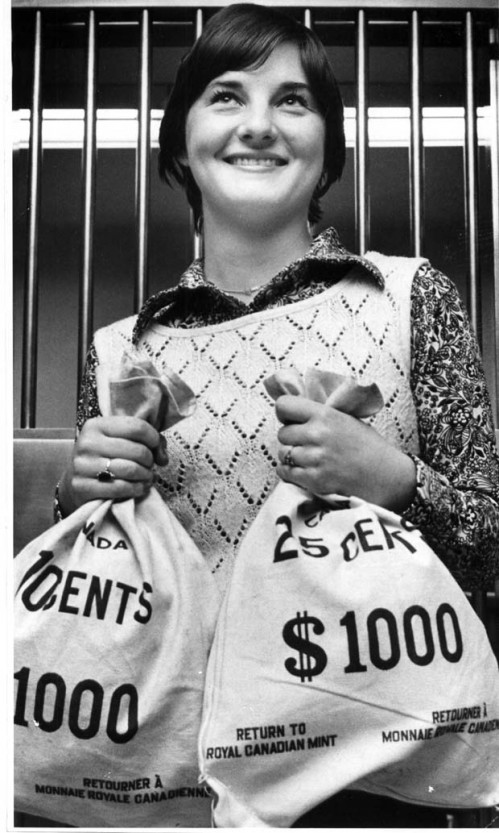
(PS. The picture is from the Winnipeg Tribune archives at the University of Manitoba. I couldn’t resist using it — plus it has meaning because each of those bags are $1,000 broken down into quarters. Symbolism! The original caption says that it is from Jan. 10, 1974: “Jayne Weetkovich (age 21) who is a remittance teller for the Bank of Nova Scotia, holds money bags of dimes and quarters.” Photographer: Jeff Debooy.)

Newspaper Death Watch: Fat Lady Singing edition

BREAKING: Computers may affect the future of the news business. This photo, and the others in this post, are from the Winnipeg Tribune Archives held at the University of Manitoba. Original caption, from 1977: "Winnipeg has entered the era of small, affordable computers which have turned sci-fi into kitchen counter reality and raised the possibility of a computer in every home."

BREAKING: Computers may affect the future of the news business. MORE TO COME. (This photo, and the others in this post, are from the Winnipeg Tribune archives held at the University of Manitoba. Original caption, from 1977: "Winnipeg has entered the era of small, affordable computers which have turned sci-fi into kitchen counter reality and raised the possibility of a computer in every home.")

A lot of other people are linking to this Jeff Jarvis rant, so when I got an email directing me to read it — stat! — I delved in.

Jarvis argues that the newspaper industry has had decades to see, recognize and react to the changes that were coming — from Craigslist to Google — and that since they failed to change, they deserve to fail.

My (lengthy) analysis, after the jump:

Read more »

Dansette