Posts tagged: economy

24 hours inside a Wal-Mart, the time-lapse

Artist and photographer Stephen Wilkes spent 24 hours in a Wal-Mart in New Jersey, shooting a frame every 10 seconds and later stitching them together into a 2-minute time-lapse video for Fortune magazine.

He ended up using just 1,800 of the resulting 8,640 frames, and I think he’s compressed time during some of the really slow overnight portions, but the video is slightly mesmerizing.

I have been thinking of trying a time-lapse of my own, actually, watching the parking lot of a big-box power centre through a whole day.

China’s massive investments in green technology are starting to pay off

I was riveted by a story in the New Yorker about China’s huge shift towards renewable energy. I’ve been reading Thomas Friedman’s pieces in the New York Times about it for a while, but it’s easy to dismiss an opinion columnist as hyping something, even when you kind of agree with him.

A first-person account of the massive investment that China is making, though, made much more of an impact on me. Called the 863 Program (it was conceived in March of 1986), the Chinese initiative hasn’t been perfect, but it’s been dedicated, where in North America, the political will has come and gone, started and stopped:

In 2001, Chinese officials abruptly expanded one program in particular: energy technology. The reasons were clear. Once the largest oil exporter in East Asia, China was now adding more than two thousand cars a day and importing millions of barrels; its energy security hinged on a flotilla of tankers stretched across distant seas. Meanwhile, China was getting nearly eighty per cent of its electricity from coal, which was rendering the air in much of the country unbreathable and hastening climate changes that could undermine China’s future stability. Rising sea levels were on pace to create more refugees in China than in any other country, even Bangladesh.

In 2006, Chinese leaders redoubled their commitment to new energy technology; they boosted funding for research and set targets for installing wind turbines, solar panels, hydroelectric dams, and other renewable sources of energy that were higher than goals in the United States. China doubled its wind-power capacity that year, then doubled it again the next year, and the year after. The country had virtually no solar industry in 2003; five years later, it was manufacturing more solar cells than any other country, winning customers from foreign companies that had invented the technology in the first place.

Read the full piece here.

Me vs Jeff Rubin

Several months ago, I wrote a rant about Jeff Rubin, CIBC’s Cheif Economist. I was perturbed about the fact that he was receiving a bunch of media attention about his doom and gloom prophecies for 2009. According to this CBC article, for example:

“Even with a second-half recovery, it is hard to see the TSX beyond 9,000 by the end of the year,” Rubin said.

The reticence among investors to buy already-cheap stocks, experts said, could depress equity values.

Canada’s main stock exchange closed 2008 at 8,988, already well off of its peaks of last summer.

Once a recovery takes hold, Canadians could see a TSX at 11,000 by the end of 2010, still 30 per cent below these lofty level of mid-2008, CIBC said.

Just for the record, as of this moment, the TSX is sitting at about 11,500. Back in March, I said that Canadian banks would be doing just fine and, look! They’ve been held up as models of banking all over the world.

Rubin’s a knob.

Oh, what’s that?

The TSX should begin to recover by the end of 2009, Rubin said, but only to a level equal to its closing one year earlier.

That’s funny, your counterparts over at TD announced today that the recession was over. No, I’m not picking and choosing whcih economists to listen to. The TD folks are too rosy in their predictions, but I’d rather have good news overstated than bad.

There’s enough bad in the world without dumbass economists driving people to panic, increasing the bad.

My prediction for 2010? Some/moderate growth. The TSX will end 2010 at or about 16,000.

We’ll talk again then.

Slow down and enjoy your fast food

fancyfastfood

Mmm. What a deliciously decadent looking pasta dish. It looks as if the pasta was rolled and stuffed by hand, the sauce lovingly constructed and simmered for hours before finally being ready.

Wrong.

It’s Tacobellini. Or, fancy Burrito Supreme.

Yes, in these trying economic times, it is still possible to add a touch of class to your meals. Just visit Fancy Fast Food where they instruct you how to transform those artery-clogging — yet cheap! — fast food meals into a work of (still artery-clogging) art.

The instructions for this lovely dish are as follows:

Ingredients:

  • 2 Taco Bell Burrito Supremes (beef)
  • 1 beef soft taco
  • 1 large Sierra Mist
  • packets of mild, hot or Fire sauce (to your liking)
  • parsley (for garnish)

Think outside the tortilla. Carefully unwrap the Burrito Supremes and soft taco, and extract their stuffings in a bowl. Carefully rinse off each of the tortillas, and then briefly steam them in a steamer to soften and moisten them. Then lay each tortilla on a cutting board and cut circles in it using a small circular cookie cutter, or simply an empty tin can measuring around 2 1/2” in diameter. Take the filling and put a small amount in each small tortilla circle, then fold it in half and pinch it into a tortellini shape. The moisture should keep it sticky enough to stay put. Pile the tortellinis on a plate. Next, cut open and pour the contents of the sauce packets in a measuring cup, then generously drizzle the sauce over the tortellini. Garnish with parsley and serve with Sierra Mist in a wine glass.

(h/t to metafilter)

If you have too much cash, and a distrust of the banks, how do you hoard it in your house?

While I was poking around on the Consumerist website, I also noticed their list of Seven Places Around the House to Stash Your Cash:

1. The Freezer: Wrap your cash in aluminum foil and stick it in a ziplock bag.
2. Picture Frames: Slice apart the cardboard backing and insert the cash.
3. Under Heavy Things: Place the cash in an envelope and slide it under the corner of something heavy, like a piano or entertainment center.
4. Soup Cans: Why buy one of those fake-bottom cans when you just re-use one of your own?
5. Fake Plants: Put the cash in a ziplock bag and bury it in the fake soil of one of your fake plants.
6. Books: Improve the worst book in your collection with a knife. Hollow out the core and hide the cash inside.
7. Toys: Hide the cash in an old toy your kids don’t use anymore, and bury the toy at the bottom of the toy chest.

Although, actually, it wasn’t really their list, they point to the original post at a blog called Frugal Dad, which sounds interesting. Frugal Dad spends a bit more time on each item in the list, and adds:

It’s important to remember that any cash saved at home could be lost in a fire or natural disaster. The ultimate hiding place is a fireproof safe bolted to the floor, and even that isn’t fool-proof. The ideal spot for storing large amounts of cash is an online savings account, far away from your house and any potential danger. But for the small amounts you stash at home, take the time to put it out of sight.

Also, remember to tell a spouse or close friend about the money in case you are not able to get to it (you die, or become injured or ill and cannot communicate). Keep enough cash on hand to cover you a few days in a major emergency, but not so much that you’d be completely wiped out if it all disappeared.

But I really wonder about the desire to hoard cash like this. Everyone always says it’s for a “major emergency” but I can’t really conceive of a situation where I would be glad to have, say, $1,000 in cash that I couldn’t get out from the bank.

In any emergency where I couldn’t withdraw money from the bank, it’s likely to be drastic enough that cash would be of limited use anyway. People would be looting instead. The only time I guess it would be useful is if there was a run on the banks, but this isn’t talking about keeping all your money on-hand, just an emergency stash.

Scenarios anyone?

Why does communism always get a bad rap?

600px-Flag_of_the_Soviet_Union.svg

I will not pretend to be much of a student of the history of the Soviet Union. I’m not going to be an apologist for repression in the name of Revolution.

But I will staunchly maintain that I think communism has been given the short shrift in history. The latest is in a book (which otherwise sounds interesting) by Archie Brown. It’s intelligently reviewed in Salon, here:

For Brown, a Communist system had three pairs of identifying characteristics, all of which have their origins in Lenin’s ideology and philosophy. In the political realm, a monopoly of power was held by one party, with most of the power concentrated at the top, and that party operated through the process Lenin called “democratic centralism.” That was supposed to mean that open discussion could precede decision-making, which was then administered with unanimity and iron discipline. It usually meant, of course, that decisions were handed down from a dictator or a small circle of oligarchs, and were neither discussed nor questioned. In the economic realm, the state controlled the means of production, and a command economy, rather than a market economy, predominated. In the ideological realm, the declared aim of building communism — for Marx, the classless, stateless final stage of human development — was the state’s “ultimate, legitimizing goal,” and the state belonged to an international Communist movement aimed at moving the whole world toward that future society.

And there’s the one thing that I disagree with: communism does not always have to be Communism. The fact is that communism, as I see it, is primarily an economic system — unfortunately, it’s always been hitched to a political system that is totalitarian in nature.

I’m not sure that it has to be — there are things about communism that would work really well under a democracy, I should think.

And no, I’m not an anti-capitalist. The genius of capitalism is that it manages to harness individual human greed, and through a market, turn that into a group benefit for consumers. I don’t necessarily think that communism is better than capitalism. But I do think that democracy is, by and large, better than the inevitable corruption that comes with a dictatorship. And I just wish that a communist economic system had been tried without the handicap of a totalitarian political system.

I know, communism tends to require a command economy, which tends to require commands. But even in the blockquote above, those commands are supposed to be debated democratically. Look at Canada — we have, if we ever get back to a majority government, essentially a totalitarian government that we elect every four years.

Of course, could a command economy every be as efficient as a market economy? Everyone says no, but they didn’t exactly rely on a free market to provide all the tanks in WW2, did they?

Anyway, the book sounds interesting: “The Rise and Fall of Communism.”

Board games that misled us all (and caused the financial meltdown)

Slate’s “The Big Money” section has a (slightly tongue-in-cheek) slideshow on board games that we played as kids, and how they are fundamentally flawed. The thesis of the slideshow is how these fundamental flaws can lead to illogical behaviour in the real market.

Take Monopoly, for example (I took the image above from Flickr user DaylandS’ photostream, which is the same place The Big Money got theirs, but I chose a different picture):

Monopoly has taught us that financial institutions are invincible. The game’s banker cannot go bankrupt, according to the rules: “The Bank never ‘goes broke.’ If the Bank runs out of money, the Banker may issue as much as needed by writing on any ordinary paper.”

Whoops?

They also take a look at The Game of Life, PayDay, Risk, and Mall Madness — as well as a game I’d never heard of called Acquire. Two games they didn’t examine, but which I played lots, were Pit and Stock Ticker.

One thing all these games do have in common — and which I think we’ve seen in the economy as well — is the concept of one winner, many losers.

Vintage capitalist instructional video just makes me sad

Poor kid just wants to go fishing — and instead is roped into starting a giant corporation.

Note that despite his eventual success, he is never shown enjoying any of the fruits of his labour (although, “incidentally” he has a family). Also note that corporations are simply assumed to pay decent wages out a sense of social justice, and that the merits of government are never questioned.

Interesting perspective from 50 years ago.

(via BB)

Interesting idea: Government credit cards

It’s an idea that some might call (horror!) “socialist.” But Slate writer Christopher Beam asks, reasonably, if the U.S. government is taking over the banks, why not get directly into the credit card business?

Sure, there’s talk of regulating the credit industry a little more stringently — even here in Canada. But Beam wants to know if that’s enough — or even if it’s the best way:

But instead of cracking down on companies that treat their customers poorly, why doesn’t the government just offer a credit card of its own? After all, government regulation may help, but it’s unlikely to solve the problems of the credit industry—namely, spiraling interest rates coupled with rising defaults. Obama likes to talk about constructive alternatives. Why not offer an O-card? With his face on it?

State-owned banks in other countries already issue their own credit cards. And since profit isn’t the main goal, they can offer lower interest rates and fewer fees. Beam also mentions that a government-backed credit card could help out troubled borrowers — they could refinance on the new card, rather than on their old cards, and stay above water.

But he also says that government-issued credit cards would be handed only to the “super creditworthy.”

Sounds like it’s great from a keeping-the-taxpayers-from-having-to-cover-losses perspective, but I don’t know that it’s the super creditworthy who are having all the problems these days.

I suspect that, since the government has powers of coercion (like withholding your tax refund) that would make Visa or Mastercard jealous, it could just offer a lower limit to people with imperfect credit, but steady jobs.

So why not? As Beam points out, the government will already help loan you money for things like student loans and mortgages. And I’ll add that you loan the government money every time you buy a savings bond.

May I even suggest that, since the government would be getting into the market, that they call it “Social Credit“?

(Image credit to Flickr user doyoubleedlikeme. It’s an American Express “Red” card, offered only in the UK as part of the Product(Red) line, but I couldn’t resist the socialist implications.)

Who’s up for some post-capitalism?

Socialism has failed. Now capitalism is bankrupt. So what comes next? That’s the provocative question being asked by Eric Hobsbawm in The Guardian:

The basic idea that dominated economics and politics in the last century has patently disappeared down the plughole of history. This was the way of thinking about modern industrial economies, or for that matter any economies, in terms of two mutually exclusive opposites: capitalism or socialism.

Both are bankrupt. The future, like the present and the past, belongs to mixed economies in which public and private are braided together in one way or another. But how?

This isn’t the first time in history that whole economic systems have been tossed out. Feudalism anyone? But for generations, we’ve been told that capitalism was all set to dominate the future. Having conquered communism, it was unfettered profit for anyone who was ready to grasp it by the horns.

It doesn’t look quite so bulletproof now, though. Now, I don’t know if capitalism is really going the way of the dodo, but I expect some market reforms in the near future.

The most interesting part of Hobsbawm’s essay, though, were almost throwaway points like this:

Nobody seriously thinks of returning to the socialist systems of the Soviet type - not only because of their political faults, but also because of the increasing sluggishness and inefficiency of their economies - though this should not lead us to underestimate their impressive social and educational achievements.

“Impressive social and educational achievements.” Indeed! I mean, Cuba is famed for its cigars, but I’ll bet its most important exports are its educated doctors (that it trades for oil with Venezuela, for example).

So why are government so focused on economic growth, to the exclusion of all else? Because I think they’ve bought into the capitalist assumption that “a rising tide floats all boats” — so that the GDP and the stock market was believed to be a shorthand measurement of how healthy society was.

As Hobsbawm (and others) have argued, though, rising wealth in society hasn’t been shared equally. With a growing income gap between rich and poor, the average wealth may go up, but the bulk of people don’t get any richer.

More on this as I think about it, but I wanted to point out Hobsbawm’s column for more people to read. My initial thoughts are that: a) governments should use something like the “Happiness Index” and not just economic indicators to set policy; and b) free “trade” should mean opening borders to people — ie. to labour — and not just to goods.

Comments?

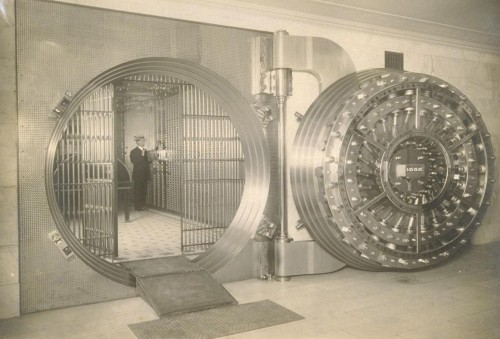
The safety of banks

Bank vaults have been secure throughout the ages. But what about the banks themselves?

Bank vaults have been secure throughout the ages. But what about the banks themselves?

The Canadian press can’t seem to get enough of telling us that Canadian banks are far more regulated and therefore much less likely to ever get into the dire situation that is affecting many of the bank in the U.S. Though I’m no expert, I can see evidence of this very simply. All the big banks are virtually indistiguishable from one another when it comes to their offerings to consumers (feel free to nitpick on this point, I’ll stand by it).

On the other hand, I also have a business bank account in the United States. When I was doing my research as to which bank would best suit my needs, I was stunned by the wide range of offerings and packages available. Now, well established with my bank in North Dakota, I started to worry a bit about whether or not it was in the same financial trouble as some of the other banks.

The Internet to the rescue!

The Investigative Reporting Workshop at the American University School of Communication has put together a database where you can search for a bank and see its “total troubled assets” as well as its “troubled asset ratio.” Each of these numbers are available for 2007 as well as 2008.

There is more financial information than you can shake a stimulus package at, and all of it is terribly fascinating. You can also see which companies have received money through TARP (the Treasury Department’s Troubled Asset Relief Program).

You’ve seen them talking about the toxic assets held by banks on the news, now you can see which banks actually hold them and how much of them they have on the books.

AIG bonuses are a classic case of PR biting you in the back

After all the hullabaloo over the AIG bonuses — where a troubled insurance giant, having taken $170 billion of government money (the US gov’t now owns 80% of AIG) has decided that it needs to honour its employment contracts and pay out $165 million in executive bonuses — seems to be dying down.

A new article in the New York Times argues that the sanctity of contracts is more important than populist rage.

I ‘d like to point out that, while I wouldn’t turn down $165 million, it’s less than one-tenth of one percent of the amount that the government has invested in AIG. It sounds big to you and me, but it’s a tiny drop in that ocean of money.

But also, I don’t think there would be any hint of that “populist rage” if AIG hadn’t paid bonuses ever before.

Well, obviously, you say. But let me explain. In popular conception, a “bonus” is extra money — above and beyond your regular salary, and given because you’ve gone above and beyond your regular duties as an employee.

Sometimes, they’re tied to specific metrics — like if the stock price goes up a certain amount, you get a bonus. But in Wall Street culture, bonuses have started to become accepted methods of general compensation. Everyone gets them, and they’re just part of your paycheque — except you get them in one lump sum instead of every two weeks.

Despite that, the term “bonus” has persisted. And why not? It’s a jolly, feel-good word! Everyone likes getting a bonus! And people like paying them out, too — it makes them feel special. It’s so much nicer than a workaday “salary” or eep! “wage.”

But imagine if you will, a news article that screamed: “Congress demans AIG explain paying $165 million in wages.” Wouldn’t happen.

Maybe — just maybe — there would be a small investigation into whether “$165 million in executive salaries” was excessive and could be trimmed. But there wouldn’t be this anger about “bonuses.”

I think the bonus culture causes other problems — it’s much better to spread compensation out over the year, and paying it all out of the same pot makes it easier for auditors and investors to keep track of, too. I’m not against a small bonus of appreciation if an employee does something special, or a small gift near Christmas, say.

And if AIG had just done that, instead of wallowing in the idea of a “bonus” — same amount of money, just doled out more rationally — then they wouldn’t be in this PR pickle right now.

Is Communism due for a comeback?

Come on, the ’80s are back — can’t we get a new Evil Empire, too?

Anyway, I was meaning to blog about this all weekend, but I missed it. The University of London (England, not Ontario) hosted a major conference entitled “On the Idea of Communism” that sounds like it would have been really interesting:

The symposium will not deal with practico-political questions of how to analyze the latest economic, political, and military troubles, or how to organize a new political movement. More radical questioning is needed today - this is a meeting of philosophers who will deal with Communism as a philosophical concept, advocating a precise and strong thesis: from Plato onwards, Communism is the only political Idea worthy of a philosopher.

According to coverage in the Guardian, interest in the conference was so strong that the venue has had to be changed three times — and tickets are still sold out:

Although the conference seems particularly timely, it was planned last summer, well before the scale of the current economic collapse had become apparent.

“The response has taken us by surprise,” said Costas Douzinas, director of the Birkbeck institute for the humanities, which is hosting the three-day event. “It must be related to the wider political context. There is a sense that we have to start thinking again.”

He said that the gathering was about the meaning of communism and speakers had indicated that they would be very critical of the Soviet model. Among the questions to be addressed is whether “communism is still the name to be used to designate the horizon of radical emancipatory projects”.

I’m not convinced that a totalitarian political model is ever a good idea, but it’s always struck me that communism as an economic system should be well-suited to a democracy — and yet it never seems to work out that way.

Attention mainstream media: STOP!

Seriously. I mean it. Stop reporting anything Jeff Rubin (CIBC’s Chief Economist) has to say. If you need to quote someone about aspects of the economy, quote me — I’m right more often than Rubin.

I’m not kidding.

This past summer when oil prices were in the triple digits, Rubin was fear-mongering with talk about $200 barrels of oil being on the horizon. I, on the other hand, called it a bubble that would burst before the year was up. Who was more accurate? (Don’t believe me? Ask any of my customers who came in to buy investment books about that time - we had some heated conversations…that’s Pennywise Books at 1031 Rosser Avenue in Brandon).

Nor was that the only time that Rubin has been significantly wrong. He just “revises” his predictions. For example, in early December of 2008, he cut his prediction for the TSX in 2009 from 12,000 to 11,000. Today?

“Even with a second-half recovery, it is hard to see the TSX beyond 9,000 by the end of the year,” Rubin said.

To be fair, he’s a modern-day oracle, inhaling the fumes of ink and CPU-emitted ozone, spewing out indecipherable babble which is then translated for the “benefit” of those who listen — meaning he’s bound to be wrong a good portion of the time. We just need someone to look into the future for us.

The problem with Rubin is that his attempt to divine the future are not helpful at all. Going back to the example of the $200 oil, his predictions encouraged additional speculation by, well, speculators which led to further inflation of the petro-bubble. (Again, in fairness, there were other culprits too, but this rant is about Rubin, so back off.)

Today, Rubin is again NOT helping. Most commentators are in agreement that in order for the economy to get bak on track, investors need to start investing again. What does Rubin do? Of course. He encourages them NOT to:

Essentially, while many forecasters see a Canadian economic recovery in the cards in the next six months, Rubin said that scenario is not a given.

Gross domestic product in both Canada and the United States should continue to shrink in the second quarter, he said. As well, the U.S. banking crisis will keep leaking into the valuations of Canadian financial institutions, driving down the stock market prices of Canada’s banks and other finance firms, Rubin said.

The TSX should begin to recover by the end of 2009, Rubin said, but only to a level equal to its closing one year earlier.

I’m going to go out on a limb here and say that Rubin doesn’t know jack. I’ll even go a step further and make my own prediction and readers can evaluate for themselves who is the betterr forecaster.

I say that, yes, there are still some troubles to be seen, but Rubin is overly pessimistic. I say that NOW is the time to be buying stocks (and I do indeed put my money where my mouth is). I say that with the international attention that Canadian banks are receiving, we’ll see the stock prices of Canadian banks begin to climb very soon. These rising financials will pull up the TSX, dragging some other stocks with them (sorry Nortel, not you). Oil will continue to languish. By the end of 2009, we won’t be fully recovered, but it won’t be just beginning.

Sure, I may be wrong. If I am and Rubin is right, I’ll tip my hat to him.

That doesn’t change the fact that the media should stop reporting his Debbie Downer claims. The public needs to have some good news — some reason to stop hoarding cash and putting back into circulation. Reporting Rubin’s pessimism is of no help to anyone in any way.

I just needed to get that off my chest.

Who says you can’t advertise in an economic downturn?

Clever! (From the blog Canadian Design Resource, via Draplin)

Dansette